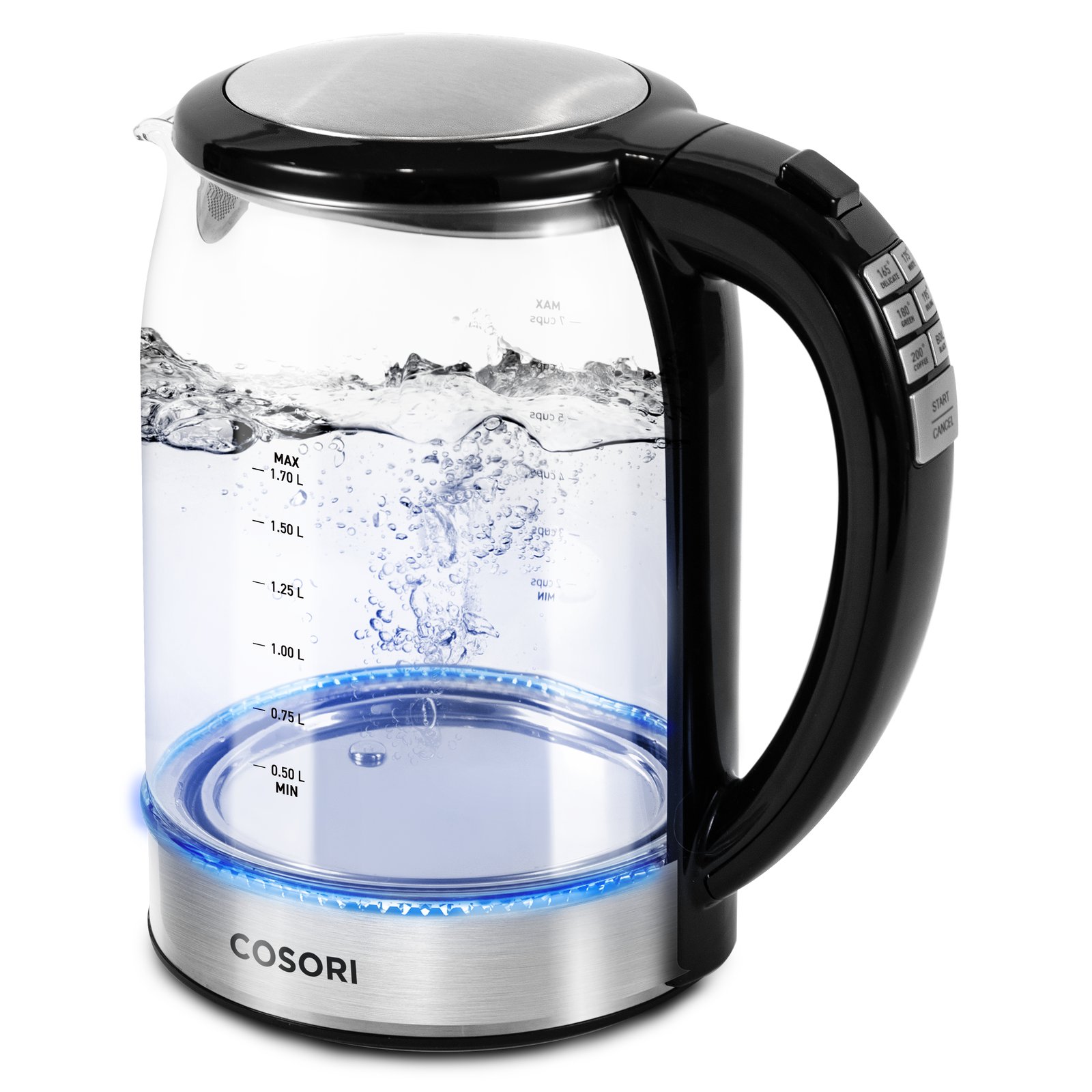
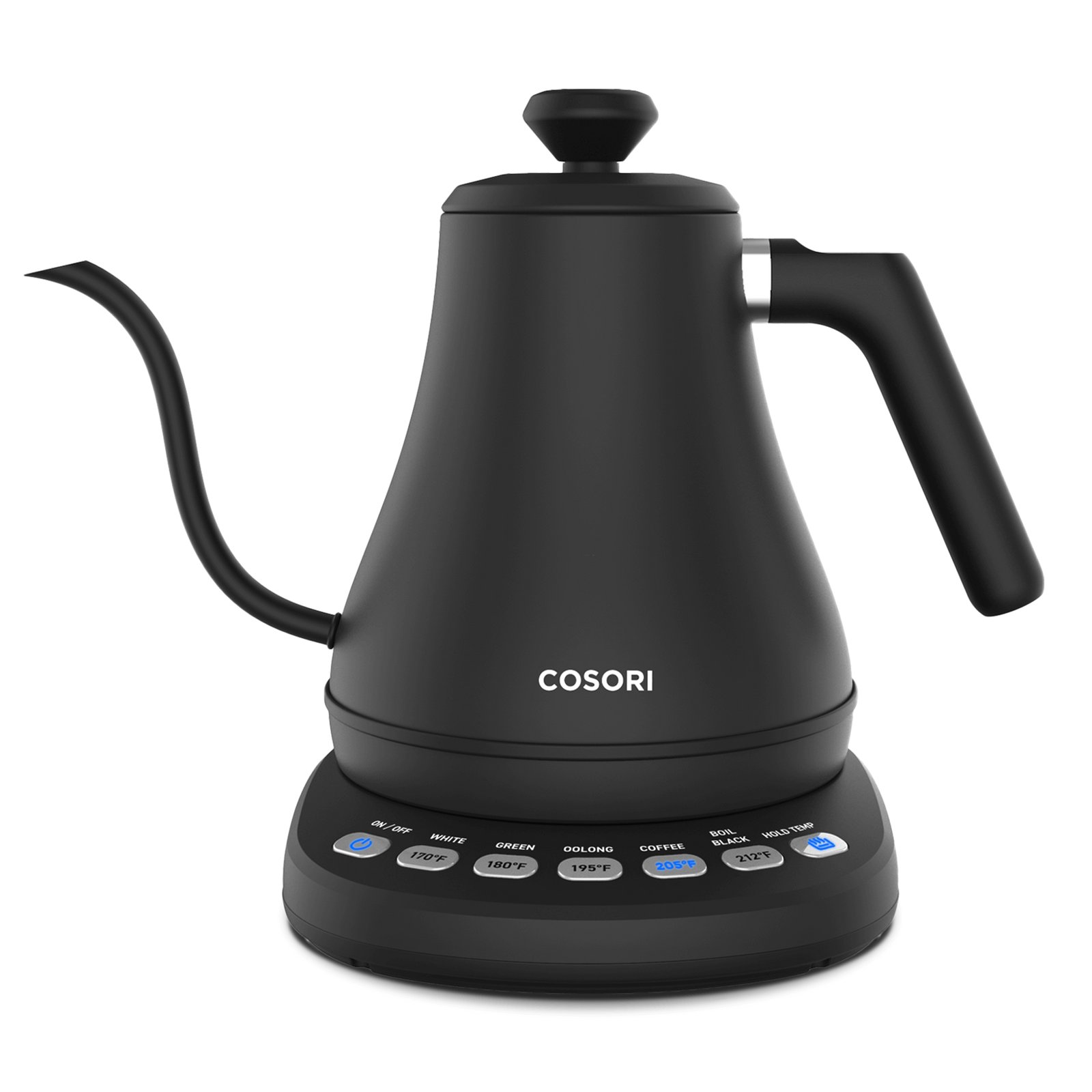
If you make pour-over coffee, buy the gooseneck — the Cosori Original Electric Gooseneck at 0.8 liters and 1200 watts. If you make tea, instant noodles, French press and occasionally a pour-over, buy the regular kettle — the Cosori Original Digital Glass at 1.7 liters — and accept a clumsier pour twice a week.
This comparison uses two kettles from the same brand and the same product line on purpose, because almost every gooseneck-versus-regular argument online is really an argument about temperature control. Both of these have it. Both have presets, both hold a temperature, both are Cosori Originals. Strip that out and one variable is left standing: the shape of the spout, and the capacity that comes with it.
What the spout actually changes is the rate and the aim of the water. A wide kettle spout dumps a fast, broad stream that digs a crater in the coffee bed, pushes grounds up the side of the filter, and puts most of the water through the middle. A gooseneck narrows it to something you can place. That matters enormously for a V60 and not at all for a teabag.
How to shop for an electric kettle
Stream width and where the water lands
A pour-over extracts evenly only if the whole bed gets wet at roughly the same rate. A wide spout cannot do that from a tilted kettle — the flow rate at the start of the pour is far higher than at the end, and the stream is wider than the area you are trying to wet. Neither manufacturer publishes an inner spout diameter, so this is judged on published design rather than a number.
Capacity, and what else the kettle has to do
The gooseneck holds 0.85 quarts — 0.8 liters — which is one or two pour-overs and nothing else. The glass kettle holds 1.7 liters, more than twice as much. In a kitchen with one kettle, that is the real trade: a specialist that pours beautifully or a generalist that fills a French press, a teapot and a saucepan.
Temperature control, which is not the variable here
Both kettles have presets and a hold. Cosori publishes five presets from 170 to 212 °F on the gooseneck with a 60-minute hold, and six presets with a 3 to 7 minute boil and a 60-minute keep-warm on the glass kettle. SCA Standard 310-2021 specifies 90 to 96 °C — 194 to 205 °F — and both reach into that band. This is the reason the comparison can be about the spout.
Time to temperature, against a full kettle
The gooseneck draws a published 1200 W into 0.8 L; the glass kettle publishes a 3 to 7 minute boil for 1.7 L. More water always takes longer, so the generalist is slower to a cup of anything even though it makes more of it.
What the water touches
Cosori publishes food-grade stainless throughout the gooseneck — kettle, lid and spout, with no plastic on the water path — and borosilicate glass with a 304 stainless filter on the glass kettle. Both carry a published two-year limited warranty. On this axis they are genuinely equivalent.
Buy this if you brew pour-over
Image: Cosori
Cosori Original Electric Gooseneck Kettle
0.8 L, aimable, one job
Model
CO108-NK
Spout
Gooseneck
Temp control
5 presets 170-212 °F · 60-minute hold
Build
0.85 qt / 0.8 L · food-grade stainless, no plastic on the water path · 1200 W
Reasons to buy
The narrow curved spout makes the stream slow and placeable, which is the single component that changes a pour-over most — more than the dripper, more than the filter
A 205 °F preset sits at the top of the SCA's 90 to 96 °C band, with a published 60-minute hold so the water is still right after you have ground and weighed
1200 watts into 0.8 liters comes up fast, because a small kettle heating quickly is the compensation for a small kettle
Kettle, lid and spout are all food-grade stainless with nothing plastic touching the water
Reasons to avoid
0.8 liters is two mugs of pour-over and it will not fill a teapot, a French press and a hot water bottle in the same evening
Presets only — 170, 180, 195, 205 and 212 °F with nothing between them — and Cosori publishes no dimensions or weight for it anywhere
If pour-over is why you are buying a kettle, this ends the argument. The spout is not a style choice: a narrow stream lets you wet the whole bed at a rate you choose, and a wide one does not, and everything downstream of that — even extraction, no channelling, a repeatable time — follows from it.
It leads our pour-over kettle guide for the same reason. The 0.8-liter capacity is the honest cost, and in a kitchen that already owns a kettle for tea it is not a cost at all.
1.7 L · borosilicate glass with a 304 stainless filter · boils in 3-7 minutes, wattage not published
Reasons to buy
1.7 liters, more than twice the gooseneck, which is the difference between a kettle that makes coffee and a kettle that runs a kitchen
Six temperature presets with a published 60-minute keep-warm, so tea at 175 °F and coffee at 200 °F are both a button rather than a guess
Borosilicate glass with a 304 stainless filter and a published two-year limited warranty, plus automatic shut-off and boil-dry protection
You can see the water level and the boil, which sounds trivial and is the reason glass kettles keep selling
Reasons to avoid
The wide spout pours fast and broad — fine into a mug or a French press, and it will dig a hole in a coffee bed and run down the side of a paper filter
Cosori publishes a boil time and no wattage for it, and the specific preset temperatures are not listed on the product page
1.7 L of glass is a two-handed object to fill and lift, where the 0.8 L gooseneck is a one-handed one
The kettle to own if you own one kettle. Six presets and a 60-minute keep-warm mean it covers green tea, black tea and coffee properly, and 1.7 liters means it also covers everything that is not a drink.
On a V60 it is a compromise and you will feel it in the first pour. There is a workaround worth knowing — pour from the kettle into a small jug and pour from the jug — which costs you the temperature the presets just gave you. If pour-over happens more than twice a week, buy both, and if that sounds absurd, buy the gooseneck. One note on where to buy it: checked in September 2026, this model's Amazon page carried no buy box, so the button here goes to Cosori's own store.
Not the right fit if pour-over is your main brewing method — see the gooseneck.
We have not poured with either kettle and this comparison does not rest on a tasting. It rests on two kettles chosen so that only one variable is left.
Both spec blocks came from Cosori's own product pages, linked in Sources — capacity, preset count, hold duration, materials, warranty, and wattage or boil time where published. Neither product page states an inner spout diameter, and neither publishes exterior dimensions, so both rows say so.
The temperature band used throughout is SCA Standard 310-2021, which specifies 90 to 96 °C (194 to 205 °F) for brewing. Both models' Amazon pages were opened and each page title checked against the Cosori model number named here, because Cosori sells several 1.7-liter kettles that differ in what the water touches. Only the gooseneck had a buy box on the day we checked.
The verdict
Buy the gooseneck if pour-over is your method. The narrow, placeable stream is the one thing a wide spout cannot imitate, and at 0.8 liters and 1200 watts the Cosori Original is the cheapest good version of it.
Buy the 1.7-liter glass kettle if this is the only kettle in the kitchen. Six presets, a 60-minute keep-warm and a two-year warranty cover tea, coffee and everything else, and the pour-over compromise is real but survivable.
Check price at AmazonBuy this if you brew pour-over: Cosori Original Electric Gooseneck Kettle
Questions people ask
Do I really need a gooseneck kettle for pour-over?
You need a controllable stream, and a gooseneck is the only practical way to get one from a kettle. A standard spout pours fast and wide: the water digs into the bed, channels through the middle, and runs down the paper instead of through the coffee. You can work around it by decanting into a jug, at the cost of the temperature you just set.
What temperature should the water be?
SCA Standard 310-2021 specifies 90 to 96 °C, which is about 194 to 205 °F. The gooseneck's 205 °F preset sits at the top of that band; the glass kettle's six presets cover it too. Water straight off a rolling boil at 212 °F is above the standard, so with a kettle that only boils, wait 30 to 45 seconds before pouring.
Is a 0.8-liter kettle too small?
For pour-over, no — a 350-gram brew uses less than half of it, and heating only what you need is faster. For a household kettle, yes: 0.8 liters will not fill a teapot and a French press in one boil, which is why the 1.7-liter kettle exists and why plenty of kitchens end up with both.
Can I just use a regular kettle and pour slowly?
Slower helps and it does not solve it. The problem is stream width as much as speed — a wide spout wets a wide area at once, so the bed cannot be agitated evenly or left alone deliberately. Tilting a full wide kettle far enough to trickle also puts the lid at an angle that drips.
Does a gooseneck kettle make the coffee taste better on its own?
Not by itself. It makes an even extraction possible, and an even extraction is what tastes better. If your grind is inconsistent — the usual cause of a bitter-and-sour cup at the same time — the kettle will not rescue it. Fix the grinder first; our burr versus blade comparison explains why.
Also considered
Fellow Stagg EKG Pro — A to-the-degree gooseneck from 104 to 212 °F with a brew stopwatch in the display, and the overall winner of our pour-over kettle guide. It is a better kettle than the Cosori gooseneck and it costs considerably more, which would have turned this comparison into an argument about price instead of spout shape.
Stovetop gooseneck kettles — A Hario Buono pours as well as any electric gooseneck and has no thermostat at all, so temperature becomes a stopwatch exercise after the boil. That is a third category rather than the other side of this question.
Cosori 1.7 L stainless kettles — Cosori sells several 1.7-liter kettles with the same capacity and different water paths, and their photographs carry burned-in marketing labels rather than plain product shots. We used the glass Original so both kettles in this comparison come from the same product line.