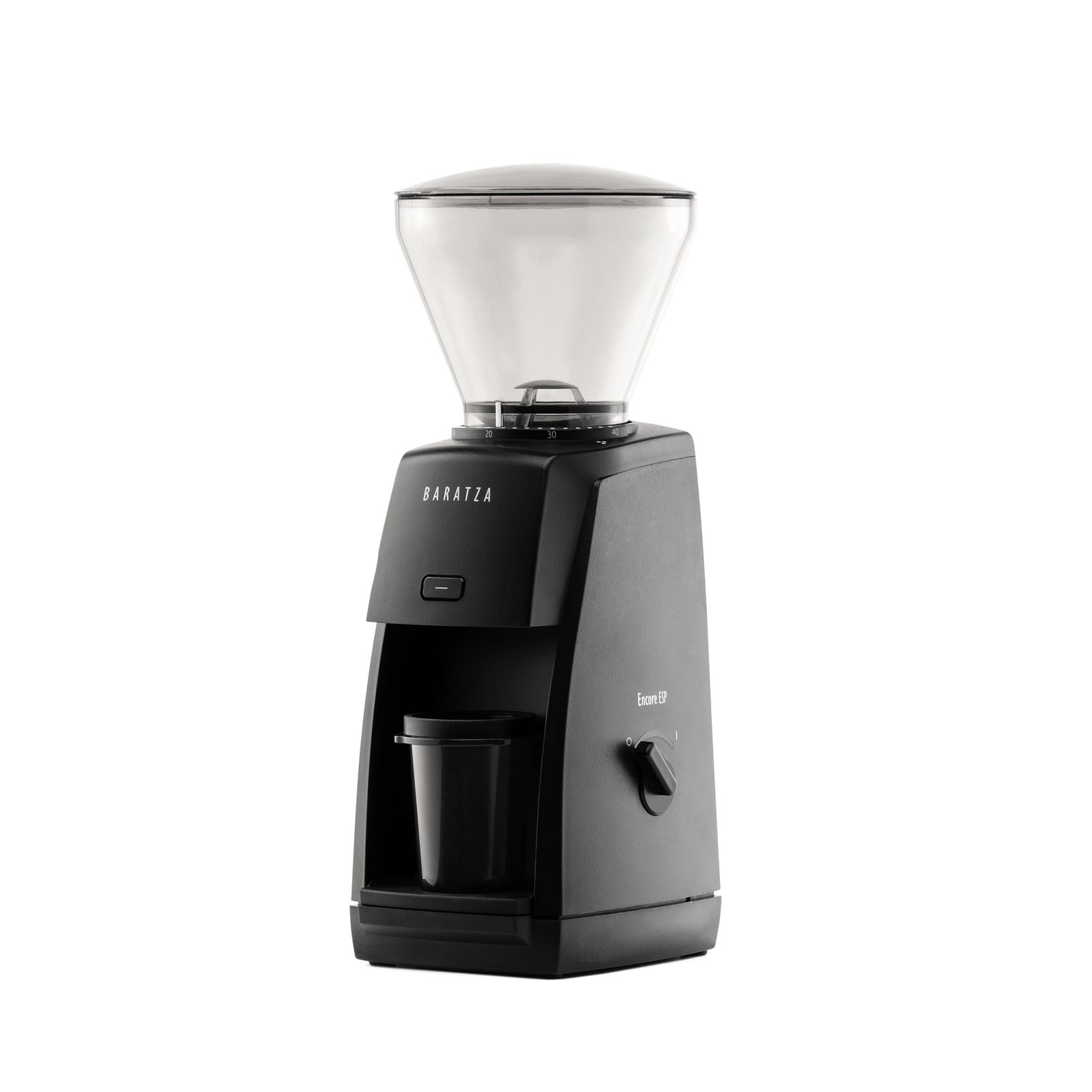
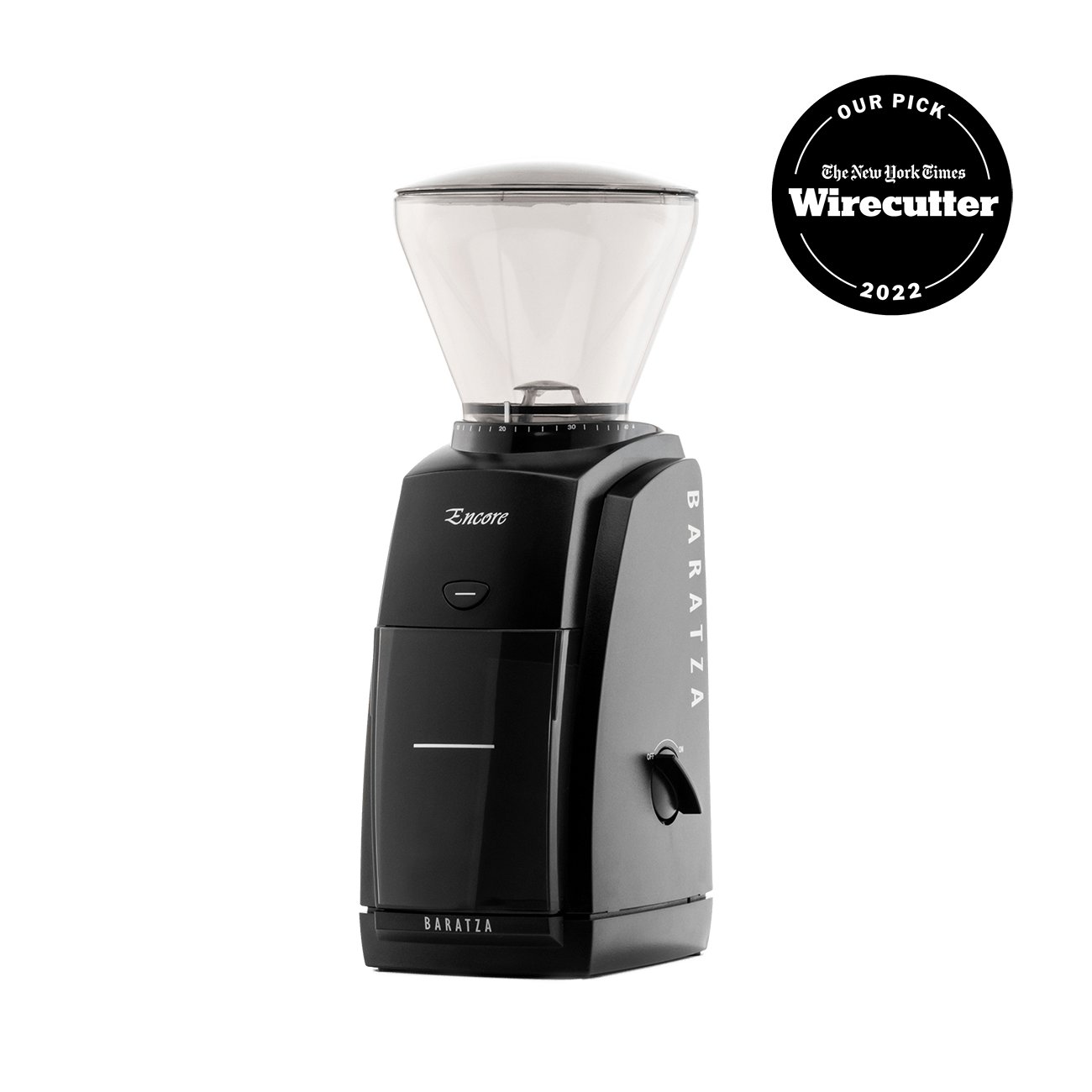
If you own or intend to own an espresso machine, buy the Encore ESP. If you brew pour-over, drip or French press and expect to keep doing that, buy the Encore and spend the difference on coffee. They are the same grinder body with two different burr sets and two different maps of the same forty clicks, and the only question that matters is where you want those clicks spent.
Baratza publishes the difference plainly, which is unusual and makes this an easy comparison to settle. Both grinders are 40 mm conical steel, both have a 300-gram hopper and a 120-gram bin, both are 13 by 15 by 34 centimetres, both draw 70 watts. The Encore uses the M3 burr; the ESP uses the M2. And the ESP recalibrates the range so that twenty of its forty macro steps sit inside the espresso band, where the plain Encore bottoms out at a fine drip grind.
That last sentence is the whole product difference, and it is why a plain Encore cannot pull a shot no matter how far you turn the dial. It is not that it grinds badly at its finest setting. It is that its finest setting is not fine enough, by design, because those clicks were spent on the coarse end where French press lives.
How to shop for a burr grinder
Where the forty steps land
Both grinders have forty macro settings. The Encore spreads them from cold-brew coarse to fine drip. The ESP compresses the range so half of them fall inside espresso. Forty is not a measure of precision on its own — the spacing is what you are buying, and Baratza is explicit that these two have different spacing.
Burr geometry, M3 versus M2
Same 40 mm diameter, same steel, different cut. Baratza fits the M3 burr to the Encore and the M2 to the ESP, and the M2 is the geometry designed to produce the finer, tighter particle distribution espresso needs. This is a hardware difference, not a firmware one: you cannot turn an Encore into an ESP by adjusting it.
What is on the front of the machine
The ESP ships with a portafilter holder so the grounds fall where they are going. The Encore has a bin. On a machine you use twice a morning, that is the difference between a clean counter and a funnel, a cup and a transfer step where the dose you weighed stops being the dose you get.
Published throughput
Baratza publishes a grind rate for the Encore — 1.3 grams per second at setting 10 and 2.2 at setting 30 — which is the only stated throughput figure in this class. An espresso dose of 18 grams at the fine end is therefore a slow operation on either machine, and slow is correct.
What it costs to keep either one
Both are sold as serviceable machines with published replacement burrs, and both carry a one-year warranty, which is short for the money against Fellow's two years. The running cost of either is a burr set every few years rather than a new grinder, which is most of the reason the Encore has been the default recommendation for a decade.
Buy this for drip, pour-over and French press
Image: Baratza
Baratza Encore
40 steps, none of them espresso
Model
ZCG485
Burrs
40 mm conical steel (M3)
Settings
40 stepped, no espresso range · 1.3 g/s at setting 10, 2.2 g/s at setting 30
Size and power
13 × 15 × 34 cm · 300 g hopper / 120 g bin · 70 W
Reasons to buy
Forty steps spread across the brewing range means pour-over, drip, Chemex and French press all sit comfortably mid-dial with room to move either way
A published grind rate and a published 550 RPM burr speed — slow enough to keep heat out of the grounds, and the only throughput figure anyone in this class prints
The cheaper of the two, and for a household that never makes espresso the extra money buys nothing at all
Serviceable with published replacement burrs, which is why this grinder has been the standard first burr grinder for years
Reasons to avoid
It cannot grind fine enough for espresso and no adjustment changes that — the range simply ends before espresso begins
Dimensions published in centimetres only, with no weight, so a US buyer converts 34 cm to about 13.4 inches themselves
For a kitchen that brews with paper and water, this is still the right grinder and the ESP is money spent on a range you will never enter. Forty steps across the brewing range is generous spacing — you can move one click and taste the difference, which is the entire point of owning a grinder with settings.
It leads our pour-over and drip grinder guide for the same reason: Baratza tells you what it does, in numbers, and then sells you the parts to keep it doing it.
Not the right fit if you own an espresso machine, or think you will within a year — see the Encore ESP.
40 stepped (1-20 espresso) · throughput not published by Baratza
Size and power
13 × 15 × 34 cm · 300 g hopper / 120 g bin · 70 W
Reasons to buy
Twenty of its forty macro steps sit inside the espresso range, which is what makes a repeatable shot possible rather than a lucky one
The M2 burr geometry is a hardware change aimed at the finer, tighter particle distribution espresso needs — not a recalibration of the same burr
A portafilter holder in the box, so the dose goes straight into the basket instead of through a cup and a funnel
It still reaches the coarse end well enough for drip and French press, so a household that does both is not buying two grinders
Reasons to avoid
Spending the extra money for a grinder you will only ever use at drip settings is buying compressed spacing you do not want
Stepped rather than stepless, and on a light roast in a single-wall basket twenty steps is sometimes one step too coarse in both directions
Baratza publishes a throughput figure for the plain Encore and none for the ESP, so the one number that would compare them on speed is missing
If espresso is on the counter or on the list, this is the one, and the reason is the same reason the Encore cannot do it: the spacing. Twenty positions inside the espresso band means walking the grind finer one click at a time while watching the shot time move, which is what dialling in actually is.
It is also the value pick in our espresso grinder guide, where the machines above it are stepless and cost two or three times as much. Stepped is a real ceiling and this is the cheapest electric grinder that clears the floor.
Not the right fit if you will never own an espresso machine — see the plain Encore and keep the difference.
We have not ground coffee on either machine, and this comparison does not rest on tasting. It rests on what Baratza publishes about two grinders it sells side by side.
Both spec blocks above came from Baratza's own product pages, linked in Sources — burr material and geometry, settings count and range, hopper and bin capacity, dimensions, wattage and, for the Encore, grind rate. The ESP's throughput is marked "Not published" because Baratza does not state it.
Both Amazon pages were fetched and each page title checked against the model number named here, which matters more than usual for this pair: the two grinders share a name, a body and a price band, and retail pages routinely describe one with the other's specification.
The verdict
Buy the Encore ESP if espresso is anywhere in your plans. Twenty of its forty steps sit inside the espresso range and it ships with a portafilter holder, and it still handles drip and French press well enough that you are not buying two machines.
Buy the plain Encore if you brew with paper and water and always will. The forty steps are spread where you actually grind, it costs less, and it is the grinder that leads our pour-over and drip guide.
Either way, the grinder decides more about the cup than the brewer does — the numbers behind that claim are in our burr versus blade comparison.
Can the plain Baratza Encore grind espresso if I go to setting 1?
No. Setting 1 on an Encore is a fine drip grind, not an espresso grind, because the forty steps are mapped across the brewing range rather than compressed into espresso. On an unpressurised basket the result runs through in well under ten seconds. This is a range limitation, not a calibration problem.
What is the actual difference between the M2 and M3 burrs?
Both are 40 mm conical steel burrs from Baratza. The M3 is fitted to the Encore and the M2 to the Encore ESP, and the M2 is the geometry Baratza specifies for the espresso range. Because it is a different burr rather than a different dial, the change cannot be made by adjusting the grinder you already own.
Can the Encore ESP still do pour-over and French press?
Yes, with less room to manoeuvre. It keeps the full forty macro steps and reaches the coarse end, but half of those steps are spent inside espresso, so the brewing range is covered by roughly twenty positions rather than forty. For a household doing both, that is the right compromise; for a household doing only pour-over, it is a downgrade.
Which one should I buy if I have not decided on espresso yet?
The ESP, because the upgrade path is one-way. The two grinders sit in the same price band, the ESP still brews drip and French press acceptably, and a plain Encore becomes a second-hand sale the day an espresso machine arrives. Paying a small premium once beats buying twice.
Is the Encore ESP good enough for a Breville Bambino?
Yes — it is the value pick in our espresso grinder guide for exactly that pairing. Twenty espresso steps is enough to find a workable shot on a 54 mm single-wall basket and not always enough to perfect one on a light roast. A stepless grinder such as the MiiCoffee DF54 is the next rung, at about half as much again.
Also considered
Baratza Sette 270 — Grinds directly into the portafilter with near-zero retention and a far finer adjustment than either Encore. It costs well above both, which puts it in a different conversation rather than this one.
Timemore Chestnut C3 ESP — A hand grinder with a published 0.0233 mm per click, which is finer resolution than the ESP's twenty steps, at a fraction of the money. It is also entirely manual, so it answers the budget question rather than the Encore-versus-ESP one.
Breville the Dose Control Pro — Sixty settings against the ESP's forty, and a hopper and timer the Baratzas do not have. Breville publishes no burr size, no capacity and no wattage for it, so it cannot be compared with a pair of grinders whose maker publishes all three.