As an Amazon Associate I earn from qualifying purchases. Links marked "at Amazon" are paid links.
How to measure your counter before you buy a coffee maker
 By Chris Y. · Founder & editor
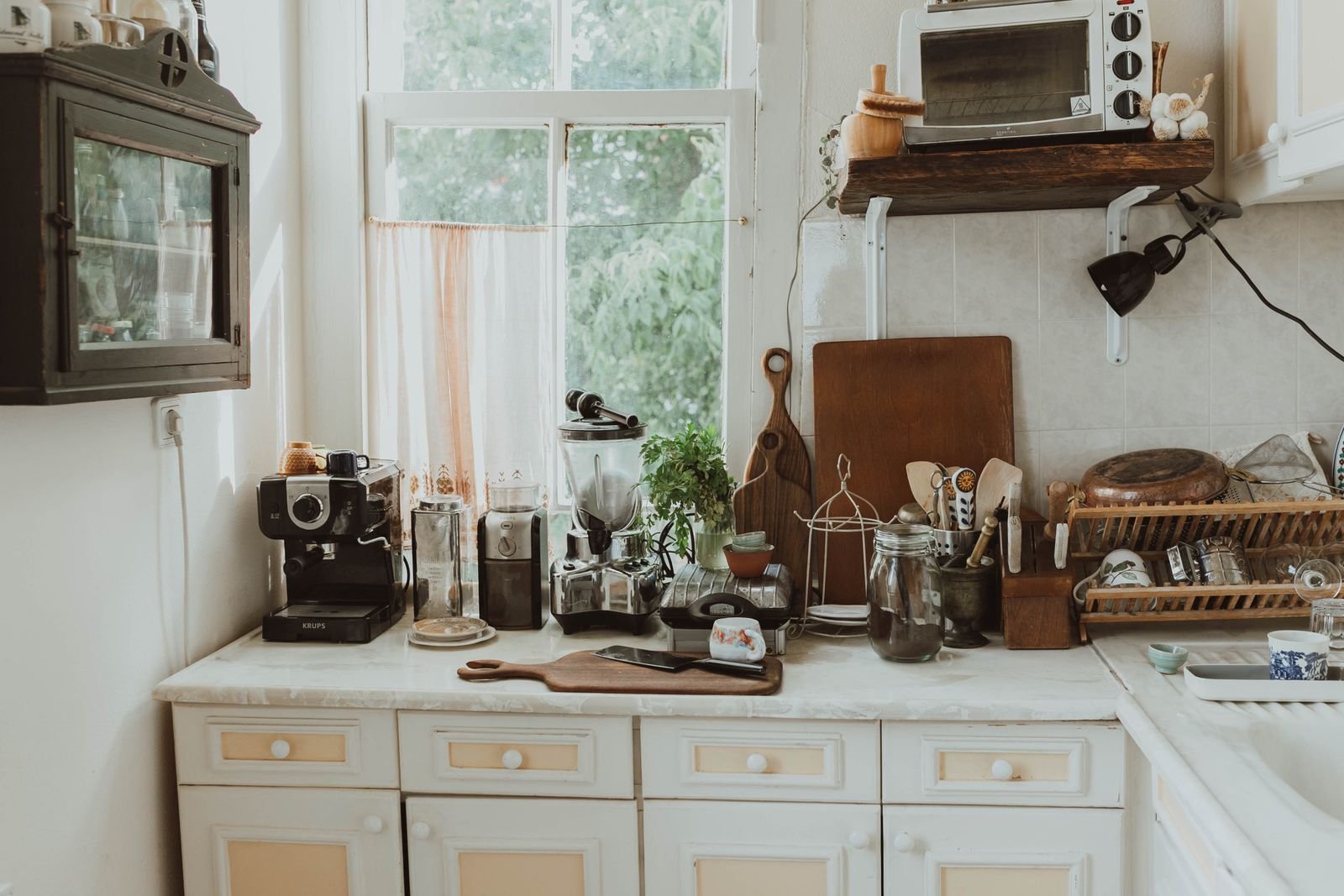
The most common way to waste money on coffee gear is not buying the wrong machine. It is buying a machine that physically does not work where you intend to put it — too tall to open under the cabinet, too deep for the counter, or sharing a circuit with the kettle and tripping the breaker every morning.
There are five numbers. Four of them take a tape measure and about six minutes. The fifth one you get by reading the label on your breaker panel. Write all five on a card and keep it in your wallet, because every spec block on this site — and every spec page a manufacturer publishes — is answerable from that card.
The number almost nobody measures is the second one: how tall the machine is with the water reservoir lid standing open. Manufacturers publish the closed height and not one publishes the open one. Your cabinet cares about the open one.
The verdict
If you only write down one number, make it clearance — counter to cabinet underside, measured where the machine will stand. It is the number that disqualifies products, and it is the number no product page answers for you.
If you write down two, add the wattage already plugged into that run. Height failures are obvious the day the box arrives. Circuit failures show up three weeks later, at 6 a.m., and everybody blames the coffee maker.
Questions people ask
How much clearance does a coffee maker need under a cabinet?
Enough for the machine's height plus whatever its lid needs to open — assume five extra inches for a rear-hinged reservoir lid, or none for a front-access door. Most kitchens have 18 inches of clearance because wall cabinets are installed 54 inches above the floor over a 36-inch counter.
Is 15 inches of counter-to-cabinet clearance a code requirement?
No. The NKBA's Guideline 25 uses 15 inches as the condition for countertop frontage to count as usable, not as an installation rule. There is no clearance dimension in the NKBA guidelines, and 18 inches is the common built figure rather than a required one.
How deep is a standard kitchen counter, and does the cabinet above cover all of it?
A standard base cabinet is 24 inches deep and a standard wall cabinet is 12 inches deep, so the cabinet only covers roughly the back half. A 13-inch-deep machine with a front-hinged lid can open into the space in front of the cabinet.
Can I run a coffee maker and an electric kettle on the same outlet?
Usually not. At 120 volts a 20-ampere circuit carries 2,400 watts; a 1,500-watt brewer plus a 1,200-watt kettle is 2,700 watts, or 22.5 amperes. Kitchens are required to have at least two 20-ampere small-appliance circuits, so the fix is often just using an outlet on the other one.
What brew temperature should a coffee maker reach?
SCA Standard 310-2021 specifies 90 to 96 °C — roughly 194 to 205 °F — for certified home brewers, along with a 55 grams-per-kilogram coffee-to-water ratio. Machines that brew below that band taste thin no matter how you grind.
Does hard water actually matter, or is descaling a marketing habit?
It matters. The SCA's brewing-water table asks for calcium hardness of 50 to 175 ppm as calcium carbonate, alkalinity near 40 to 70 ppm, pH between 6 and 8, and no chlorine. Above that hardness range, scale builds inside the boiler and both brew temperature and flow drop.
The five numbers
1. Clearance: counter surface to the underside of the wall cabinet
This is the number that eliminates products, so measure it first. Put the end of the tape flat on the counter, run it straight up, and read it at the bottom edge of the cabinet above. Do it at the spot the machine will actually live, not in the middle of the run — cabinets are not always hung level with each other, and a range hood or an under-cabinet light can steal an inch.
What to expect: cabinet makers install wall cabinets at a standard 54 inches above the finished floor, which over a 36-inch counter leaves 18 inches of clearance. KraftMaid publishes exactly that figure, and American Woodmark's installation guide draws its wall-cabinet base line at 53 7/8 inches. So 18 inches is the number most kitchens have.
It is worth knowing what the industry does and does not require here, because the internet is confident about a rule that does not exist. The NKBA's Kitchen Planning Guidelines never sets a counter-to-cabinet clearance dimension. What Guideline 25 says is that countertop frontage only counts toward the recommended total if it is 24 inches deep with at least 15 inches of clearance above it. That is a rule for counting usable counter, not a rule for hanging cabinets. If you have read that "NKBA requires 18 inches," it does not, and 15 inches is a real clearance some kitchens have — particularly over a sink or where a soffit drops.
Under 16 inches of clearance changes what you can buy. It rules out most 12-cup drip machines outright and makes a front-loading reservoir or a single-serve brewer close to mandatory. Our small-kitchen drip guide is sorted on exactly this number.
2. Working height: the machine with its lid open
Here is the trap. A manufacturer's spec sheet gives you the height of the machine sitting closed on a counter. A top-filling drip brewer has a reservoir lid that hinges up and back, and that lid needs somewhere to go. No manufacturer we checked publishes the open height, so the only way to know it is to measure the machine yourself in the store or before the return window closes — which is how a 13-inch machine on paper fails to fit under 18 inches of cabinet.
There are three ways out, in order of how much they cost you:
- A front-access reservoir. The water door swings toward you instead of up. Nothing hinges into the cabinet. This is the single most useful design feature in a small kitchen and it is rarely mentioned in reviews.
- A removable reservoir. You lift the tank out, fill it at the sink, and put it back. It needs vertical room to lift clear, so measure the tank height too, but it is usually less than a hinged lid needs.
- Pull the machine forward to fill it. Free, and annoying every single morning. Most people stop doing it by week three and the machine lives at the counter edge permanently.
If a brand does not publish an open height — and almost none do — assume a rear-hinged lid needs the machine's height plus five inches, and check the product photographs for which way the lid opens.
3. Depth, and the gap the cabinet gives you for free
Standard base cabinets are 24 inches deep and standard wall cabinets are 12 inches deep. Both figures are published by KraftMaid and corroborated in Aristokraft's 2024 specification sheet. That difference is worth understanding, because it is a loophole in your favor.
Your wall cabinet only covers the back 12 inches or so of the counter. A machine that is 13 or 14 inches deep, pushed back against the wall, has its front third standing in open air below the cabinet's front edge. If its lid hinges up from the front of the machine, that lid opens into nothing and the cabinet never comes into it. Machines that fail the clearance test on paper sometimes pass it in the room. Check where the hinge is before you write a product off.
Measure your own counter depth anyway, from the wall to the front edge including the overhang, and subtract anything permanent — a backsplash ledge, an outlet strip, a tile lip.
4. Width: the run you actually have, not the run you wish you had
Measure between the two things that are not moving. A toaster you are willing to relocate does not count as a wall; a stand mixer that lives there does. Then subtract two inches of breathing room, because appliances that heat need air and a machine wedged tight against a wall is a machine you will never clean behind.
For context on what a kitchen is designed to have: the NKBA's Guideline 25 recommends a total of 158 inches of countertop frontage across the whole kitchen for all uses. That is the sum of every usable stretch in the room, not one stretch — a useful reminder that your coffee corner is competing for space with every other job the counter does.
5. The circuit, which is where the real failure happens
This is the number people skip and then blame the appliance for. A US kitchen is required to have two or more 20-ampere small-appliance branch circuits serving the countertop receptacles — that is NEC 210.11(C)(1), and those circuits are not allowed to serve anything else. NEC 210.52(C)(1) puts a receptacle within 24 inches of any point along the countertop, which is why outlets sit roughly four feet apart.
Now the arithmetic. At 120 volts, a 15-ampere circuit carries 1,800 watts and a 20-ampere circuit carries 2,400 watts. A 1,500-watt drip brewer and a 1,200-watt electric kettle running together draw 2,700 watts, which is 22.5 amperes. That trips a 20-ampere breaker and badly overloads a 15-ampere one. It has nothing to do with the "80 percent rule" people cite — that rule applies to loads running three hours or more, which neither a brewer nor a kettle does. The pair overloads the circuit for the simple reason that 2,700 is bigger than 2,400.
So: read the wattage on the bottom of anything already plugged into that stretch of counter, add the new machine's wattage, and if the total clears 1,800 watts, find out whether those outlets are on the same circuit before you buy. The cheap test is to switch off one breaker and see what goes dead.
The six-minute procedure
- Clear the stretch of counter completely. Measurements taken around a bread bin are fiction.
- Measure clearance at the exact spot, counter to cabinet underside. Write it down.
- Measure depth, wall to counter edge, minus the backsplash lip.
- Measure width between the two fixed obstacles, then subtract two inches.
- Find the wattage labels on everything already plugged in along that run, and add them up.
- Cut a cardboard box to the candidate machine's published width, depth and height, stand it on the counter, and open the cabinet door above it. Five minutes with a box has saved more returns than any specification sheet.
Keep the four measurements on a card. Every spec block on this site leads with height, footprint and capacity in the same units, so a card and a guide page settle the question in about ten seconds.
While you have the tape out: water and temperature
Once a machine fits, two things decide whether it makes good coffee, and both are published figures rather than opinions.
Brew temperature. The Specialty Coffee Association's standard for home coffee brewers, SCA Standard 310-2021, specifies a brewing temperature of 90 to 96 °C — about 194 to 205 °F — and requires a certified brewer to print a coffee-to-water ratio of 55 grams per kilogram of water. That is where the figure comes from. A machine that cannot hold the top of that band is why supermarket drip coffee tastes sour and thin; cheap brewers often sit below it and no grind adjustment rescues them.
One correction worth carrying around, because the error is everywhere: the SCA's Golden Cup standard does not mention temperature at all. In full, it specifies a brew strength of 1.15 to 1.35 percent total dissolved solids from an extraction yield of 18 to 22 percent — strength and yield, nothing else. The familiar "195 to 205 °F" range belongs to the heritage definition of espresso, and the 200 °F figure belongs to the cupping protocol. Correct numbers, wrong document.
Water. The SCA's published brewing-water table asks for water with no chlorine, a calcium hardness of 50 to 175 ppm as calcium carbonate, alkalinity at or near 40 to 70 ppm, and a pH of 7.0 with an acceptable range of 6 to 8. In practice: if your tap water tastes of chlorine, a carbon filter fixes the cup and costs almost nothing. If your kettle furs up with white scale in a month, your water is hard, and descaling every two months is part of the machine's running cost — plan for it rather than discovering it. And note that the widely-quoted "TDS 150 mg/L, acceptable 75 to 250" line comes from the retired SCAA table, not the current SCA one, which has no TDS row at all.
Where to go from here
With the card in hand, pick the guide that matches the constraint you just discovered:
- Tight clearance, needs a full pot: the best drip coffee makers for small kitchens — ranked on height first.
- Enough room, want real espresso: the best beginner espresso machines, including what "15 bar" on the box actually means.
- Machine is fine, coffee is not: the best grinders for pour-over and drip, and burr vs blade if you are still deciding whether it matters.
- Smallest possible footprint: the best pour-over kettles and kits — a dripper and a kettle need about seven inches of counter and no clearance at all.
Sources
- NKBA — Kitchen Planning Guidelines with Access Standards (Guideline 25, countertop frontage and 15 in clearance)
- KraftMaid — What Are Standard Kitchen Cabinet Sizes? (54 in wall-cabinet height, 24 in base depth, 12 in wall depth, 36 in counter height)
- American Woodmark — Cabinet Installation Guide (wall-cabinet base line at 53 7/8 in)
- Aristokraft — Specifications, January 2024 (24 in base cabinets, 12 in wall cabinets)
- NFPA 70 (NEC) — 210.52(C)(1) countertop receptacle spacing and 210.11(C)(1) small-appliance branch circuits, verbatim in NFPA public-input submittals
- SCA Standard 310-2021 — Home Coffee Brewers: Specifications and Test Methods (§6.2 brewing temperature 90–96 °C; §6.7 ratio 55 g/kg)
- Specialty Coffee Association — Coffee Standards, revised 2018 (§5.1 Golden Cup; §4.1 water for brewing)