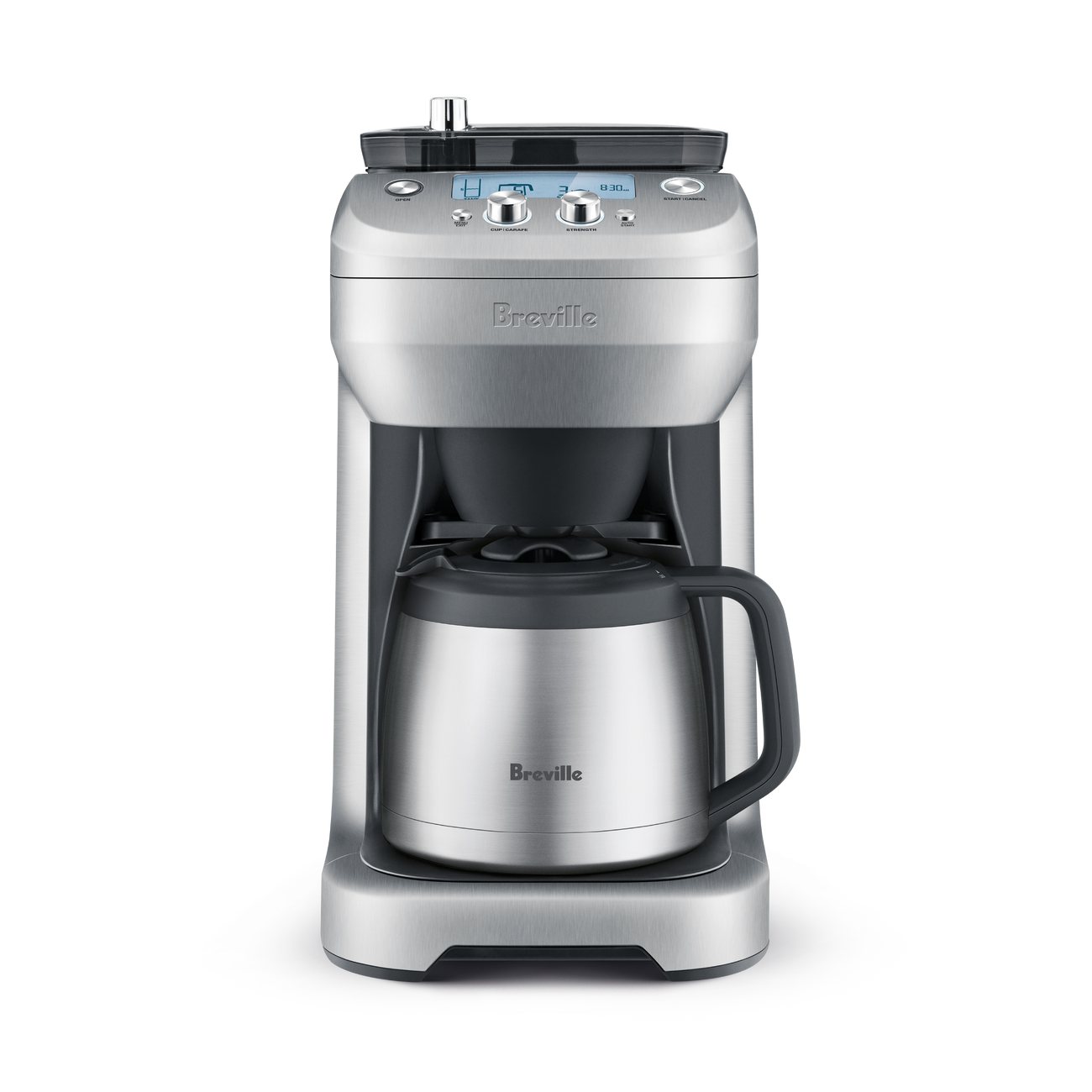
Buy the Breville the Grind Control. A grinder bolted to a drip machine has to put the bean hopper somewhere, and every maker here puts it on top — which is why four of these five stand between 15.5 and 17.8 inches tall. Breville puts the hopper beside the water tank instead, and the whole machine measures 12.5 inches high. That is the difference between a machine that lives on your counter and one that comes out of a cupboard.
If you want the same idea for much less money, the BLACK+DECKER Mill & Brew is 15.5 inches tall and costs about a quarter as much. If you want burrs rather than spinning blades and can spare the height, the Cuisinart Burr Grind & Brew is the one, at 16.34 inches.
One warning before the picks. Only two of these five brands will tell you, on their own product page, whether the grinder inside is a burr mill or a blade. That matters more than any other feature on the box, and it is the second thing this guide ranks on.
How to shop for a coffee maker with a grinder built in
Height, measured against the cabinet
A grind-and-brew is a drip machine with a second appliance stacked on it. The hopper lid has to open, so the clearance you need is the published height plus a few inches of swing. Every height below comes from the manufacturer's own specification block, and the spread is 5.3 inches from the shortest to the tallest.
Burr or blade, and whether the brand says
Burrs shave beans to a repeatable size; blades smash them into a mix of dust and boulders, and the dust over-extracts while the boulders do not extract at all. Breville and Cuisinart print the grinder type. BLACK+DECKER and GEVI do not, which tells you something on its own.
Carafe type
Glass sits on a hotplate that keeps cooking the coffee; a dual-wall thermal carafe holds temperature with no heat applied. One machine here ships thermal, four ship glass. The thermal one is also the shortest, which is not a coincidence — no hotplate, no base.
Depth, because the hopper sits under the cabinet
Width is usually fine. Depth is what decides whether the machine can sit back far enough to clear an overhanging cabinet, and it runs from 6.5 to 10.7 inches here. Measure from the wall to the front edge of your counter before anything else.
What it costs to keep running
A grinder adds a second thing to clean and a second thing to break. Warranties here run from one year to three, and every machine on this page ships a permanent metal filter, so there is no paper to buy.
Best overall
Image: Breville
Breville the Grind Control
Short, but the widest thing here
Model
BDC650BSS
Height
12.5 in · 16.7 W × 9.1 D
Grinder
Stainless steel burr
Carafe
12-cup dual-wall thermal
Reasons to buy
At 12.5 inches this is the only machine here that fits under a standard 18-inch cabinet gap with room to open the hopper, and it is three inches shorter than the next one
Stainless steel burrs rather than a blade, which is the single decision that separates a fresh-ground cup from a bitter one
A dual-wall stainless thermal carafe, so there is no hotplate slowly stewing the pot for the next hour
Breville's Steep and Release system brews directly into the carafe, a tall cup or a travel mug, so the machine does single cups without a second appliance
Programmable auto start, and Breville publishes the full dimension set on the product page rather than a vague "compact"
Reasons to avoid
16.7 inches wide is the widest footprint on this page, so the height you win back is partly paid for in counter run
Four times the money of the BLACK+DECKER, for a machine that makes the same 12 cups
Breville solved the shape problem everybody else accepted. Put the hopper on top and you get a 16-inch tower; put it alongside and you get a 12.5-inch box that clears the cabinet. The thermal carafe removes the base plate as well, which is where the rest of that height goes.
The burrs are the other half. A blade mill gives you a different grind every time you press the button; a burr mill gives you the same one, which is what makes a programmed 6 a.m. brew worth programming. You pay for both of those, and this is the most expensive machine on the page by a wide margin.
Not the right fit if your counter is narrower than it is short — see the GEVI DCMF0, which is 7.9 inches wide.
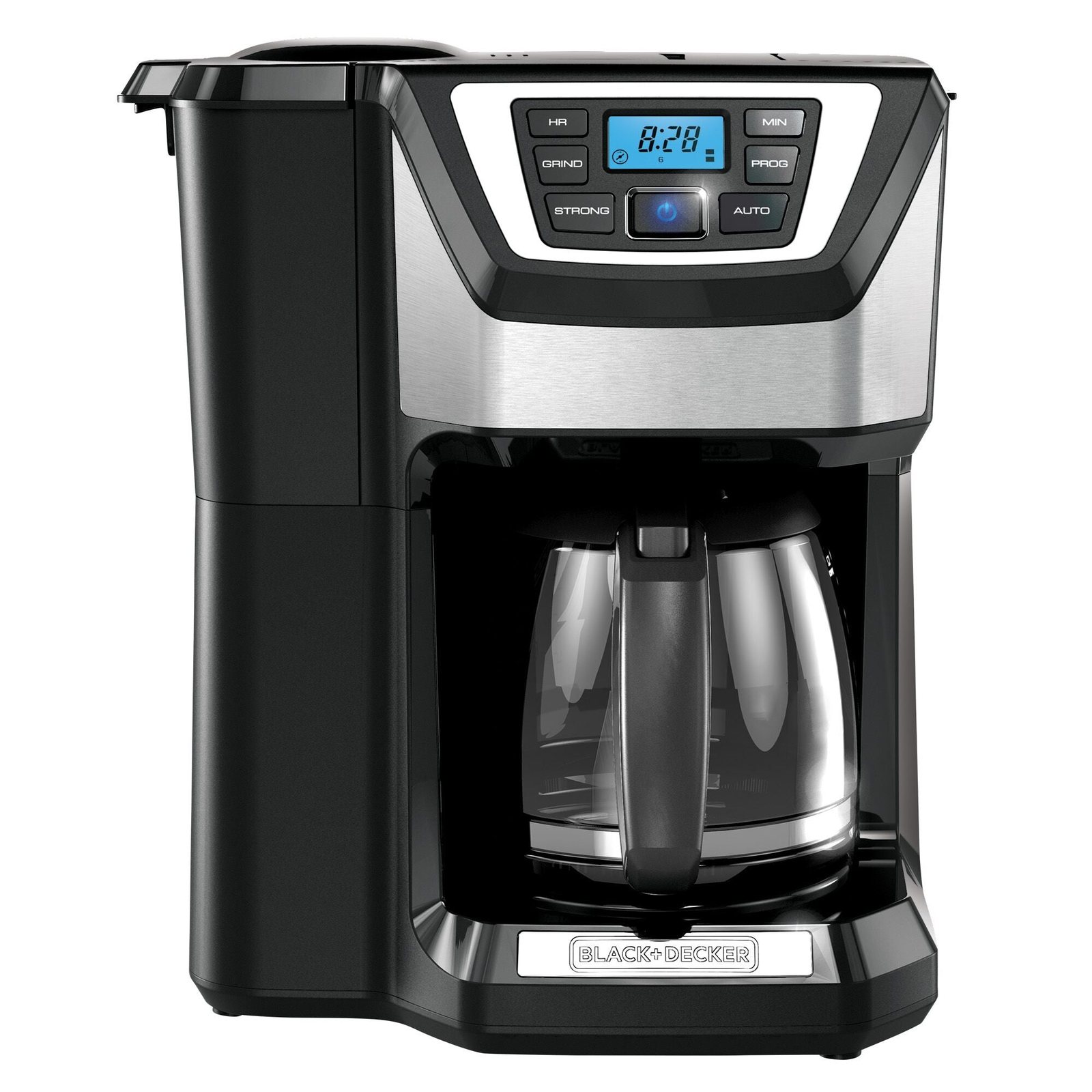
The cheapest way into grind-and-brew by a long way, for the least money of anything on this site, and it still does the whole job
A bronze-tone permanent filter attached to the grinder, so there is nothing to buy again and both parts lift out to wash
BLACK+DECKER publishes a 325 ml grinder dustbin capacity, which nobody else here quotes at all
A grinder-off setting for pre-ground coffee, so the machine is still useful on the day you run out of beans
Reasons to avoid
The product page calls it a grinder and never says burr or blade, which for a machine whose entire premise is the grinder is the wrong thing to leave out
10 inches deep, the second deepest here, and 13.5 inches wide
A two-year warranty against Cuisinart's three
This is the machine that makes the category make sense to most people. It is a normal 12-cup drip maker with a mill on top, it costs about what a decent plain drip maker costs, and at 15.5 inches it is no taller than the two Cuisinarts.
What you give up is knowing what is inside. Everything about the price suggests a blade mill, BLACK+DECKER does not say so, and this guide will not put a number on a spec the maker has not published.
Not the right fit if you want to know what the grinder is — see the Cuisinart DGB-800.
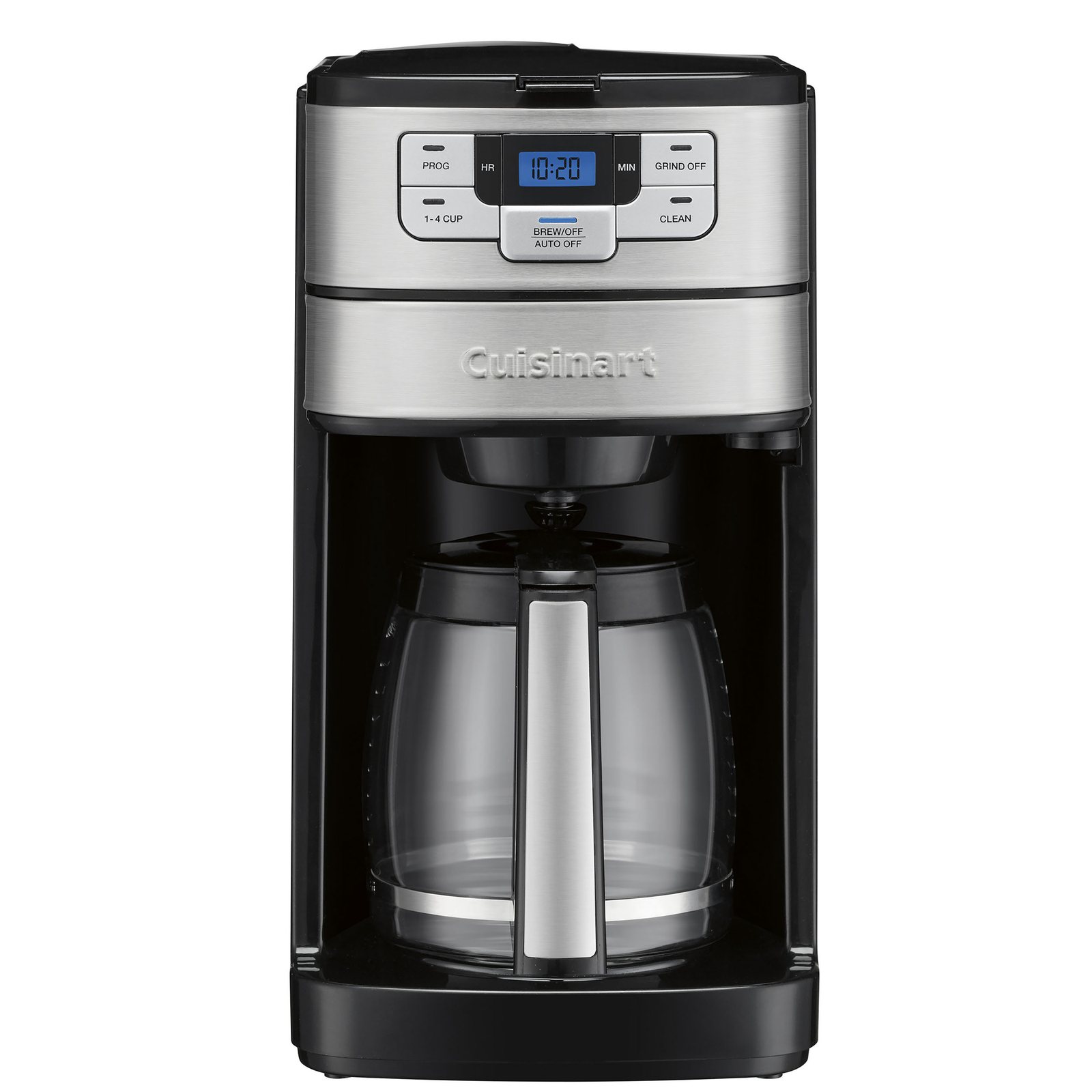
9.98 inches wide and 8.13 deep is the smallest footprint of any machine here, which matters more than height on a counter with a run of appliances already on it
Cuisinart states plainly that this is a blade grinder, which is worth more than a machine that hides it
A limited three-year warranty, the longest on this page
A gold-tone permanent filter and a charcoal water filter in the box, plus Brew Pause, 24-hour programming and a 1-to-4-cup setting
Reasons to avoid
A blade mill chops rather than shaves, so the grind is a mix of sizes and the cup is less even than anything with burrs
10 lb of machine on a glass carafe and a hotplate, which keeps cooking the pot after brewing
Checked in September 2026, cuisinart.com answered a 404 to every automated request for its own product pages, so the only button here is Amazon's
If your problem is counter width rather than cabinet height, this is the machine. Ten inches by eight is the smallest rectangle on the page — the GEVI is narrower but four inches deeper.
It is honest about being a blade machine, and that honesty is what buys it a place above the BLACK+DECKER in this guide despite costing a little more. A blade grind-and-brew still beats pre-ground coffee that has been open for a fortnight.
Not the right fit if you care about grind consistency — see the Cuisinart DGB-800 with burrs.
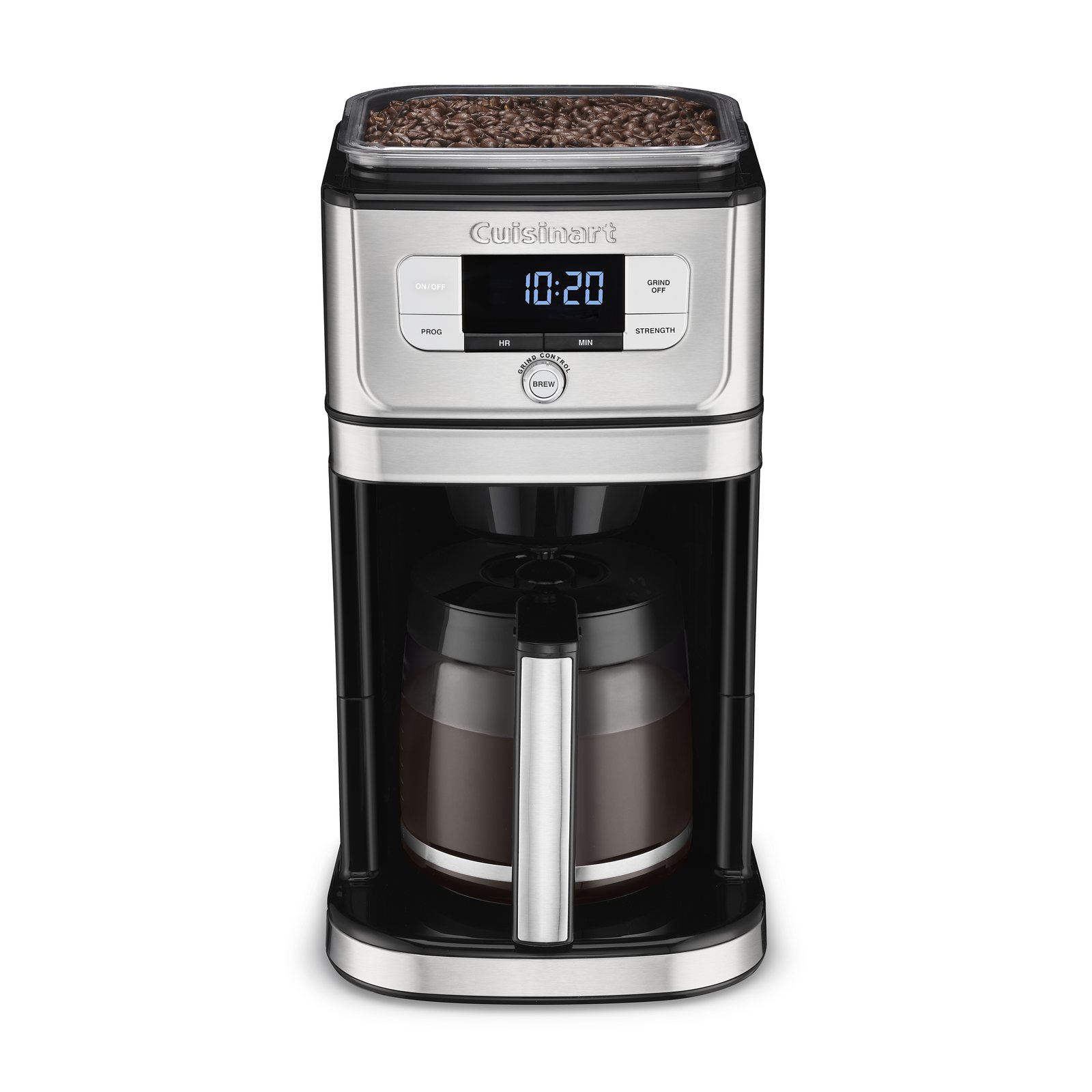
A professional-style burr grinder for a fraction of the Breville's money, which is the cheapest way to get burrs and a carafe in one box
Cuisinart's DirectFlow assembly moves the grounds straight from the burrs into the brew basket, and an auto-rinse cycle pushes the stragglers through so the dose you ground is the dose you brew
It grinds only the amount the cup setting asks for, rather than a fixed dose you then waste
Three flavor strengths, a charcoal water filter, Brew Pause, and a limited three-year warranty
Reasons to avoid
16.34 inches tall, which is over an inch taller than the blade machines and nearly four above the Breville
A glass carafe on a hotplate, so the thermal advantage of the Breville is not on offer at any price here
10.8 lb, the heaviest thing on this page to move for cleaning
This is the value answer to the Breville. You get burrs, a dose tied to the cup count, and the best warranty here, and you pay for it in four extra inches of height rather than in money.
Whether that trade works is a tape-measure question, not a taste question. Measure the gap between your counter and the cabinet above it; if the answer is under 20 inches, the hopper lid will not open and none of the rest matters.
Not the right fit if your cabinet gap is tight — see the Breville Grind Control at 12.5 inches.
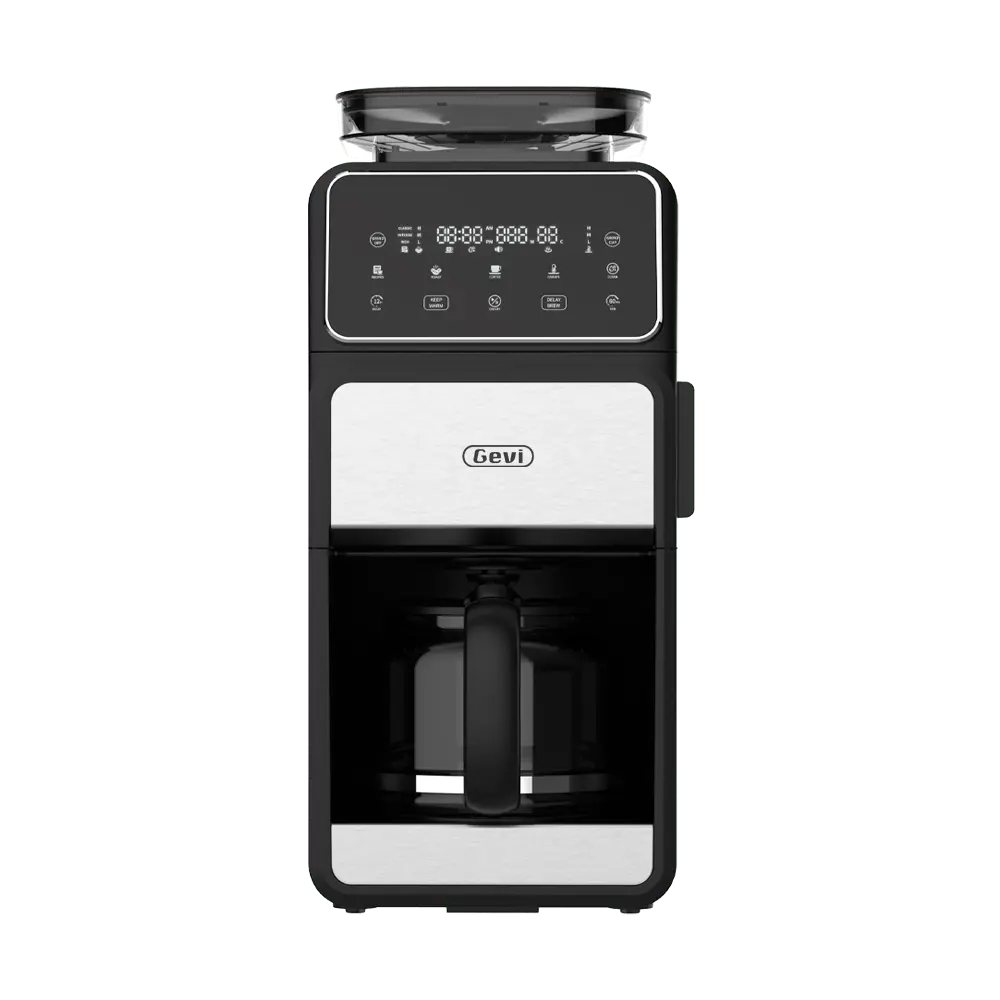
7.9 inches wide is the narrowest machine here by two full inches, which is the number that matters if your counter gap is between two cupboards rather than under one
A pre-infusion step that wets the bed before the main pour, which no other machine on this page publishes
An iced-coffee mode that brews at a lower temperature, and a keep-warm plate GEVI rates at up to 185°F for four hours
A 1.5 L water tank and a 4 to 10 cup range, so it is the only machine here that admits a sensible minimum batch
GEVI publishes the full spec block — 120 V, 1000 W, 1.5 L, 4.67 kg and all three dimensions — which is more than De'Longhi manages on a machine costing three times as much
Reasons to avoid
17.8 inches is the tallest thing on this page, so the narrow width comes straight back as height
The product page never says whether the mill is a burr or a blade
A one-year standard warranty, the shortest here
10.7 inches deep, the deepest of the five
The interesting shape. Every other machine here is a box; this one is a column, and a column fits places a box does not. If the space you are filling is a slot beside the toaster, 7.9 inches wide changes the answer.
The pre-infusion and the iced mode are features the two cheap machines do not have at all. The missing grinder specification and the one-year warranty are what keeps it out of the top half.
Not the right fit if you have height but not width to spare — see the Breville Grind Control.
Nobody brewed with these five for this page, and there is no lab behind it. Here is what the ranking is built on.
Every height, width and depth came from the manufacturer's own specification block, linked in Sources. Where a brand publishes no grinder type, the table says so by name rather than guessing from the price.
Every Amazon page was opened, its title matched against the model number printed here, and the buy box checked, which is how the GEVI ended up with a brand-store button instead.
Prices were read on the same day the bands were set, and the bands are ordered against that ladder rather than against memory.
The verdict
Best overall: Breville the Grind Control, because 12.5 inches is the only height here that clears a normal cabinet gap with the hopper lid open, and because stainless burrs and a thermal carafe are the two upgrades that change the cup rather than the panel.
Best for the least money: the BLACK+DECKER Mill & Brew at 15.5 inches. Smallest footprint: the Cuisinart DGB-400NAS at 9.98 by 8.13 inches. Best burrs without Breville money: the Cuisinart DGB-800, which costs its four extra inches of height. Narrowest of all: the GEVI DCMF0 at 7.9 inches wide and 17.8 tall.
Measure twice before any of it. Counter to cabinet, then wall to counter edge, then write both numbers down — our measuring guide lists the five that matter and the one everybody forgets.
Is a built-in grinder actually better than grinding separately?
A separate burr grinder is better coffee and a worse morning. One box means one thing to clean and one power outlet; two boxes mean you can buy a grinder that costs more than the whole machine here. If you already own a burr grinder, a plain drip maker is the better spend — our small-kitchen drip guide covers those.
How much clearance do I need above a grind-and-brew?
The published height plus enough room to swing the hopper lid — allow three inches over the number in the table. That makes the Breville a 15.5-inch job and the GEVI a 20.8-inch one, against a standard counter-to-cabinet gap of 18 inches.
Do these machines grind into the basket or into a separate chamber?
All five grind straight into the brew basket. Cuisinart is the only brand here that publishes what happens next — its DirectFlow assembly plus an auto-rinse cycle exists because loose grounds stick to the chute on the way down.
Can I use pre-ground coffee in one?
Yes, on all five. Every machine here has a grinder-off setting. It is the feature to check on any grind-and-brew, because it is what keeps the machine useful the week the mill jams.
Which of these has a thermal carafe?
Only the Breville, which ships a 12-cup dual-wall stainless carafe. The other four are glass on a hotplate. That is also why the Breville is the shortest machine here — there is no heated base under the pot.
Also considered
De'Longhi TrueBrew CAM51035M — A genuinely interesting machine — conical burr grinder, six brew sizes from a 3 oz espresso-style cup to a 40 oz carafe. De'Longhi's US product page publishes voltage, frequency, brew sizes and brew styles, and not one dimension. On a page ranked by height that is disqualifying, and it is the most expensive machine we looked at.
KRUPS KM785D50 Grind and Brew Auto-Start — The obvious mid-price burr machine in this category. Every KRUPS US product URL we tried returned the same short holding page to an automated request, so there is no first-party specification to read and no maker page to link. No published specification, no pick.
Cuisinart Grind & Brew Single-Serve (DGB-2) — A current Cuisinart product with a conical burr mill and a 100 g hopper, aimed at one cup at a time. Its product page answers a 404 to an automated request while the model is still sold, so the dimensions this guide ranks on are unreadable.
Capresso CoffeeTEAM TS — A burr grinder and a thermal carafe in one body, which on paper is the Breville's formula for less money. Capresso's product page serves a missing-image placeholder and no specification block, so there is nothing to measure.
Any pod machine with a grinder — There is not one, and the two ideas are opposed: a pod exists so that nothing has to be ground. If you want fresh grounds, none of the single-serve pod systems are in this category at all.