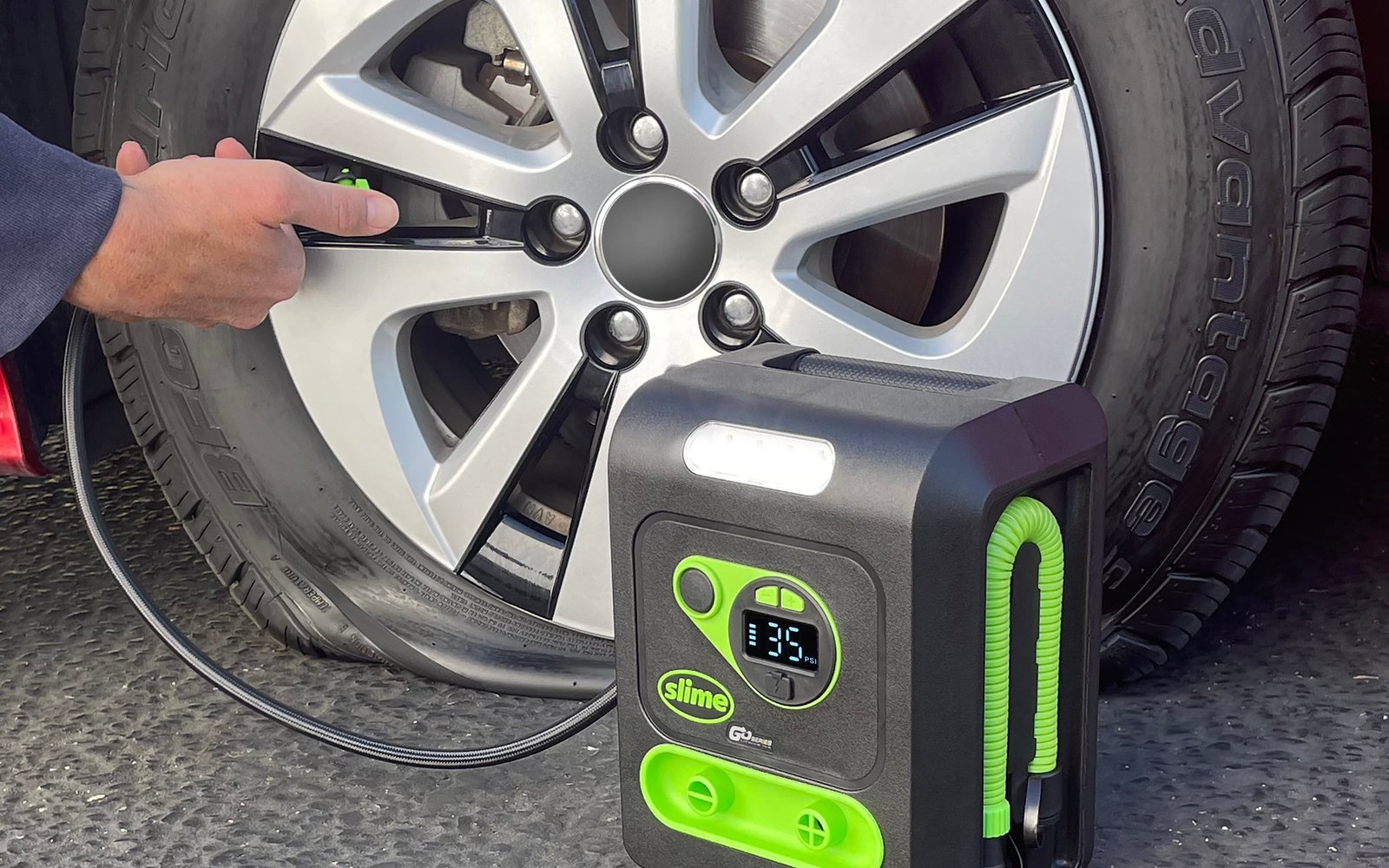
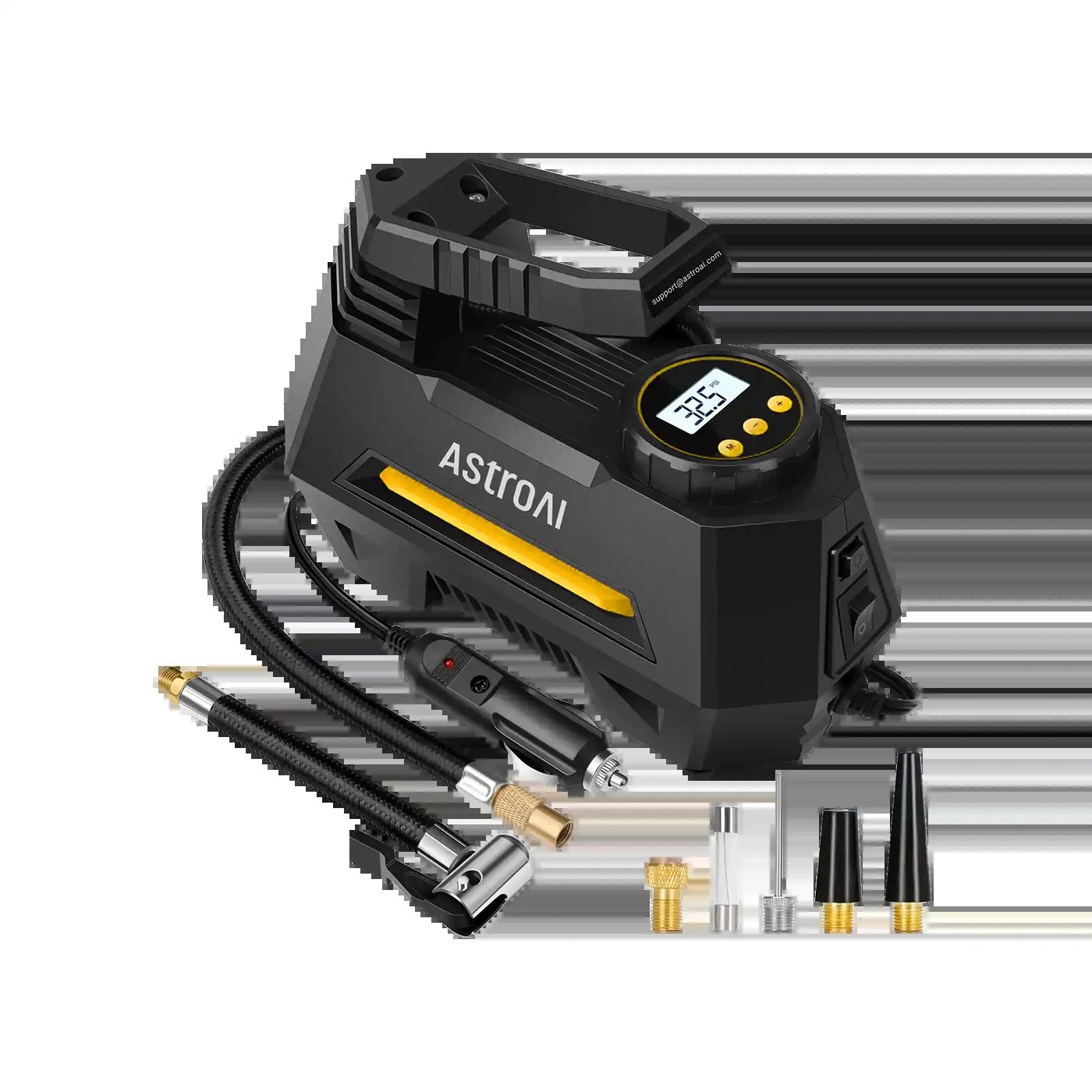
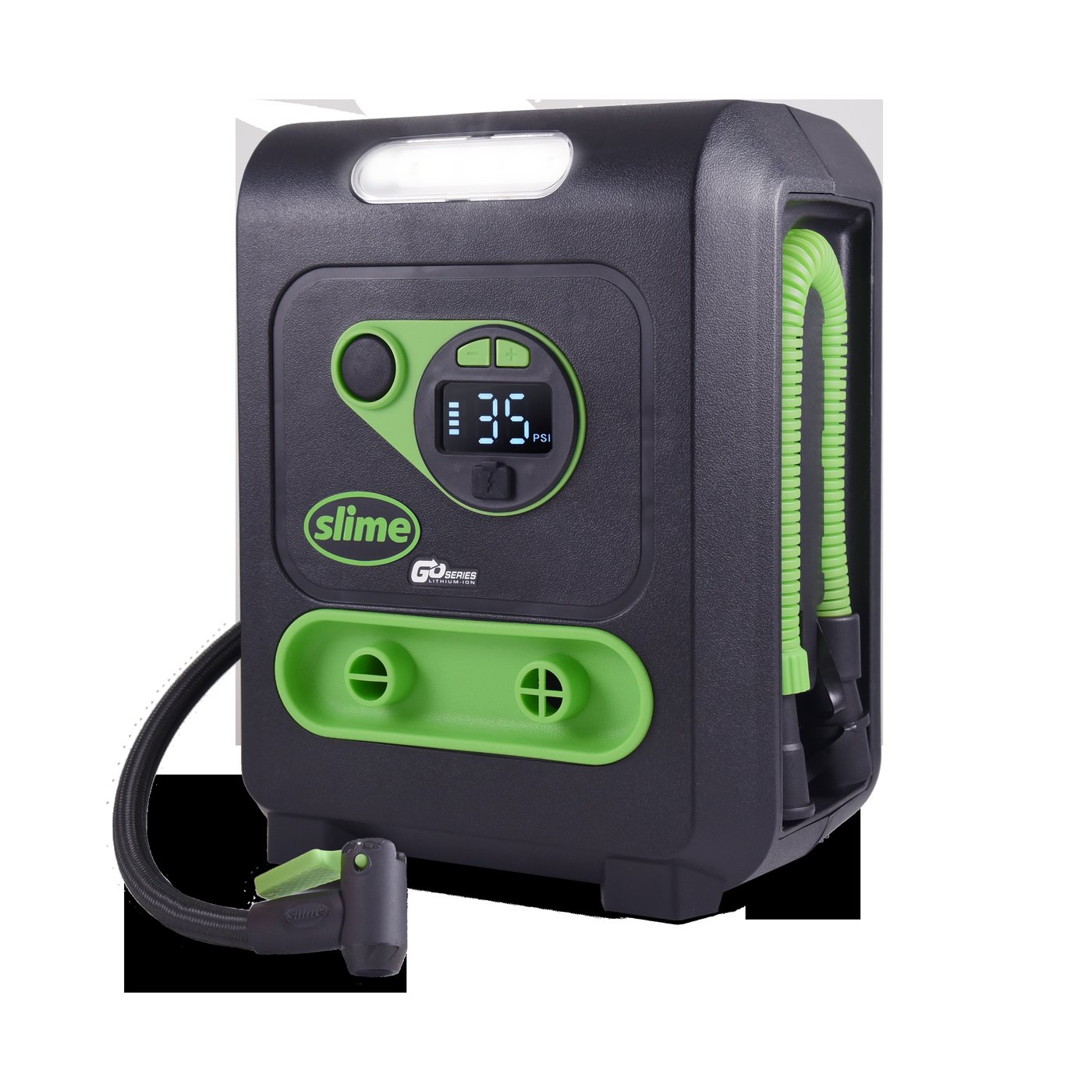
Buy cordless if the inflator will live in a car — the Slime Cordless Multi-Purpose Inflator ($$), which Slime rates at four months of standby charge and 6 minutes for a flat car tire. Buy 12V or mains if it will live on a garage shelf, and that is the AstroAI dual-power compressor ($$), which has no battery to be flat.
This is the only real decision in the inflator aisle. PSI ratings, work lights and the number of nozzle adapters are noise next to where the power comes from, because the power source decides whether the tool works on the specific bad day you bought it for. A cordless unit works with a dead car battery, in a parking lot, at night, ignition off. A 12V unit never has a flat battery of its own and never stops halfway up a truck tire.
The two failures are not symmetrical, which is why the answer depends on where the tool sits. A cordless inflator fails by being flat after six months of neglect — a calendar problem. A 12V inflator fails by needing an engine you cannot start — a physics problem. One of those you can fix with a reminder.
How to shop for a tire inflator
What fails, and when
A cordless inflator fails by being flat after six months in a hot trunk; a 12V inflator fails by needing an engine you cannot start. Pick the failure you can live with.
Current draw versus the socket
A 12V accessory socket is typically fused at 15 amps. A serious compressor like the VIAIR 88P draws around 20 amps and clamps directly to the battery terminals for that reason. Socket-powered units are limited by the fuse, not by the pump.
Four tires, not one
Compact cordless units publish per-tire times — 6 minutes from flat on the Slime, under 1.5 minutes for a top-up on the AstroAI L7 — and most publish no duty cycle. Corded units simply keep going.
Where it is stored
A trunk-stored tool has to hold charge unattended. Slime states four months of standby on the 40085's built-in battery, and that single spec is the whole argument for cordless.
Best cordless
Image: Slime
Slime Cordless Multi-Purpose Inflator
Works with a dead car, 6 minutes a tire
Power
Built-in lithium-ion, USB-C charging
Works with engine off
Yes
Published fill
Flat to full in 6 min; 3 tires per charge
Standby
4 months of charge (Slime)
Display
0–99 psi LED, auto shut-off
Model
40085
Reasons to buy
No cable to the car at all, so it works on a car that will not start and on a bicycle two miles from one
Slime publishes four months of standby charge — the number that decides whether a trunk-stored tool is useful
Three tires from flat per charge, and 6 minutes for the first one
A second high-volume hose covers air beds and rafts, which keeps it in regular enough use that you notice a dead battery early
Reasons to avoid
It is a battery tool: forget it for a year and it will be flat on the day it matters
The 0–99 psi display rules out trailer tires above 99 PSI
The case for cordless is that the emergencies needing an inflator usually arrive with other problems attached: a nail found in a parking lot at night, a car that will not turn over. Neither is improved by a tool that needs the engine running.
The price is discipline. A reminder twice a year to top it up and it will do the job for a decade; ignore it and you are the person holding a dead inflator next to a flat tire.
Not the right fit if the inflator lives in the garage and gets used monthly — a corded unit has no charge to forget.
On a wall outlet it runs as long as the job takes — no pack sagging halfway up the fourth tire
A 150 PSI rating covers passenger, light truck and most trailer pressures
Nothing to charge, so it is ready after six months in a cupboard
Reasons to avoid
On 12V it draws through the accessory socket, which means the engine running and a cable across the hood
AstroAI publishes no fill time, so you cannot compare its speed on paper against the cordless units
For monthly maintenance, corded wins on every axis that matters. Pressures drop about 1 PSI for every 10 degrees Fahrenheit the temperature falls, so the useful habit is checking four tires and the spare when the seasons turn — a ten-minute job with no thought about charge state.
As a roadside tool it is the weaker choice, and the reason is the fuse rather than the pump. A 15-amp accessory circuit limits what any socket-powered compressor can draw, and a compressor that needs the engine running is no help at all when the problem is the battery.
Not the right fit if the tool will live in the car for emergencies — that is a cordless job.
Neither unit has been run against a tire by us. The two were compared on the same two jobs using published figures only: a single flat tire at the roadside with the engine off, and a four-tire-plus-spare pressure check in a driveway with mains power available.
Slime publishes 6 minutes from flat, 3 tires per charge and 4 months of standby; AstroAI publishes 150 PSI and dual 12V/110V power but no fill time. Neither claim was topped up with a number from a retailer's copy.
Electrical limits were taken from how the manufacturers wire their own products: VIAIR ships battery clamps and publishes a 20-amp draw for the 88P, which is why socket-powered units sit below that ceiling.
The Slime is the first inflator on this site's buying list. Once it is here we will time the flat-to-full fill and the four-tire job with a phone and publish those numbers against Slime's.
The verdict
Buy cordless if the inflator lives in a vehicle. The Slime is the one to keep in the trunk, because a four-month standby charge and a 6-minute flat-tire fill cover the actual emergency, and it works when the car does not.
Buy 12V or mains if the inflator lives in the garage. The AstroAI dual-power compressor is always ready, costs less, and makes the monthly pressure check quick enough that it actually happens — which prevents more flat tires than any roadside tool.
The honest answer for a two-car household is one of each, and the pair still costs less than a single replacement tire. All six inflators, including the tool-battery options, are in the best portable tire inflators.
Yes, if the engine is off. A compact compressor pulls 10 to 15 amps; twenty minutes of that on a battery already low is how a tire change turns into a jump start. Run the engine, or use a cordless unit.
How often do cordless inflators need charging?
Slime publishes a four-month standby charge on the 40085. A sensible habit is topping it up when the clocks change, which is twice a year and also the right moment to check all four tire pressures.
Which is faster?
Tool-battery units win on published numbers: Milwaukee states under a minute to top off a car tire on the 2475-20, and the Slime publishes 6 minutes from flat. Corded units publish no fill time at all, so they are compared on duty cycle instead.
Do I need 150 PSI?
Only for trailer or LT truck tires. A passenger car sits at 30 to 36 PSI and a compact spare at about 60. What matters is whether the pump still moves air near the top of its range, not the number printed on the box.
Can I keep a cordless inflator in a hot car?
Lithium cells age faster in heat, so a trunk in Florida summer is hard on them. Keep it in the cabin if you can, and expect a battery inflator to need replacing sooner than a corded compressor, which has no cells to degrade at all.