Buy the Slime Cordless Multi-Purpose Inflator ($$). It carries its own lithium battery that Slime says holds a charge for four months, it fills a flat car tire in 6 minutes, and it needs no engine, no socket and no tool platform — which is the entire job of something kept in the trunk.
A tire that is 6 PSI low is invisible. It does not look flat, the car does not pull, and the only symptoms are a fuel bill and a tire that wears out at the edges a year early. Spend as little as possible and the AstroAI L7 does the top-up job for a fraction of the price; already own cordless tools and the Milwaukee M12 compact inflator is the fastest thing here on a published number.
Two things separate a useful inflator from a toy: an auto shut-off that stops at the pressure you set, and either a published duty cycle or a published per-tire time so you can work out whether it will do four tires without a rest. Everything below is judged on the manufacturers' own figures, linked at the bottom.
How to shop for a portable tire inflator
Auto shut-off at a set pressure
Without it you are watching a gauge and feathering a trigger in the dark. Every pick here except the VIAIR sets a target PSI and stops.
Duty cycle, not fill speed
Four tires is four times the work of one, and small inflators overheat. VIAIR publishes 25 minutes at 30 PSI for the 88P; the cordless units publish a per-tire figure instead, which is the number to hold against your own four-tire job.
Power source that matches the emergency
A cordless unit works when the car will not start. A 12V unit never runs out mid-fill but needs the engine on. A tool-battery unit is free if you already own the platform and pointless if you do not.
Maximum pressure against your actual tires
A passenger car runs 30 to 36 PSI, a light truck 45 to 60, a trailer up to 80. Anything rated to 120 PSI covers all of it, so the 150 and 160 PSI numbers on the box matter less than whether the pump still moves air near the top of its range.
A hose and chuck that reach the valve
Short hoses fight low-profile wheels and valve stems angled into the rim. Threaded chucks stay on; push-on chucks leak as you fit them.
A display you can read at night
Flat tires happen at night, on a shoulder, in the rain. An illuminated gauge and a work light are not extras in this category.
Best overall
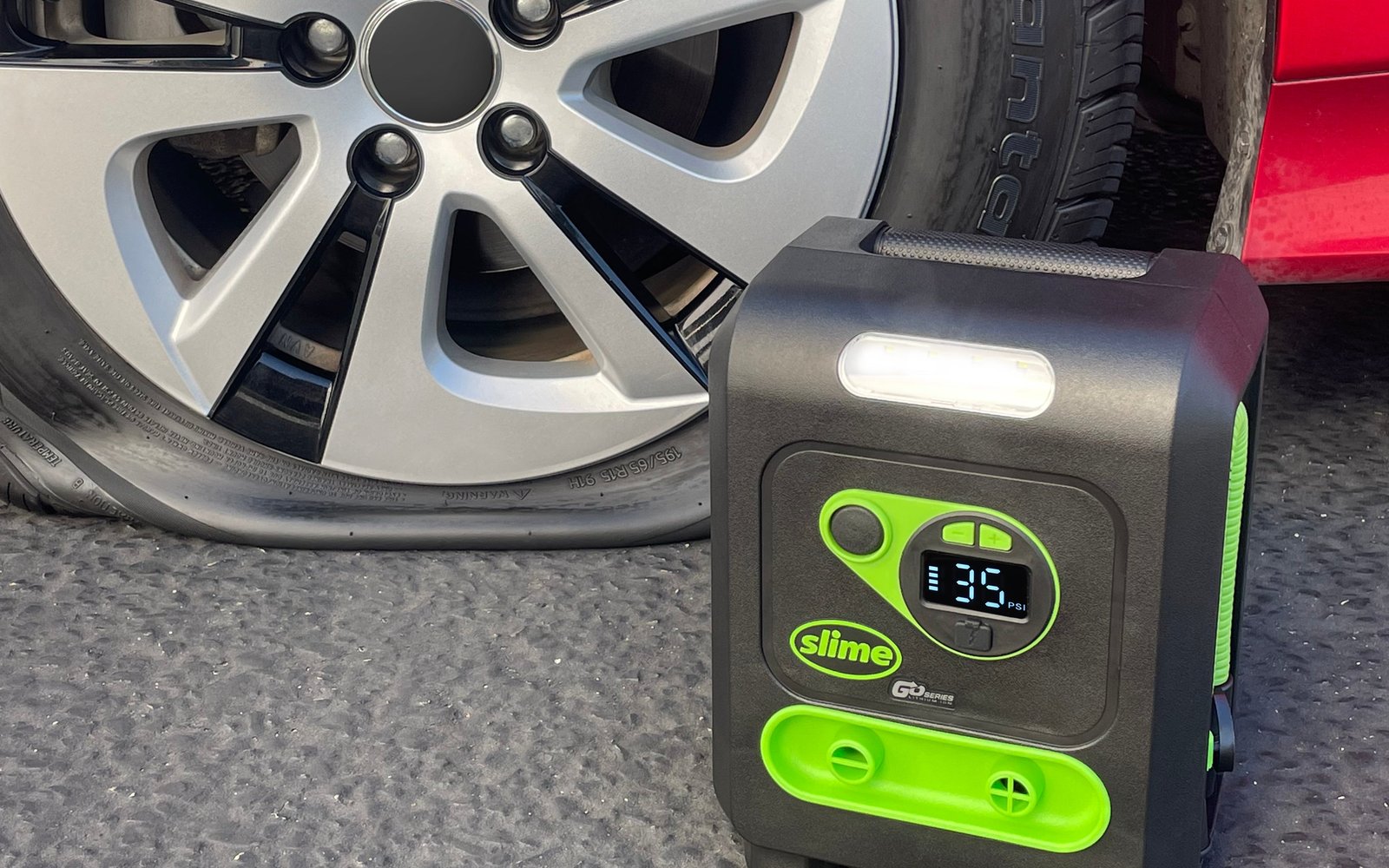
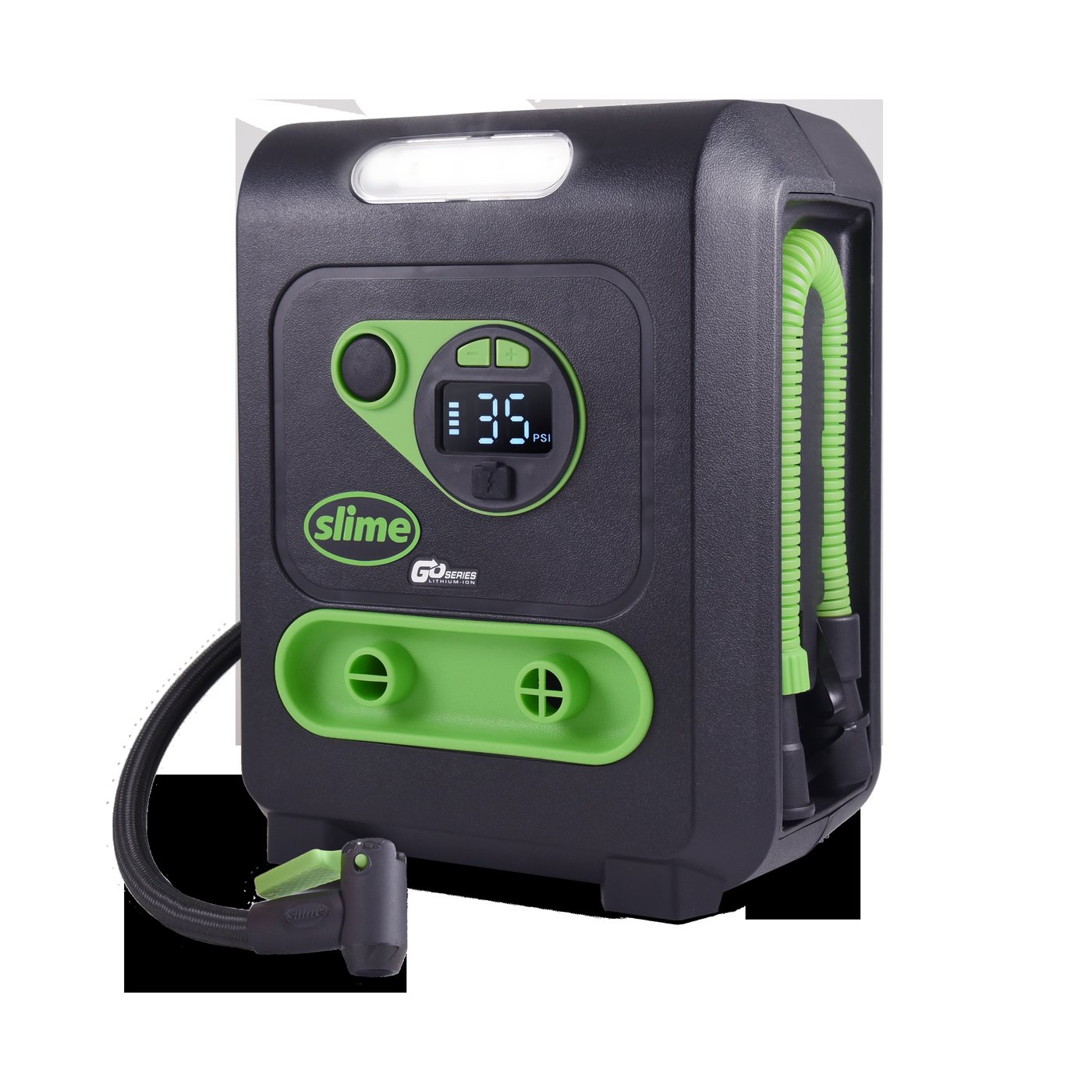
Image: Slime
Slime Cordless Multi-Purpose Inflator
Two hoses and a 6-minute flat-tire fill
Power
Built-in lithium-ion, USB-C
Max pressure
0–99 psi display
Published fill
Flat to full in 6 min
Gauge
LED digital, auto shut-off
High-volume hose
Yes
Model
40085
Reasons to buy
Slime states the built-in battery holds a charge for four months, which is the one specification a trunk-stored tool lives or dies on
Three tires from flat on a single charge, and 6 minutes for the first one
A second high-volume hose inflates a twin air mattress in 3 minutes, so the same tool covers the camping trip and the flat tire
Recharges over USB-C, and four LED lights make it usable on a dark shoulder
Reasons to avoid
The 0–99 psi display rules it out for trailer tires that run above 99 PSI
Six minutes per tire from flat means a genuine four-flat job is a 25-minute session
This is the inflator for a car that never sees a garage. It does not care whether the engine runs, it needs no tool platform, and the four-month charge claim is the reason it will still have power on the one day it matters.
The high-volume hose is the underrated part: it turns an emergency tool into the thing that inflates the kiddie pool, which is how a tool gets used often enough that you notice a flat battery early. The ceiling is real though — 99 psi on the display, and six minutes a tire from flat.
Not the right fit if you run trailer or LT tires above 99 psi — take the VIAIR 88P.
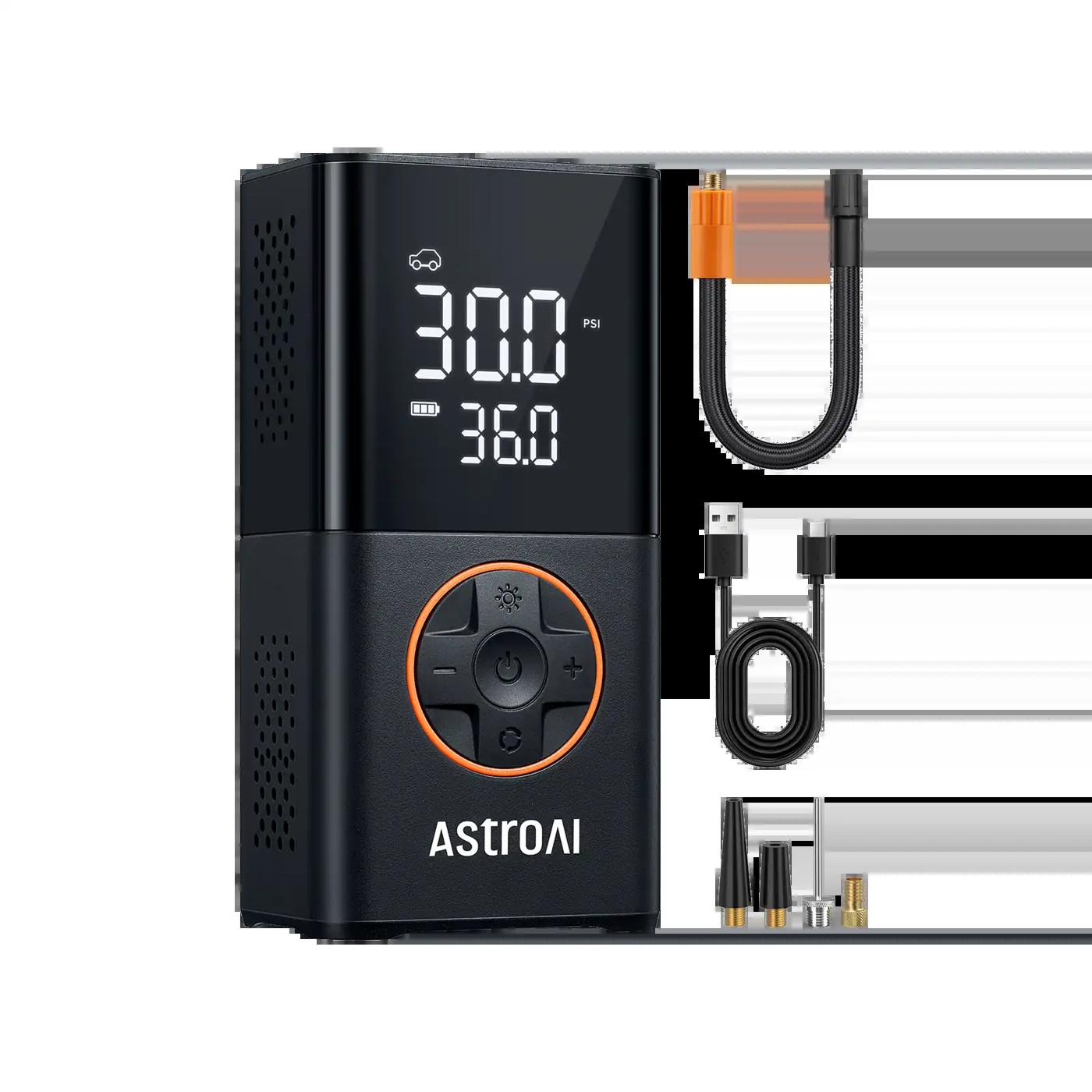
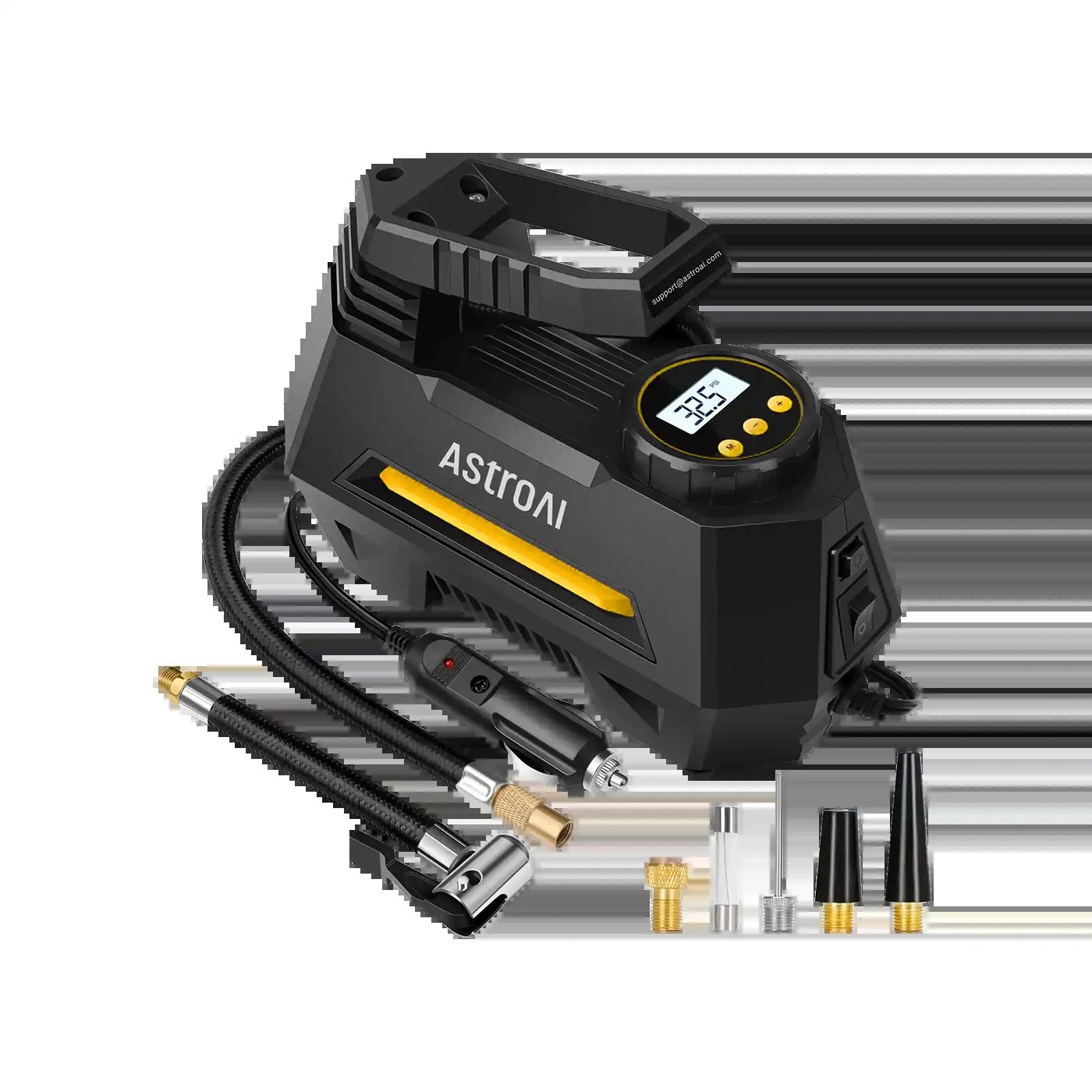
AstroAI publishes under 1.5 minutes per tire on the 4,000 mAh version — quicker than the Slime at the top-up job most people actually do
The dual-value display shows current and target pressure at once, so you are never guessing what the shut-off is aiming at
Small enough to live in a door pocket rather than take up trunk space, which is what makes a second one in the second car easy
Reasons to avoid
AstroAI states it will not inflate air mattresses — there is no high-volume mode at all
A 4,000 mAh pack is a few tires of work, not a full set from flat; this is a top-up tool
The honest use case for a compact cordless inflator is Sunday-morning maintenance: four tires each 4 to 6 PSI low, back to 35, in about five minutes. The L7 does that job well and costs less than a tank of gas.
Where it stops is the roadside disaster: from genuinely flat, a small battery and a small cylinder run down before a big tire is up. As the inflator that lives in the second car, it is the easiest recommendation here.
Not the right fit if you want one tool for tires, air beds and rafts — the Slime has the second hose.
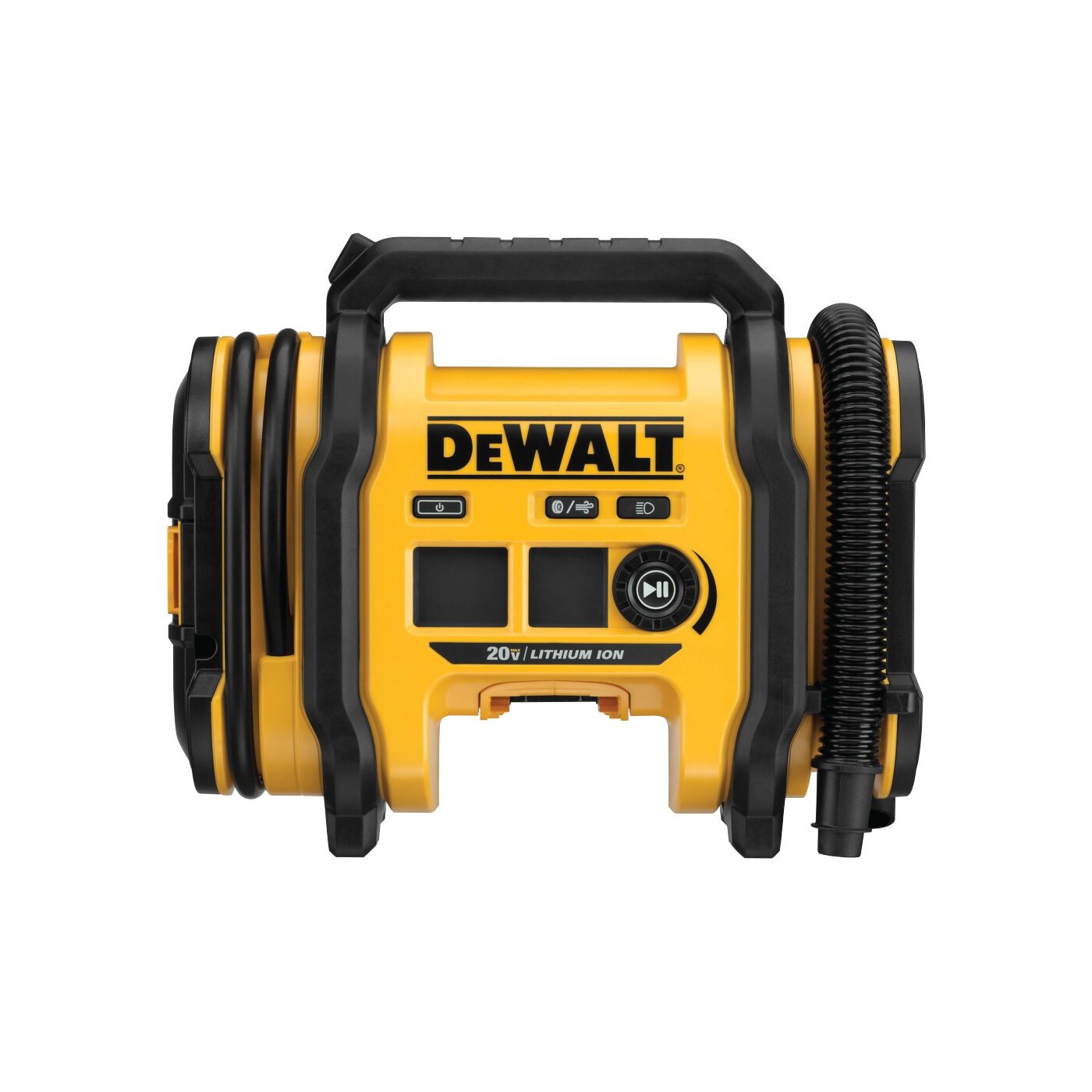
DEWALT rates it at 160 PSI, the highest published maximum here — trailer and LT pressures are not close to its ceiling
Runs three ways: 20V MAX battery, 12V DC from the car, or 110V AC in the garage, so it is never out of power in two places at once
Threaded chuck screws onto the valve stem instead of clamping, which stops the hiss-and-leak you get with cheap chucks
Separate high-volume and deflation modes for inflatables, and the needle and Presta adapter store on the tool
Reasons to avoid
DEWALT publishes no fill time or fill rate, so it cannot be compared on speed against the Milwaukee or the Slime
Bare tool: battery, charger and the AC adapter are all sold separately
6.39 lb by DEWALT's own figure, heavier than every cordless unit on this page
The three-power-source design is the real feature: mains in the garage, the 12V socket on a roadside, and the same battery as your drill away from both. For a household that already owns 20V MAX tools that flexibility beats a headline fill time.
What holds it back is speed on paper: DEWALT publishes the pressure rating and the weight but not how long a tire takes, which is why this is the pick for existing DEWALT owners rather than the overall winner.
Not the right fit if you have no 20V MAX batteries — the Slime or the AstroAI dual-power unit costs far less all-in.
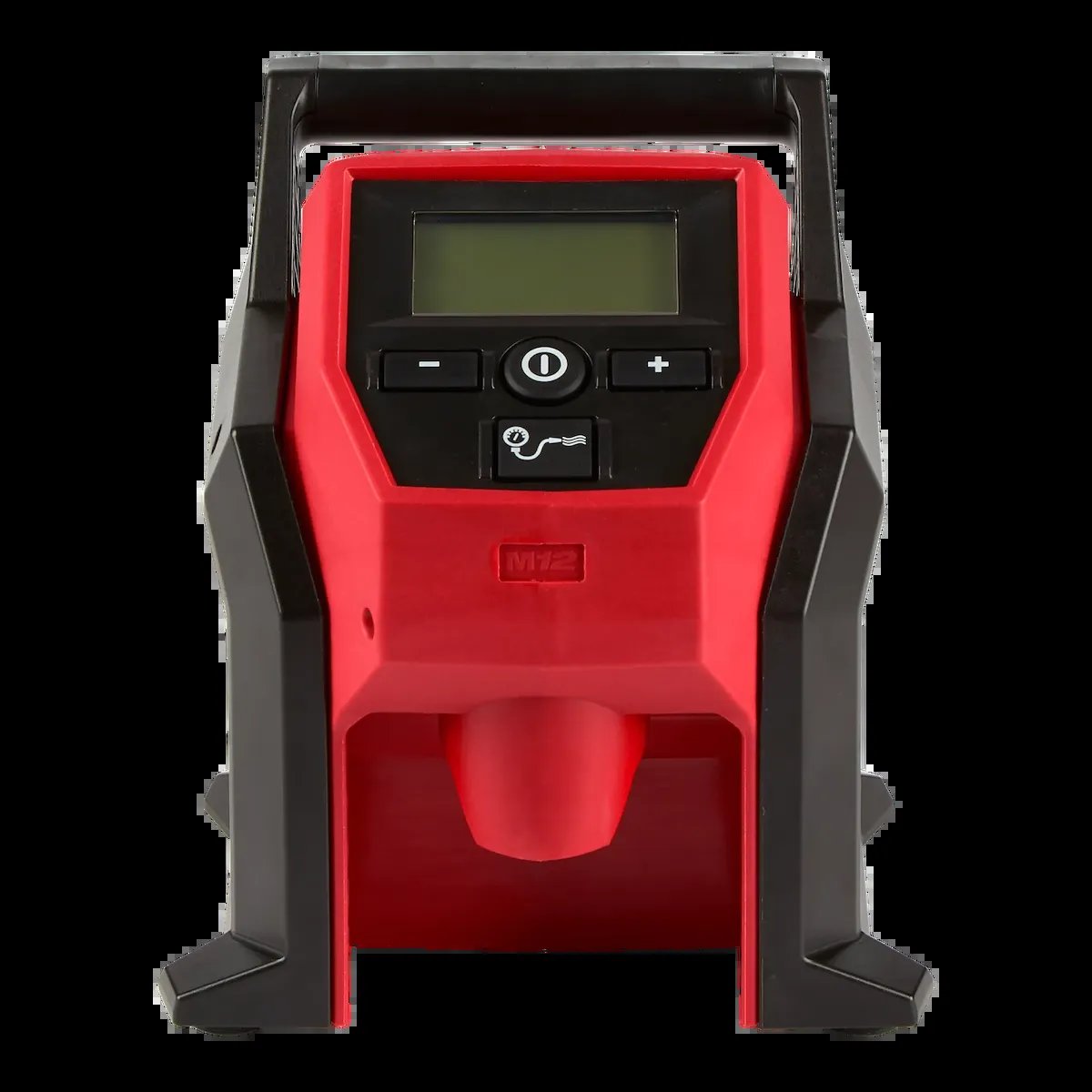
Milwaukee publishes the numbers others hide: over 120 PSI, a car tire topped off in under a minute, a light-truck tire from 30 to 45 psi in under four
The gauge senses the speed of the fill and shuts off at the target instead of overshooting it
Illuminated display, which is the difference between usable and useless on a dark shoulder
Anti-vibration feet keep it still on a smooth surface while it runs
3-year limited warranty, with Schrader, Presta and ball adapters in the box
Reasons to avoid
Bare tool on the M12 platform — with no M12 batteries this is the most expensive way to fill a tire on this page
No high-volume mode, so air beds and rafts are out
No work light on the housing beyond the lit display, and the hose is short enough to fight a valve stem angled into an alloy wheel
On published performance this is the best inflator here, full stop. Under a minute to top off a car tire and under four minutes to take a light-truck tire from 30 to 45 psi are figures nothing else here prints, and a fill-speed-sensing shut-off beats a simple pressure cut-out.
The catch is the battery: with an M12 drill already in the garage this is easy, and without one you are buying a platform in order to fill tires.
Not the right fit if you do not own M12 tools — buy the Slime and skip the platform.
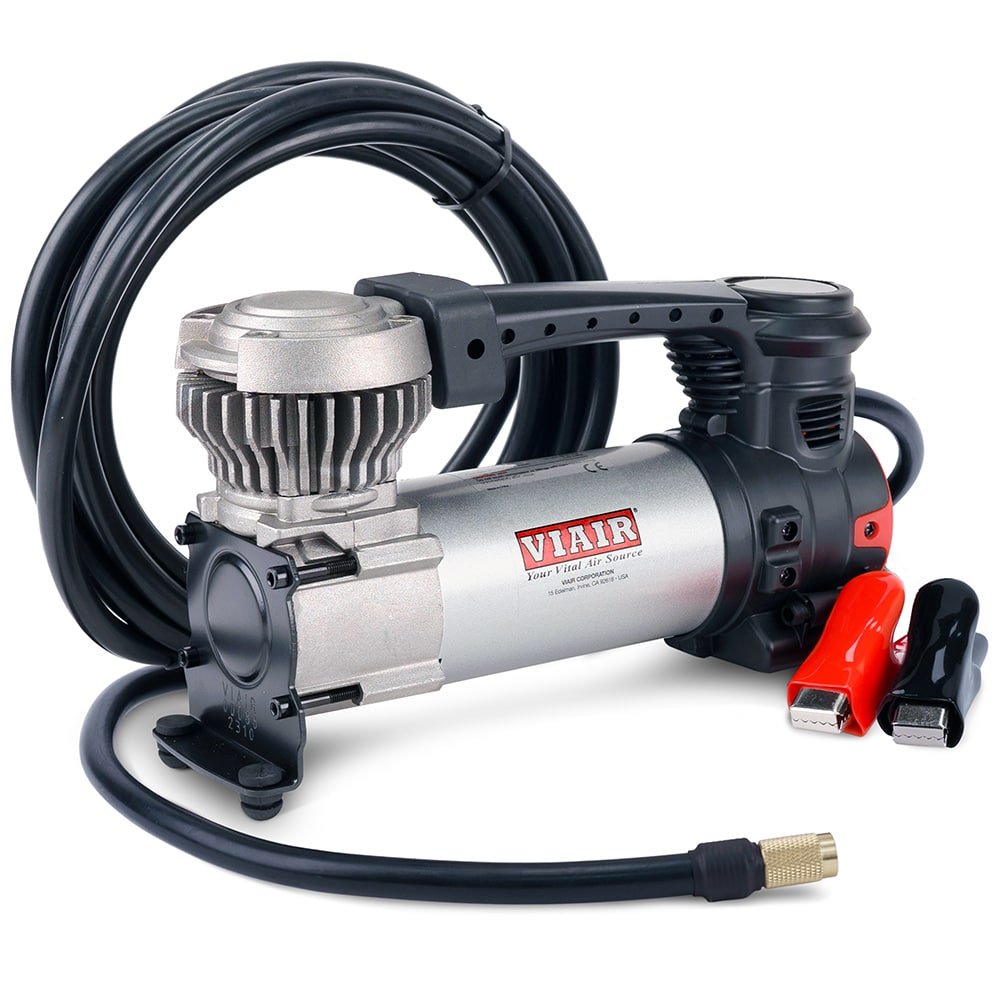
A published 25-minute duty cycle at 30 PSI — the only pick here that says how long it can run rather than how fast it starts
Rated for tires up to 33 inches, which covers most trucks and mild off-road builds
Clamps straight to the battery terminals, so it draws its 20 amps properly instead of through a 15-amp accessory socket
IP53 rated against dust and spray, with a brass twist-on chuck and an LED work light on the housing
Reasons to avoid
Battery clamps mean opening the hood every time — this is not a two-minute driveway tool
Analog gauge and no auto shut-off; you watch the needle and stop it yourself
Heavier and bulkier than every cordless unit here
The 88P is the one that will still be working in ten years: a proper 12-volt compressor with a permanent-magnet motor and a stated duty cycle, built for people who air down for sand and then put four big tires back up — the job that cooks compact inflators.
In exchange you handle it like equipment: clamps on the battery, engine running, watch the gauge, stop at pressure. Right trade at 33-inch tires, more compressor than a hatchback on pavement needs.
Not the right fit if you want to fill a tire without opening the hood — take the Slime or the AstroAI L7.
Mains or car power means there is no battery to be flat on the day you need it
Dual metal motors and a 150 PSI rating, which covers car, light truck and trailer pressures
An LED light for night use and a digital preset that shuts the pump off at your target
Reasons to avoid
Tethered either to a wall outlet or to the car's 12V socket with the engine running
AstroAI publishes no fill time, so there is no way to compare its speed with the Milwaukee or Slime figures
If the inflator lives in the garage and the job is monthly pressure checks, a corded unit is the sensible purchase: no charge cycle to remember, no cells aging in a hot trunk, and a motor that is not fighting a discharging pack halfway up the fill.
The 12V option keeps it honest as a spare-car tool, but an accessory socket is fused low, so the engine has to run. Buy this as the second inflator at home, not the one for the roadside.
Not the right fit if the tool needs to work when the car will not start — that is a cordless job.
Nothing on this page has been run against a tire by us yet. This is a specification comparison: every figure above is quoted from the manufacturer's own product page or manual, and those pages are linked in Sources at the bottom.
A candidate had to publish at least one checkable performance figure — a maximum working pressure, a per-tire fill time, or a duty cycle. That rule alone is why several of the most-advertised pocket inflators are in the rejects rather than the picks.
Published figures were compared against one job: a sedan's four tires at 28 PSI back to 35, then a compact spare from 20 to 60. Duty cycle mattered more than a headline fill speed, because four tires is four times the work of one.
Power source was matched to failure mode: a tool needing the engine running cannot help a car with a dead battery, and a tool needing a charged pack cannot help after six months in a hot trunk.
A dash in the comparison table means the manufacturer publishes no figure for that row. Nothing is filled in from a retailer's copy, and every pick with a gap names it in its reasons to avoid.
The Slime is the first inflator on this site's buying list. Once it is here we will time the four-tire job and the flat-to-full fill with a phone, check its display against a separate stick gauge, and publish those numbers next to Slime's.
The verdict
Best overall: the Slime Cordless Multi-Purpose Inflator, because it is self-contained, holds a charge for four months, does a flat tire in 6 minutes and inflates the air bed as well. It is the one that will actually be charged when you need it.
Best value: the AstroAI L7 for maintenance top-ups. Best if you already own tools: the Milwaukee M12 on M12 or the DEWALT on 20V MAX. Best for big tires: the VIAIR 88P, on its published 25-minute duty cycle.
Still not sure whether to buy cordless or 12V at all? Cordless vs 12V tire inflator runs the two power types head to head on the same four-tire job.
The number on the sticker in the driver's door jamb, not the number molded into the sidewall — that one is the tire's maximum, usually 44 to 51 PSI. Most passenger cars sit between 30 and 36 PSI cold, and every 10 degrees Fahrenheit of temperature drop takes about 1 PSI out of a tire.
How long does it take to fill a flat tire?
About 6 minutes on the Slime by its own published figure. A top-up from 28 to 35 PSI is under 1 minute on the Milwaukee 2475-20 and under 1.5 minutes on the AstroAI L7. Anything claiming 20 seconds is measuring a bicycle tire.
Cordless or 12V?
Cordless if the inflator lives in the car, because it works when the engine will not start. 12V or mains if it lives in the garage for monthly checks, because there is no battery to age. The full head-to-head is in the cordless versus 12V guide linked below.
Do these overheat?
Compact cordless units get hot doing four tires from flat, and most publish no duty cycle at all. VIAIR publishes 25 minutes at 30 PSI for the 88P, which is why it is the pick for anyone airing up truck tires regularly.
Also considered
Airmoto and similar pocket inflators — They fill one tire from flat and then need a rest and a recharge. Fine as a bicycle pump, not enough for a car at the roadside.
Socket compressors without auto shut-off — A gauge you have to watch is a tire you will over-inflate. Auto shut-off is the cheapest safety feature in this category, and every pick here has one except the VIAIR, which compensates with a real duty cycle.
Inflators with a 40 PSI ceiling — They cannot fill a compact spare, which is usually 60 PSI — the one tire you are most likely to have to inflate from flat.
Combination jump-starter and inflator units — Two tools sharing one battery, and the inflator side is usually the compromised half. Buy a jump pack and an inflator separately.
AstroAI AIRUN H — 12V-only, and AstroAI publishes no fill time for it. The dual-power AstroAI above does the same job, adds a mains option, and costs about the same.