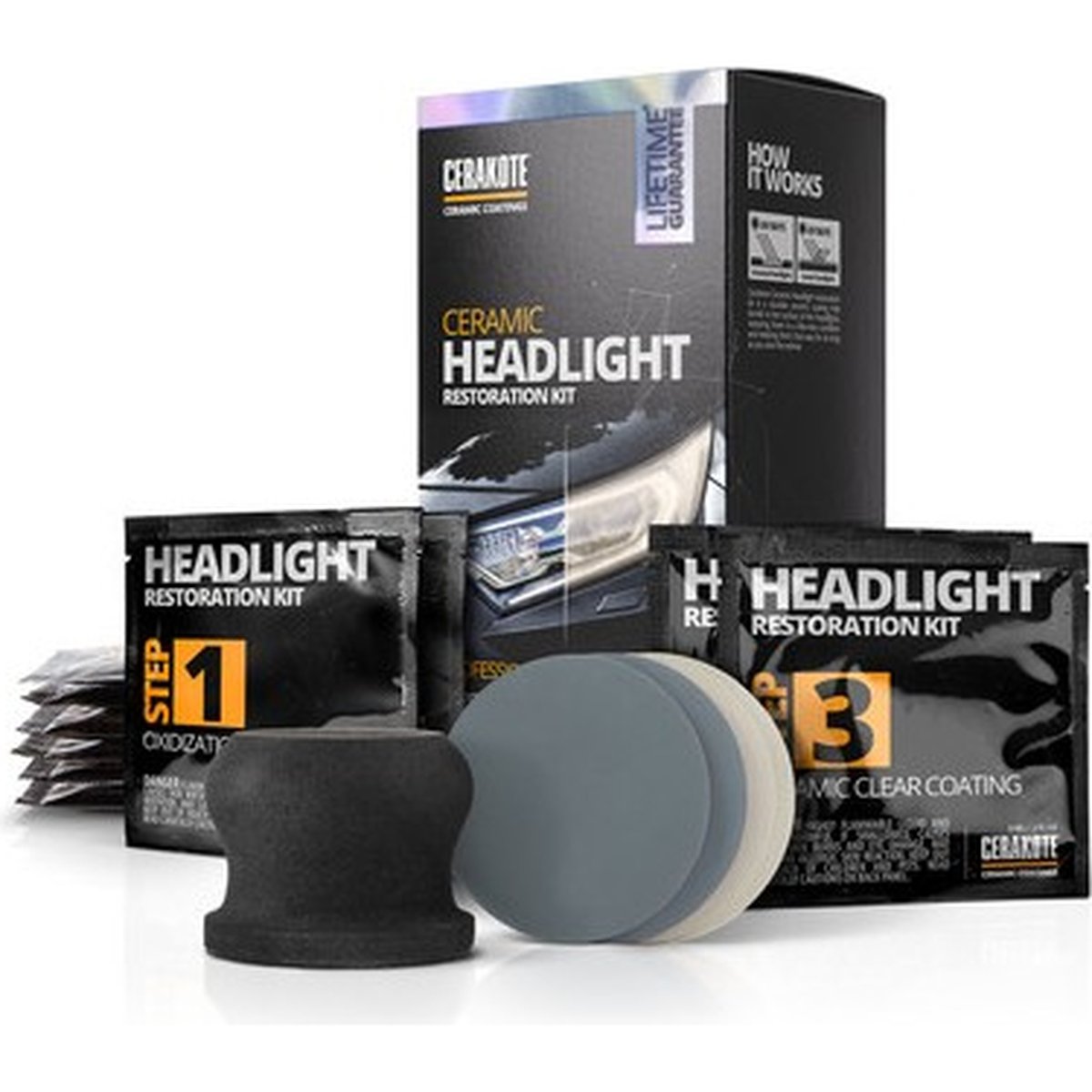
Buy the CERAKOTE Ceramic Headlight Restoration Kit ($). It is the cheapest kit here and the only one whose last step puts a ceramic clear coating back on the lens, and CERAKOTE backs it with a limited lifetime warranty for as long as you own the vehicle — three steps, about 30 minutes, no power tools.
Yellow headlights are not dirt. The factory applies a hard UV clear coat to the polycarbonate lens, sun destroys that coat from the outside in, and what you are looking at is bare, oxidized plastic. That is what decides which kits work: anything that only polishes is removing the damaged layer and leaving raw plastic in the same sun that wrecked it. It looks perfect for about four months.
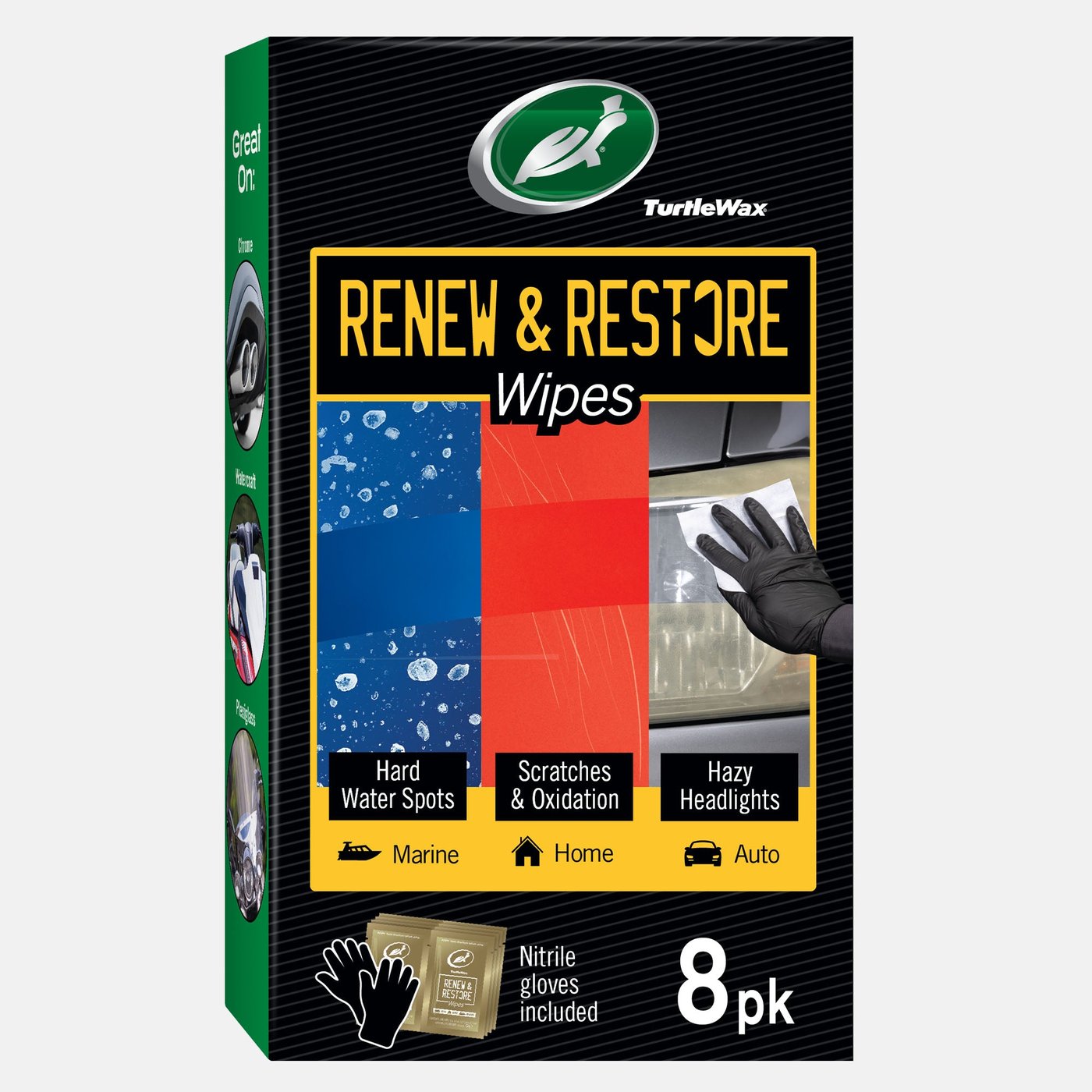
Badly clouded lenses cut faster with the Mothers NuLens kit and a drill; lightly hazy ones clear in ten minutes with the Turtle Wax Renew & Restore wipes, which leave no protection at all. One check first: wipe a lens with isopropyl alcohol. If it goes clear while wet, it is external oxidation and every kit here will work; if the fog is inside the housing, it is a failed seal and no kit will touch it.
How to shop for a headlight restoration kit
Does it put a protective coat back on?
This is the entire question. Sanding and polishing restores clarity; only a ceramic or sealant step stops the sun from re-oxidizing bare polycarbonate within a season. Three of these five have a protection step, and the two that do not say so up front.
Sanding discs, or abrasive wipes?
Heavy oxidation needs graded abrasives — CERAKOTE includes four sanding discs in two grits, Turtle Wax includes a sanding pad. Light haze does not need sanding at all, and sanding a lens that did not need it costs clear coat you cannot put back.
Tools you actually own
The NuLens kit needs a drill; CERAKOTE and both Turtle Wax kits need nothing but hands. A kit that needs a drill you do not have is not cheaper than one that does not.
Enough product for both headlights
CERAKOTE states each kit restores and protects two headlights. Kits that quietly cover one lens are the most common complaint in this category.
A published durability claim
Turtle Wax states its Lens-Coat ceramic wipes can last up to a year; CERAKOTE publishes a limited lifetime warranty. Kits with no published claim are, in practice, the ones that go yellow again first.
Refills sold separately
Mothers sells replacement sanding discs for the NuLens ball as a separate part. That turns a kit into a tool you keep rather than one you throw away after one pair of lenses.
The third step is a true ceramic coating, so the restored lens gets a UV barrier instead of being left as bare polycarbonate
CERAKOTE backs the kit with a limited lifetime warranty — their published claim is that it lasts as long as you own the vehicle
Enough product for two headlights, with a sanding pommel and four discs in two grits for moderately heavy oxidation
No power tools, which means no risk of burning through a lens with a drill at 2,000 rpm
CERAKOTE publishes a 30-minute job time, and the three steps are genuinely three steps
Reasons to avoid
By hand, severe oxidation takes real effort on the sanding stage — a drill-driven kit is faster on the worst lenses
The wipes are single-use sachets, so a third headlight means a second kit
Every kit in this category fights the same physics and most of them ignore it: strip the dead clear coat, polish the plastic, hand the car back. CERAKOTE's kit ends with a ceramic coating wipe, which is the only step that changes how long the result lasts, and the company is confident enough to publish a lifetime warranty against it.
The practical appeal is that nothing can go badly wrong: no drill to skate across the paint, no compound to fling across a bumper, half an hour on a Saturday.
Not the right fit if the lenses are severely oxidized and you own a drill — the Mothers NuLens cuts through that faster.
A liquid clarifying compound rather than wipes alone, which gives more working time on a stubborn lens
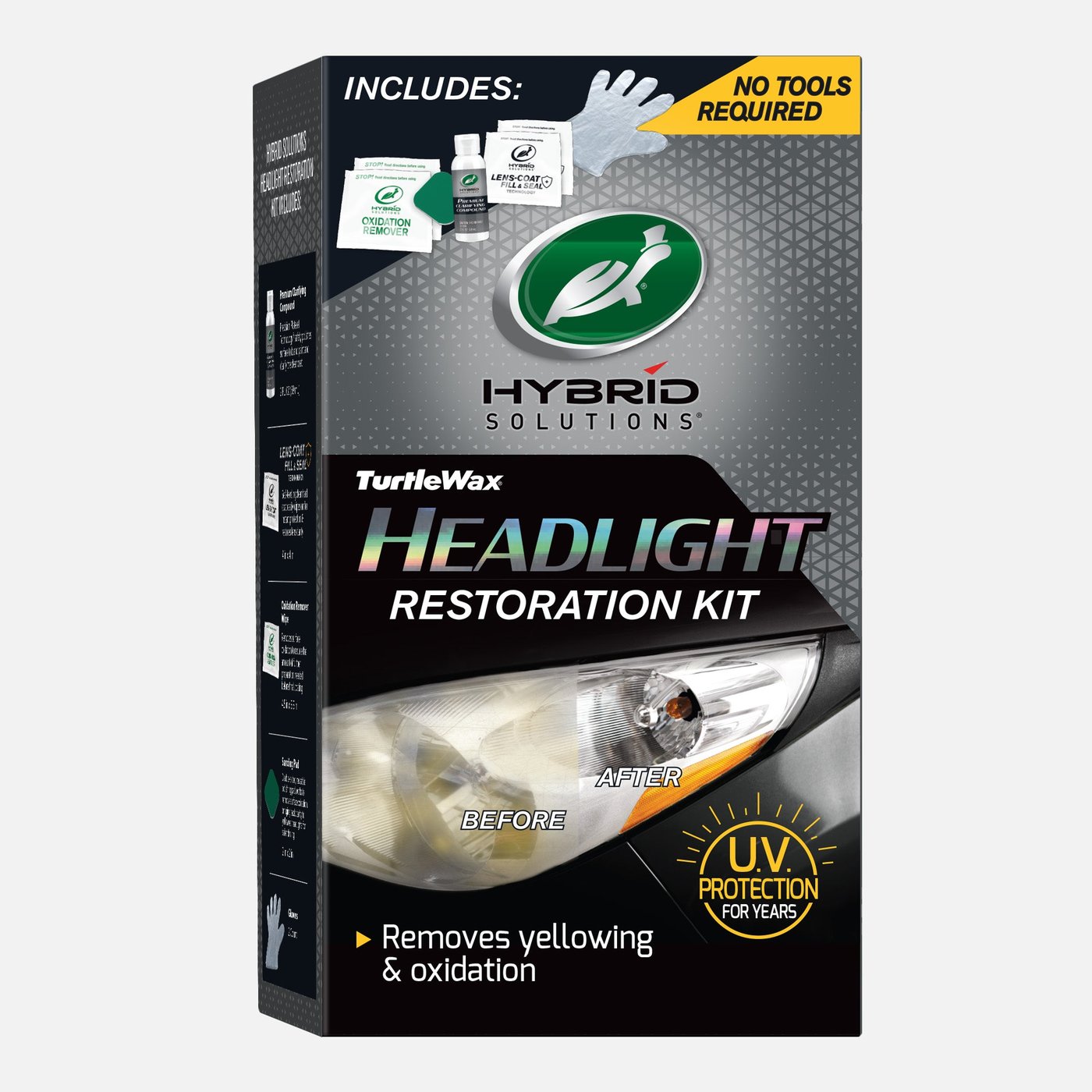
Lens-Coat Fill & Seal ceramic wipes finish the job, and Turtle Wax states the protection can last up to a year
The 2 oz compound bottle does not run out mid-lens the way a single-use sachet can
Sold in supermarkets and auto parts stores, so it is the easiest kit here to buy on a Saturday morning
Reasons to avoid
Four steps and a bottle of compound make for a messier job than a wipe-only kit
Published durability is up to a year, against CERAKOTE's lifetime warranty on a cheaper kit
This is the kit for someone who wants to work with a compound rather than a sachet. The bottle and the polishing pad let you keep working a heavily yellowed area without rationing product, and the two-wipe ceramic step means the lens does not end the job unprotected.
It is a good kit beaten on the same shelf: Turtle Wax publishes up to a year, CERAKOTE a lifetime warranty for less money. Buy this one if you prefer a liquid compound or the store stocks it.
Not the right fit if you want the least messy job possible — the CERAKOTE wipes are cleaner to work with.
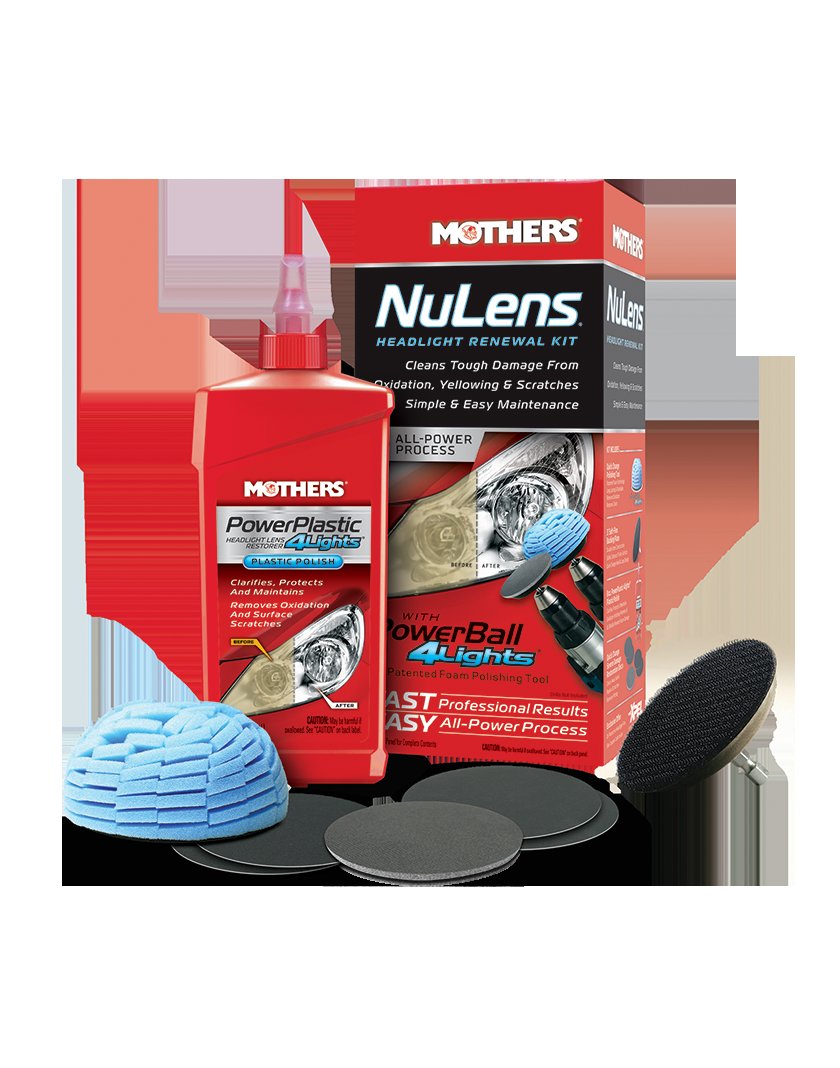
The PowerBall spins the polish at drill speed, which cuts through heavy yellowing far faster than hand pressure
Mothers describes it as a single-step process — one polish removes oxidation, stains and hairline scratches
The PowerPlastic polish leaves an oxidation-inhibiting polymer layer behind rather than bare plastic
Replacement sanding discs are sold separately by Mothers, so the ball keeps working on the next car
The same ball and polish work on tail lights, gauge covers and plastic windows, not just headlights
Reasons to avoid
Needs a drill, and a drill on a lens needs a light touch: too much speed or pressure melts polycarbonate
Mothers publishes no durability figure for the polymer layer, and a polish is not a ceramic coat
When a lens is genuinely opaque, abrasives do the work and speed is what you want. The NuLens ball puts polish where your hand cannot generate that much friction, and on a truly neglected lens it reaches clear plastic in a fraction of the time of a hand kit.
Where it falls short is the last five percent: a polymer polish is not a ceramic coating and Mothers publishes no figure for how long it holds, so the sensible plan is to cut with the NuLens and finish with a ceramic wipe from one of the kits above.
Not the right fit if you do not own a drill, or you are nervous with one near paint — take the CERAKOTE hand kit.
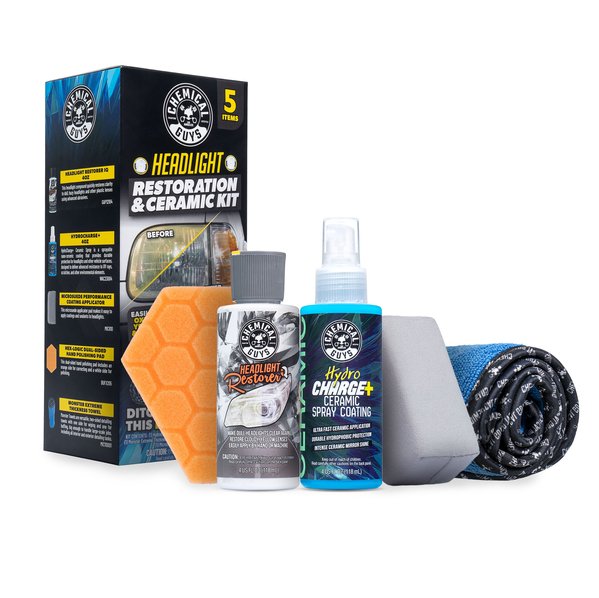
Pairs a restoration step with an actual ceramic coating rather than a wax or a sealant spray
Chemical Guys sells every component separately, so a top-up coat does not mean a whole new kit
Hand application with an included applicator — no drill, no machine polisher
Reasons to avoid
No published durability claim or warranty on the coating, which is the number that matters in this category
Costs more than the CERAKOTE kit and documents less about how long the result lasts
A competent restore-and-protect kit from a brand whose chemistry is generally good, and the ceramic step puts it in the right half of this category. If you already buy Chemical Guys products, the applicator and the process will feel familiar.
It is hard to rank above CERAKOTE, and the reason is documentation rather than chemistry: one publishes a lifetime warranty and a 30-minute process, the other publishes neither.
Not the right fit if you want the strongest published durability promise — that is the CERAKOTE kit.
Eight single-use wipes with precision abrasives — enough for four lenses, or a mix of lenses, glass and trim
Turtle Wax rates them for oxidation, paint transfer, water spots, bugs and light scratches, so the pack does not sit unused
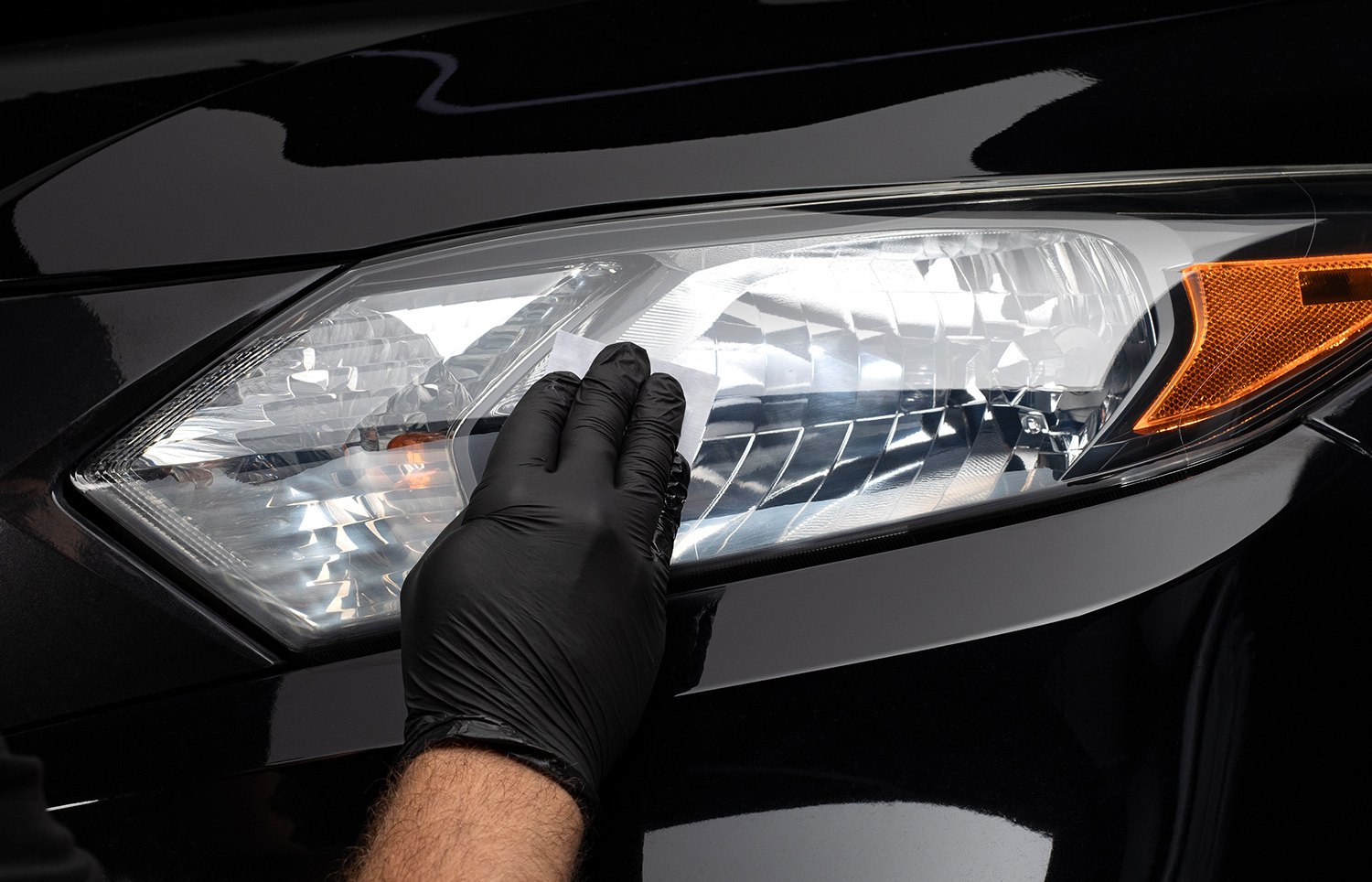
No mixing, no drill, no masking tape: light haze is gone in about ten minutes
Reasons to avoid
There is no protective step at all — a stripped lens with no coating re-yellows in the sun
Abrasive wipes will not touch heavy oxidation; that needs graded sanding discs
Bought for what it is, this is the most useful pack on the page. Light haze on a three-year-old car, water spots on the windshield, a scuff of paint transfer on a bumper — one wipe each, ten minutes total, nothing to store afterwards.
Bought as a restoration kit, it is a trap: removing oxidation without replacing the UV layer means the lens starts degrading again immediately.
Not the right fit if the lenses are properly yellow — you need the sanding and ceramic steps in the CERAKOTE kit.
No lens has been restored for this page yet. Kits were sorted first by whether they replace the UV layer they remove — a restoration kit without a protection step is a cosmetic product, and each entry here says so rather than burying it.
Kit contents come from each manufacturer's own published list — CERAKOTE's 8 oxidation wipes, sanding pommel, 4 discs in 2 grits and 2 ceramic wipes, for example — and every source page is linked at the bottom.
Durability claims are quoted only where the brand publishes one. CERAKOTE publishes a limited lifetime warranty; Turtle Wax publishes up to a year for its Lens-Coat wipes; Mothers and Chemical Guys publish nothing, and their spec blocks say so.
Tools were counted as part of the cost, so a kit that requires a drill is compared against hand kits on that basis rather than on box price. Repairability was checked the same way: whether the discs, polish or coating can be re-bought separately.
The CERAKOTE kit is on this site's buying list. Once it is here we will photograph one lens before and after, time the three steps, and publish the result against CERAKOTE's own 30-minute claim.
The verdict
Best overall: the CERAKOTE Ceramic Headlight Restoration Kit. It is the cheapest kit here, it includes sanding discs for real oxidation, and it is the only one whose final step carries a limited lifetime warranty. Thirty minutes, no power tools, two headlights.
Best for the worst lenses: Mothers NuLens with a drill, finished with a ceramic wipe. Best ten-minute fix before an inspection: Turtle Wax Renew & Restore wipes, knowing they leave no protection behind.
Do the restoration on a washed car — grit on a dry lens gets dragged into the plastic by the first wipe. How to wash a car without swirl marks covers the step before this one.
CERAKOTE publishes 30 minutes for both headlights across its three steps. A drill kit cuts that to roughly 15 minutes of working time on moderate oxidation; a wipe-only product is about 10 minutes and does nothing to protect the lens afterwards.
How long will the result last?
It depends entirely on the last step. CERAKOTE backs its ceramic coating with a limited lifetime warranty, Turtle Wax states up to a year for its Lens-Coat wipes, and a polish-only restoration typically starts hazing again within a season of full sun because the lens is bare polycarbonate.
Do I have to sand my headlights?
Only if the oxidation is heavy. Wipe the lens with isopropyl alcohol first: if it clears while wet, abrasive wipes are enough. If it stays cloudy you need graded sanding — CERAKOTE includes four discs in two grits, and the Mothers kit sands with a drill.
Will restoration fix fogging inside the housing?
No. Internal condensation is a failed seal or a missing vent plug, and nothing applied to the outside of the lens will clear it. That is a housing repair or a replacement.
Also considered
3M Headlight Lens Restoration System — A capable drill-driven system, but 3M publishes no durability claim for what it leaves on the lens, and in this category that claim is the whole comparison.
SYLVANIA Headlight Restoration Kit — Three steps ending in a UV block, and no published figure for how long that block survives. The kits above either publish a number or admit there is none.
Headlight restoration sprays sold alone — A clear coat sprayed over oxidation seals the yellow in. Without the abrasive step first, you are laminating the problem.
Toothpaste, baking soda and other kitchen methods — Mild abrasives with no UV protection step. They work for a couple of weeks and remove lens material every time you repeat them.