As an Amazon Associate I earn from qualifying purchases. Links marked "at Amazon" are paid links.
Overhead rack vs ceiling hoist for garage storage (2026)
By Chris Y. · Founder & editor · reads the installation manual before the product page
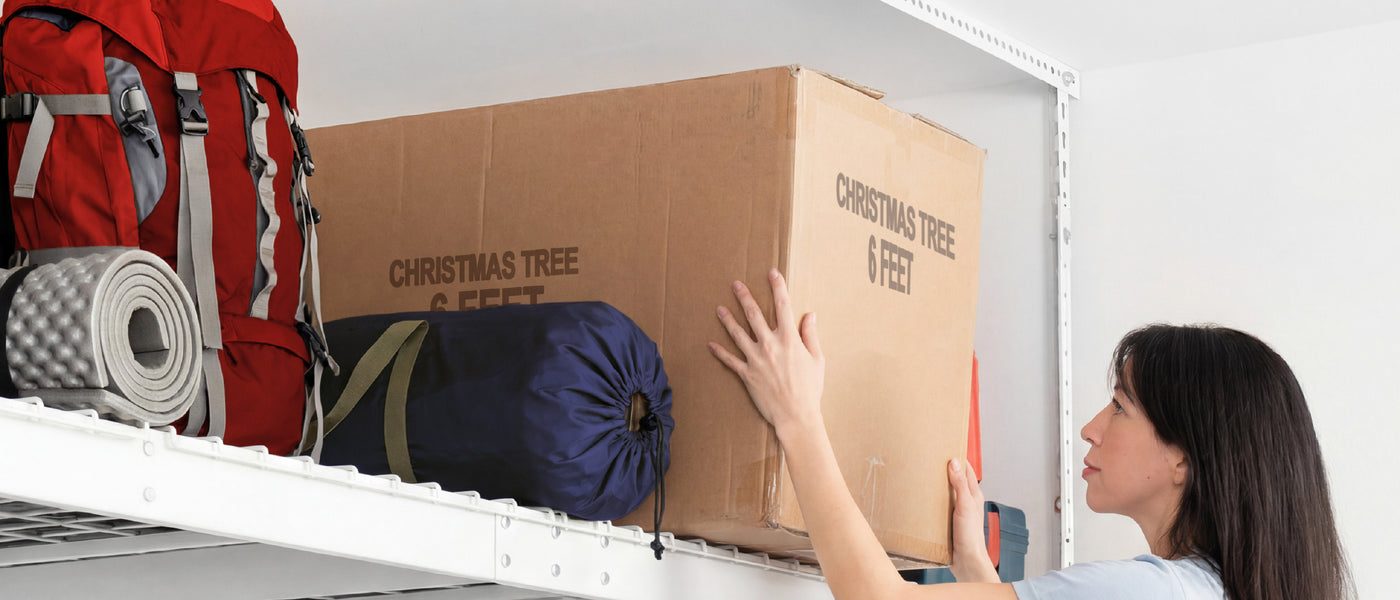
Image: SafeRacks
The short answer: a rack for many heavy things you rarely touch, a hoist for one awkward thing you take down often. A 4 × 8 rack publishes 600 to 1,000 pounds and needs a ladder every time. A hoist publishes 50 to 100 pounds and lowers itself to chest height in a minute.
The two products solve different halves of the same problem. The rack is a shelf you cannot reach — winter tires, holiday bins, the camping boxes. The hoist is a lift for a single object with an awkward shape — a kayak, a cargo box, a bike, a ladder.
The number that decides it is not capacity, it is how many times a year you touch the thing. Anything you need monthly and cannot reach without a ladder ends up back on the floor by spring, which is how garages refill themselves. Measure the ceiling first — how to plan a garage wall covers the three heights that matter.
How to shop for garage ceiling storage
Published capacity, per unit
Racks and hoists are an order of magnitude apart: 750 pounds for the FLEXIMOUNTS Classic 4 × 8, 350 for its crank-down rack, 145 for the Harken Hoister, 70 for the StoreYourBoard bike hoist.
How much ceiling it uses
A rack at its shallowest setting takes 17 to 24 inches of headroom permanently. A hoist parks its load tight to the joists and takes back the space when the load comes down.
Ladder or rope
A fixed rack means a ladder every time. A hoist at a 4-to-1 advantage turns a 60-pound lift into a 15-pound pull. That is the whole ergonomic argument.
What your joists allow
Both bolt into wood joists. Racks spread load across six posts and two or more joists; a hoist concentrates it on two mounting points, which is why hoist capacities are small.
What happens if it fails
A rack fails over whatever you park under it. A hoist fails onto the floor with a rope still attached. Neither is acceptable, but they fail differently, and racks carry ten times the mass.
Buy the rack for bulk you rarely touch
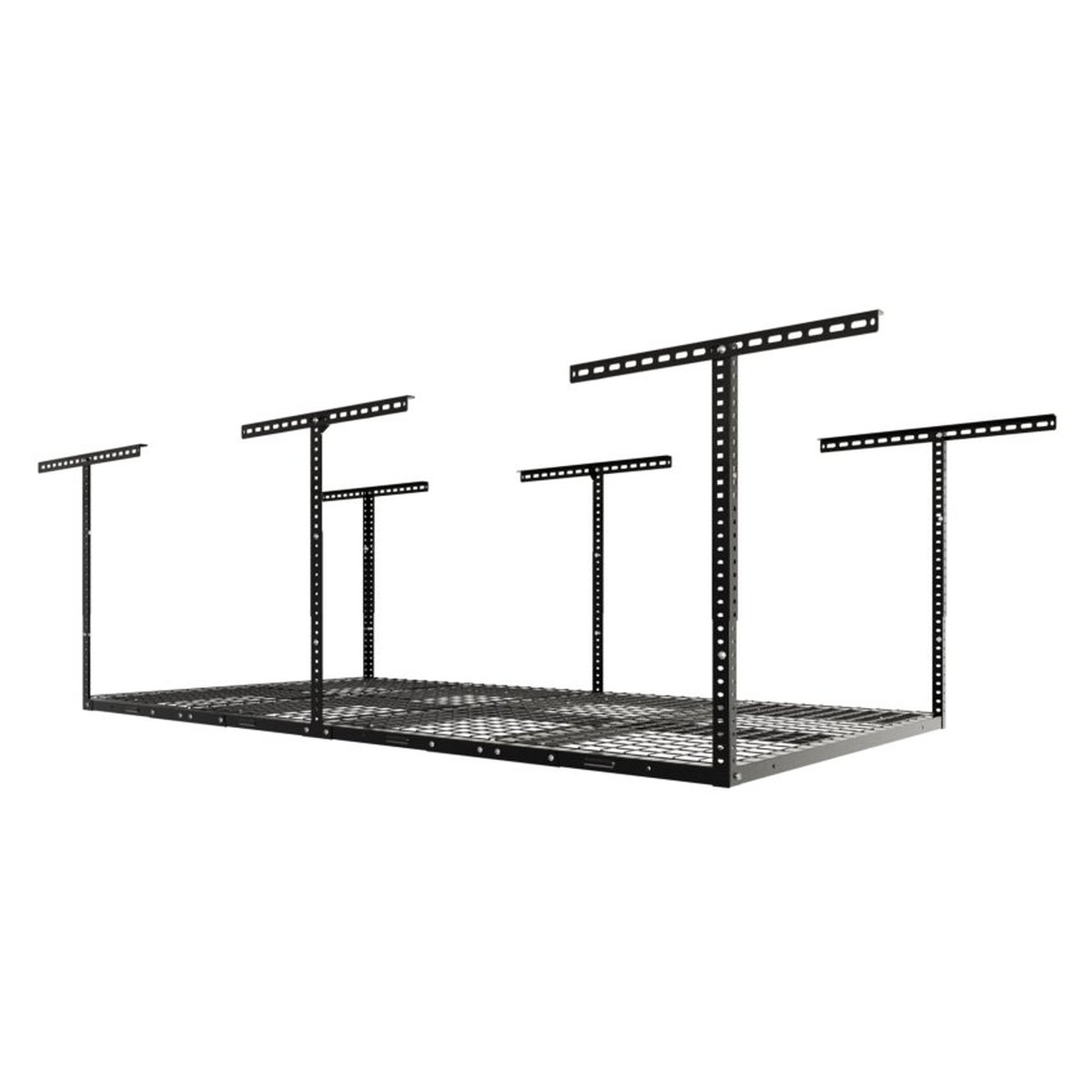
Image: FLEXIMOUNTS
FLEXIMOUNTS Classic 4 × 8 Overhead Rack
750 lb rated, 1,200 lb tested, ladder required
Model
GR48
Capacity
750 lb rated, 1,200 lb tested
Deck
4 × 8 wire, included
Ceiling drop
22–40 in
Joists
≤24 in OC (48 in OK)
Access
Ladder
Reasons to buy
750 published pounds against a hoist's 70 — ten times the storage on one mounting job
A 32-square-foot deck holds about twenty 27-gallon totes, which is a garage's entire seasonal overflow
FLEXIMOUNTS publishes a 1,200-pound tested figure beside the rating, the only tested number in either category
The load spreads across six posts and multiple joists rather than two points
Reasons to avoid
Everything on it needs a ladder, so anything used monthly will migrate back to the floor
A 22-inch minimum drop costs real headroom in an eight-foot garage
Racks win on volume and lose on access, and that trade decides almost every garage. Put the things up here that come down twice a year — holiday decorations, camping gear, the spare set of wheels — and the floor stays clear for good.
Not the right fit if the thing you are storing is one heavy awkward object you use monthly — that is the hoist.
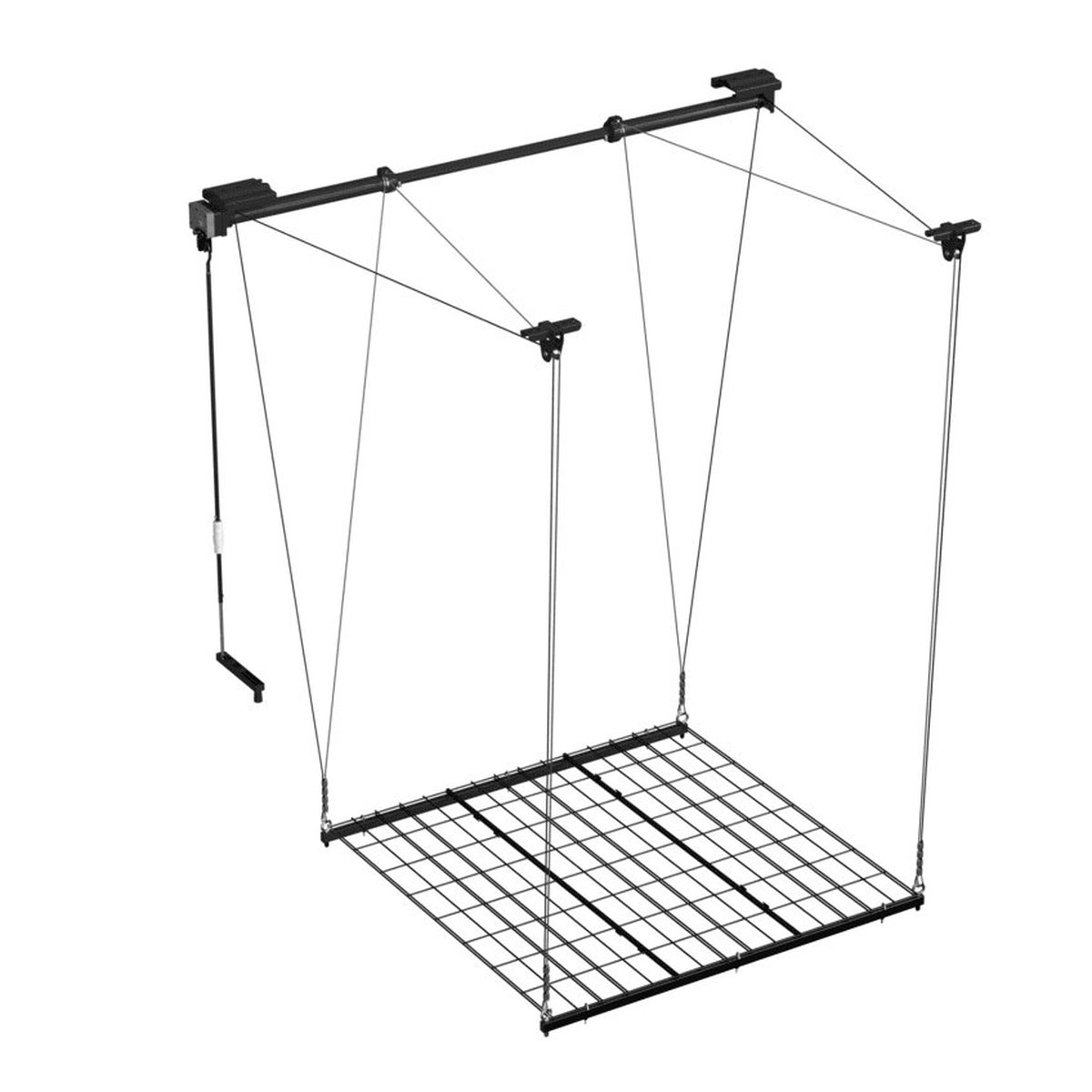
A deck with 350 published pounds that comes down to chest height on a crank — five times a hoist's capacity with a hoist's access
Parks about 10 inches below the ceiling, higher than any fixed rack here
Publishes 12, 16 and 24-inch joist compatibility, the most specific joist statement in this comparison, and the crank takes a drill so lowering a full deck takes under a minute
Reasons to avoid
350 pounds on a 4 × 4 deck, less than half the fixed 4 × 8 rack, because the lifting mechanism sits in the load path
The most expensive way here to store the least weight
This is the honest middle of the argument. If the reason you are reading this page is that you want rack capacity without the ladder, this is the product that exists to answer it — at half the deck and a higher price.
Not the right fit if you only ever lift one bike or one kayak — a rope hoist costs a fraction of this.
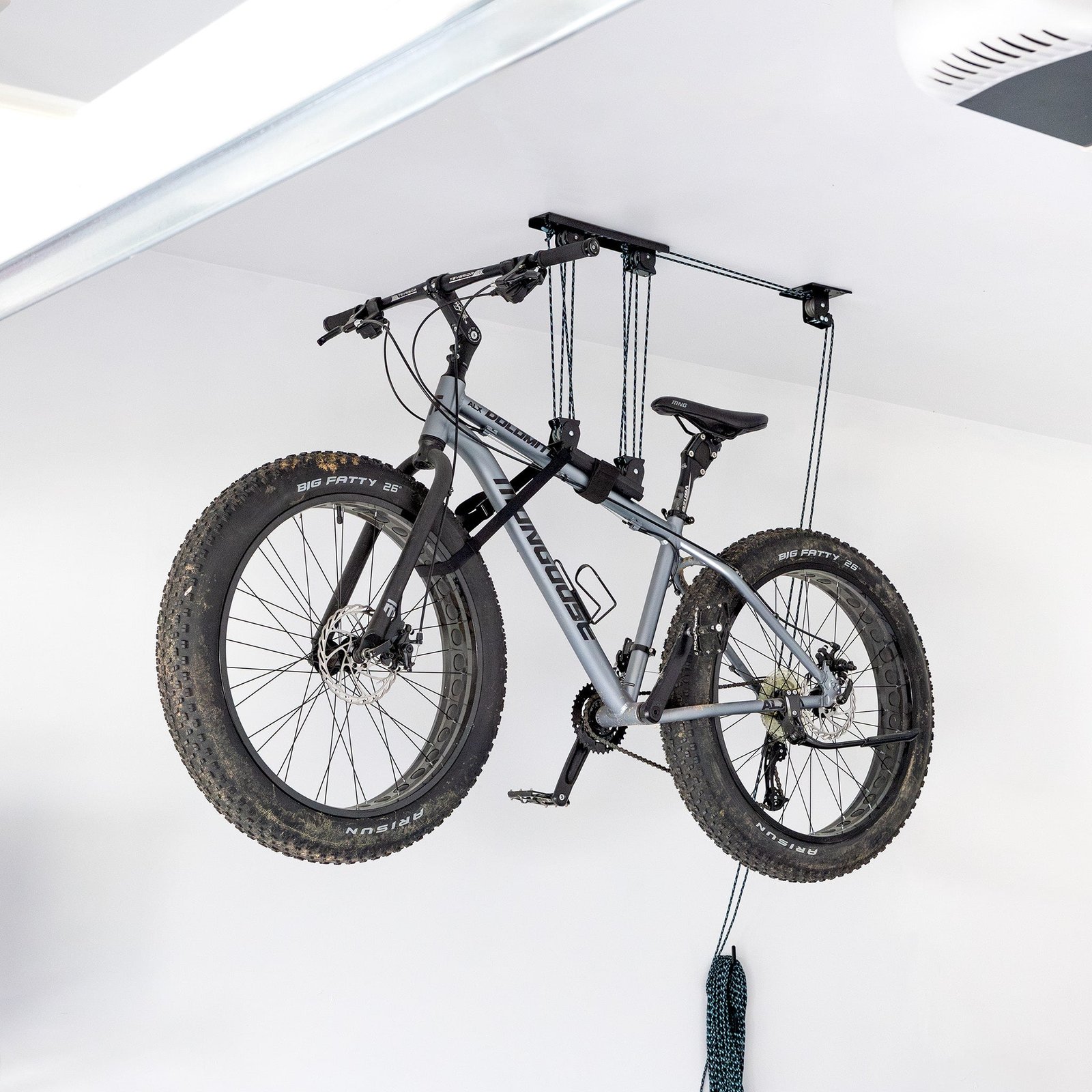
A 4-to-1 mechanical advantage turns a 60-pound e-bike into a 15-pound pull
Rated for ceilings up to 14 feet, which no rack in this comparison can use
Mounts with joists running either direction, so joist orientation stops being a reason to give up
Cheapest published route to the ceiling by a wide margin
Reasons to avoid
70 pounds total, and the load hangs from two points rather than six
Only suits objects with two solid lifting points — a bike, a kayak, a ladder, a cargo box; a stack of bins is not one of them
Rope and pulley wear is on you to inspect, because nothing in the kit tells you when the line has had enough
For a kayak, a rooftop cargo box or a ladder, the hoist is not the compromise choice, it is the right one. Those objects do not stack, do not sit flat and are exactly the shape a rope and two hooks handle well.
Not the right fit if you are storing bins and boxes — the 4 × 8 rack is the shelf they need.
A 145-pound maximum working load, double the typical bike hoist, published as a working load rather than an ultimate figure
Four lifting points rather than two, and Harken states the design lifts and lowers evenly regardless of how the weight sits
A self-locking safety cleat that grips instantly if the rope is dropped, with stainless hardware and double-braided line, from a company whose day job is sailboat rigging
Reasons to avoid
A published minimum working load of 45 pounds, so it is the wrong hoist for a child's bike or anything light
Harken sells through its own site and marine dealers: there is no retail buy box for this hoist, so the button below goes to Harken
This is the hoist to buy when the object is a rooftop tent, a Jeep hardtop, a canoe or a cargo box — things that are heavy, long and would ruin the car underneath. Four lifting points keep an uneven load level, which two-point kits cannot.
Not the right fit if you are lifting one bike — the StoreYourBoard hoist costs a fraction of this.
Capacities, drops, ceiling limits and joist requirements come from FLEXIMOUNTS, StoreYourBoard and Harken product pages and installation documents, recorded September 2026 with each maker's own qualifier.
Drop ranges were converted into remaining headroom against 8, 9 and 10-foot ceilings, which is the calculation that decides whether a rack goes over parking or over a walkway.
Every retail page linked here was opened in September 2026 and checked for a working buy box. Three of the four had one; the Harken Hoister does not, and its pick says so.
Hoist and rack capacities were left in their own units rather than averaged. They describe different mounting patterns — two points against six — and the mounting pattern is the reason for the gap.
The verdict
Buy the rack — the FLEXIMOUNTS Classic 4 × 8 — when the problem is volume you rarely touch. It is ten times the capacity of any hoist and the ladder stops mattering when the trips are seasonal.
Buy the hoist when the problem is one awkward object, and buy the crank-down rack when you genuinely want both and will pay for it. At 8 feet of ceiling neither full-size rack fits over parking — put a shallow bracket rack over the walkway instead, or hoist tight to the joists, as the overhead rack guide sets out.
Check price at AmazonBuy the rack for bulk you rarely touch: FLEXIMOUNTS Classic 4 × 8 Overhead Rack
Questions people ask
Is an overhead rack or a ceiling hoist better for a garage?
A rack for bulk you touch twice a year, a hoist for one awkward object you take down monthly. The published capacities say it plainly — 750 pounds for a 4 × 8 rack against 70 for a bike hoist.
How much weight can a garage ceiling hoist hold?
Typically 50 to 100 pounds. The StoreYourBoard hoist here publishes 70 pounds with a 4-to-1 pulley; hoists in this class hang from two mounting points, which is why they are rated an order of magnitude below racks.
Can I put a ceiling hoist on roof trusses?
Ask a professional first. The code's attic live load for limited storage is 10 pounds per square foot and it is non-concurrent; engineered trusses are designed for the roof, not for a point load you add later.
What ceiling height do I need for an overhead rack?
Nine feet to park under one comfortably. A 22 to 24-inch minimum drop leaves about 72 to 74 inches of clearance under an 8-foot ceiling, which is less than the roof height of most full-size pickups.
Do hoists work for storage bins?
Badly. A hoist needs two solid lifting points and a load that hangs level — a kayak, a ladder, a cargo box or a bike. A stack of bins has neither, and that is the job a rack deck does.