As an Amazon Associate I earn from qualifying purchases. Links marked "at Amazon" are paid links.
The 6 best overhead garage storage racks (2026)
By Chris Y. · Founder & editor · reads the installation manual before the product page
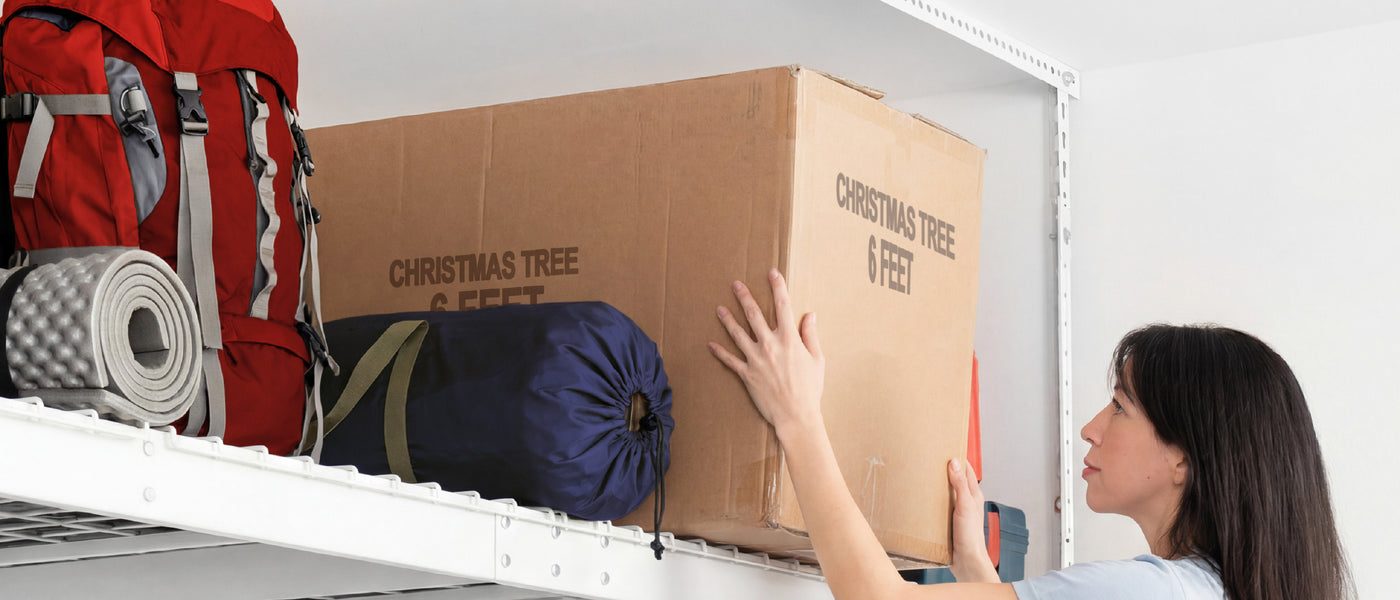
Image: SafeRacks
Buy the FLEXIMOUNTS Classic 4 × 8. It is rated at 750 pounds, FLEXIMOUNTS publishes a 1,200-pound test figure beside that rating, and it is the only rack here that tells you in writing what to do when your joists sit more than 24 inches apart.
The ceiling is the only square footage nobody is using, and the only place a bad purchase can land on a car. Across nine racks the published capacities vary by a factor of six — 150 to 1,000 pounds — and three brands publish a joist-spacing requirement. The rest leave you to find out on the ladder.
Measure first: ceiling height, the lowest point of the opener rail, and the roof of whatever you park. Those three numbers decide this purchase more than any capacity figure — and if the answer is eight feet, skip to the HyLoft. Full walkthrough in how to plan a garage wall.
How to shop for an overhead garage rack
The capacity number, and its qualifier
"1,000 lbs evenly distributed" (Gladiator) and "250lb combined" (MonsterRAX, deck not included) are not the same claim. Every figure below keeps the manufacturer's wording.
Ceiling drop range
A rack dropping 22 to 40 inches takes up to 3 ft 4 in of headroom. In an 8-foot garage that leaves 56 inches under the deck — a rack you duck under, not park under.
What it says about your joists
FLEXIMOUNTS publishes a rule for joists over 24 inches apart; SafeRacks and NewAge state wood joists only, no steel or concrete. Brands that publish nothing here generate the returns.
Is a deck included
MonsterRAX ships a frame and tells you to supply 3/8-inch plywood; Gladiator builds the decking in. That changes the price band and the capacity.
Hardware you can count
Two of nine brands publish a parts list; HyLoft itemises 8 lag screws and 20 hex bolts. The rest describe fasteners in adjectives.
A warranty with a number on it
Gladiator publishes 10 years; SafeRacks, MonsterRAX, HyLoft and StoreYourBoard lifetime limited terms; FLEXIMOUNTS none at all.
Best overall
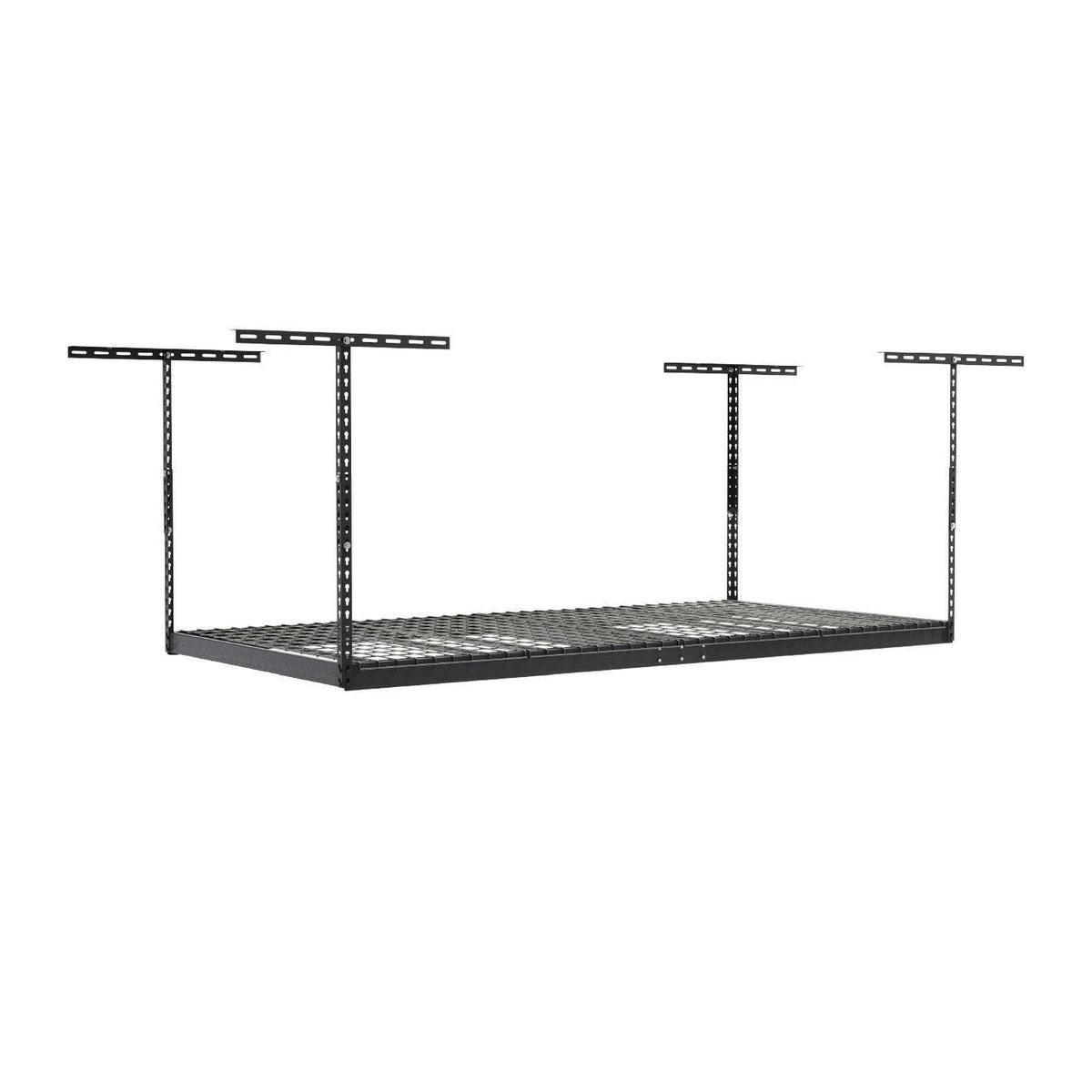
Image: FLEXIMOUNTS
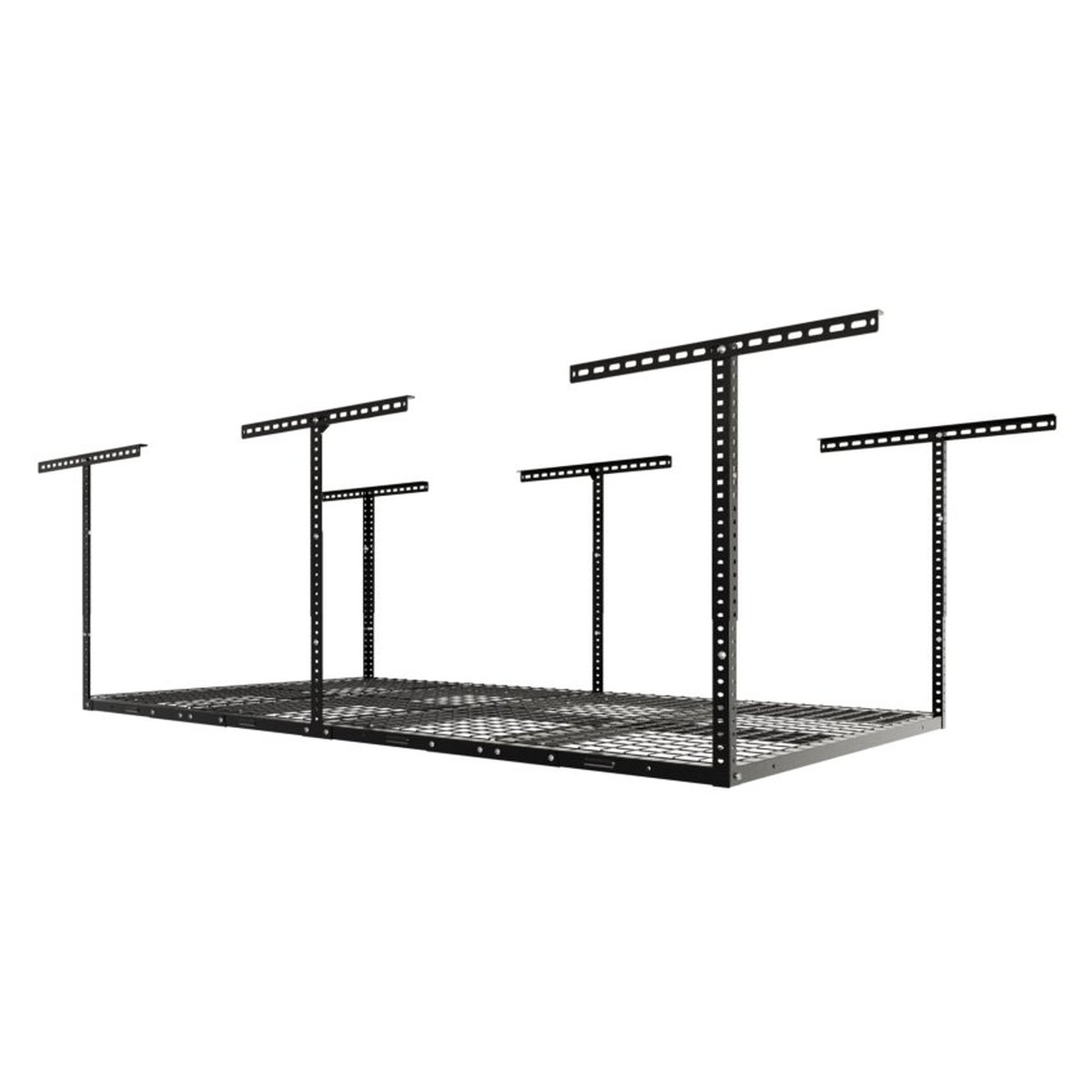
FLEXIMOUNTS Classic 4 × 8 Overhead Rack
750 lb rated, 1,200 lb tested, 22 in minimum drop
Model
GR48
Deck
4 × 8 wire, included
Capacity
750 lb rated, 1,200 lb tested
Ceiling drop
22–40 in
Joists
≤24 in OC (48 in OK)
Warranty
Not published
Reasons to buy
The only tested overload figure here — 1,200 pounds against a 750-pound rating, a 1.6× margin
The only brand publishing what to do when the joists are wrong: any spacing at or under 24 inches, plus 48
Long brackets that each catch two joists, plus six posts, so no single fastener group carries the deck
105 cubic feet at full drop, about twenty 27-gallon totes
Reasons to avoid
The shallowest setting is a 22-inch drop, too much rack for an 8-foot ceiling
No published steel gauge, assembled weight or warranty term
The 1,200-pound test number is why this is the pick. Every brand here publishes a capacity; FLEXIMOUNTS is the only one that publishes the figure it was tested to and lets you see the margin, and when the thing you buy hangs over a car a stated margin beats a bigger headline. The joist sentence matters as much: most garages are framed at 16 or 24 inches on center and this covers both, and if yours is wide-framed, 48 inches is in writing rather than guessed at on a ladder.
Not the right fit if your ceiling is 8 feet — a 22-inch minimum drop leaves 6 ft 2 in of headroom. Go to the HyLoft instead.
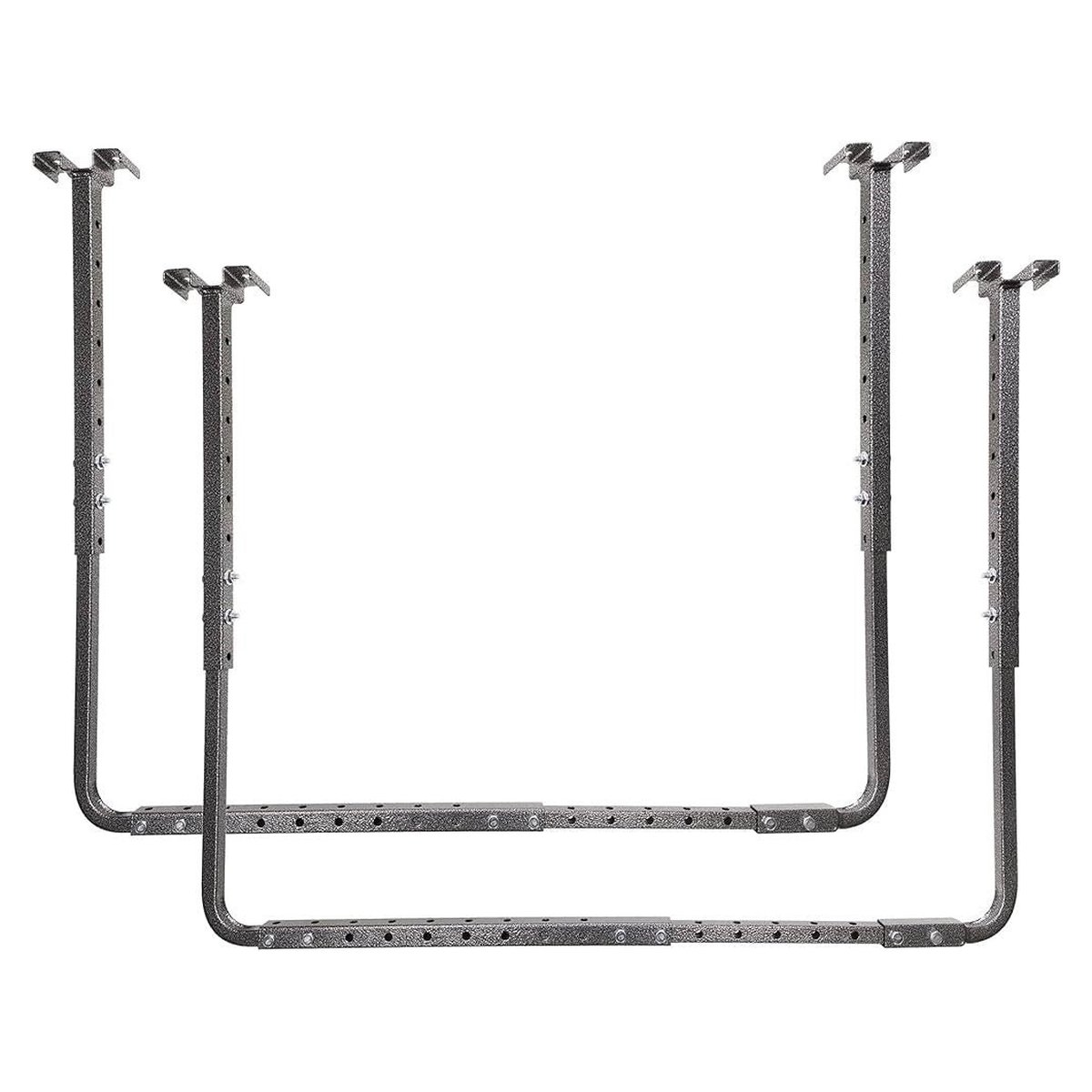
A 17-inch minimum drop, five inches shallower than anything else — the one rack here for an 8-foot garage
An itemised parts list in the installation PDF — 8 lag screws, 20 hex bolts, 20 flange nuts
Works with or without a platform: hang long items on the bars, or drop plywood across them
Units stack: a second HyLoft hangs below an existing one, which is how a low ceiling gets two levels
Reasons to avoid
200 pounds per pair is the lowest rating on this page, and the warranty is void above it
The brand publishes 200 pounds while retailers advertise 250 — the warranty is written against 200
Two HyLoft units maximum on any two ceiling beams
Almost every roundup ignores the 8-foot garage, which is strange, because that is most older houses. The HyLoft is the answer there — 17 inches of drop and a bracket pair rather than a deck, so you lose a foot and a half of headroom instead of three feet. The tradeoff is plain: 200 pounds per pair is holiday bins and camping gear, not tires and tile.
Not the right fit if you want a full 4 × 8 deck — this is a bracket pair at 34 × 26 in, so take the SafeRacks 4 × 8.
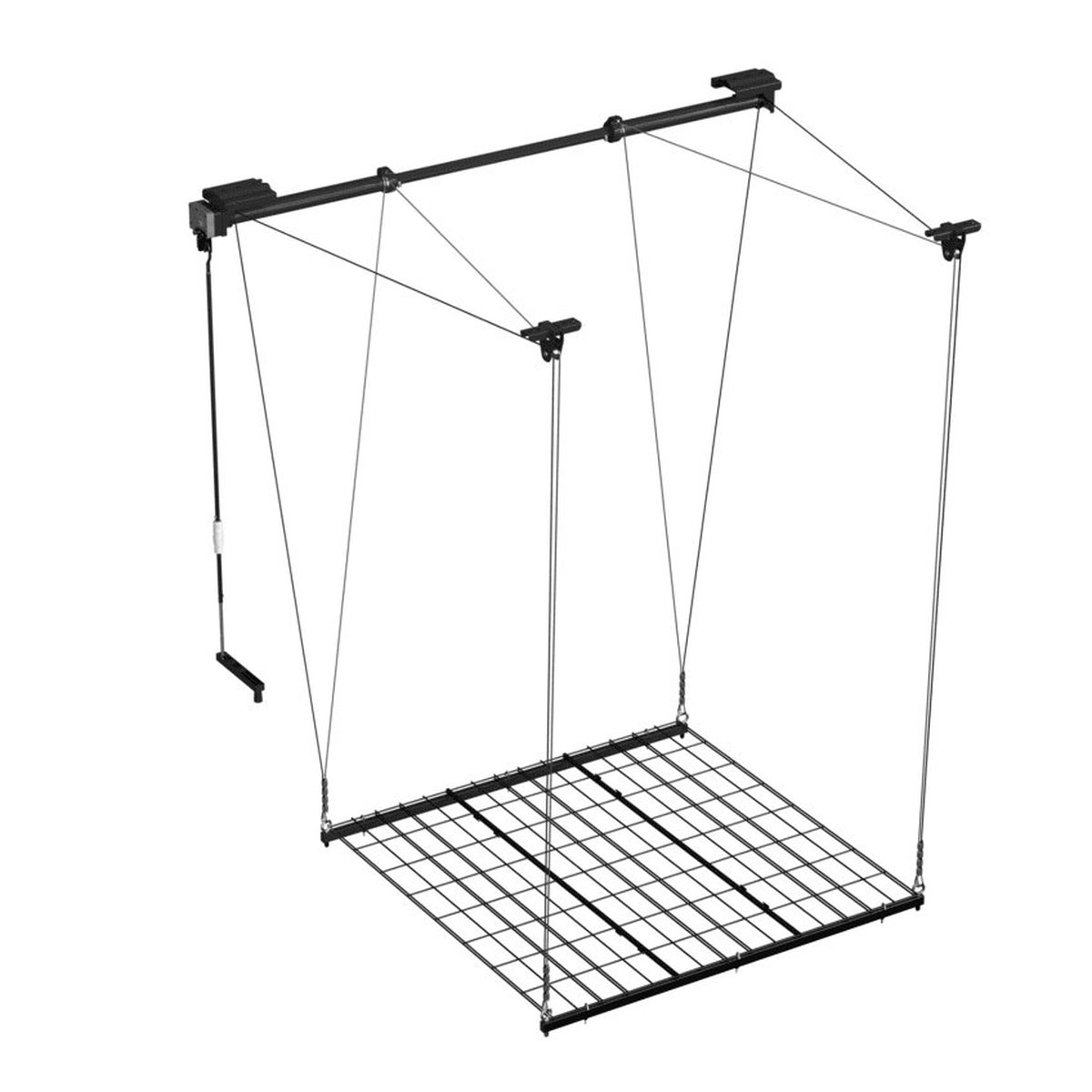
The deck winches down with the included crank or a drill, so loading is a two-minute job
Parks about 10 inches below the ceiling, higher than any fixed rack here
Publishes 12, 16 and 24-inch joist compatibility — the most specific joist statement here
Reasons to avoid
350 pounds on a 4 × 4 deck, less than half the FLEXIMOUNTS Classic, because the lifting mechanism is in the load path
The 71-inch axle is longer than the deck, so the beam run must be wider than the rack — and it sits in the top price band while storing the least weight of any full deck here
This is the pick for a garage where the stored things actually move — coolers, the camping bins that come out four times a summer. A fixed rack means a ladder every time; a crank means the deck arrives at chest height. If the bins go up in November and come down in January, a fixed rack at twice the capacity is the better buy.
Not the right fit if you need to store more than 350 pounds — the FLEXIMOUNTS Classic 4 × 8 more than doubles it.
Two drop ranges — 12 to 24 inches and 24 to 45 — so the rack matches the ceiling
Five accessory hooks in the box, more than most of this category
Brackets span two joists; the manual rules out I-beams, steel joists and concrete
Limited lifetime warranty, plus paid installation in more than 40 cities
Reasons to avoid
600 pounds total against 750 for the FLEXIMOUNTS and 1,000 for the Gladiator at a similar footprint
No steel gauge or assembled weight published; the 50-pound store figure is shipping weight
SafeRacks is the rack for an awkward ceiling, because it is the only brand here selling two genuinely different drop ranges rather than one stretched to fit everything — the 12-to-24-inch version is a real answer for a 9-foot ceiling you still want to park under. The 600-pound rating is the limit of the argument: plenty for bins and sports gear, not enough for a tire collection.
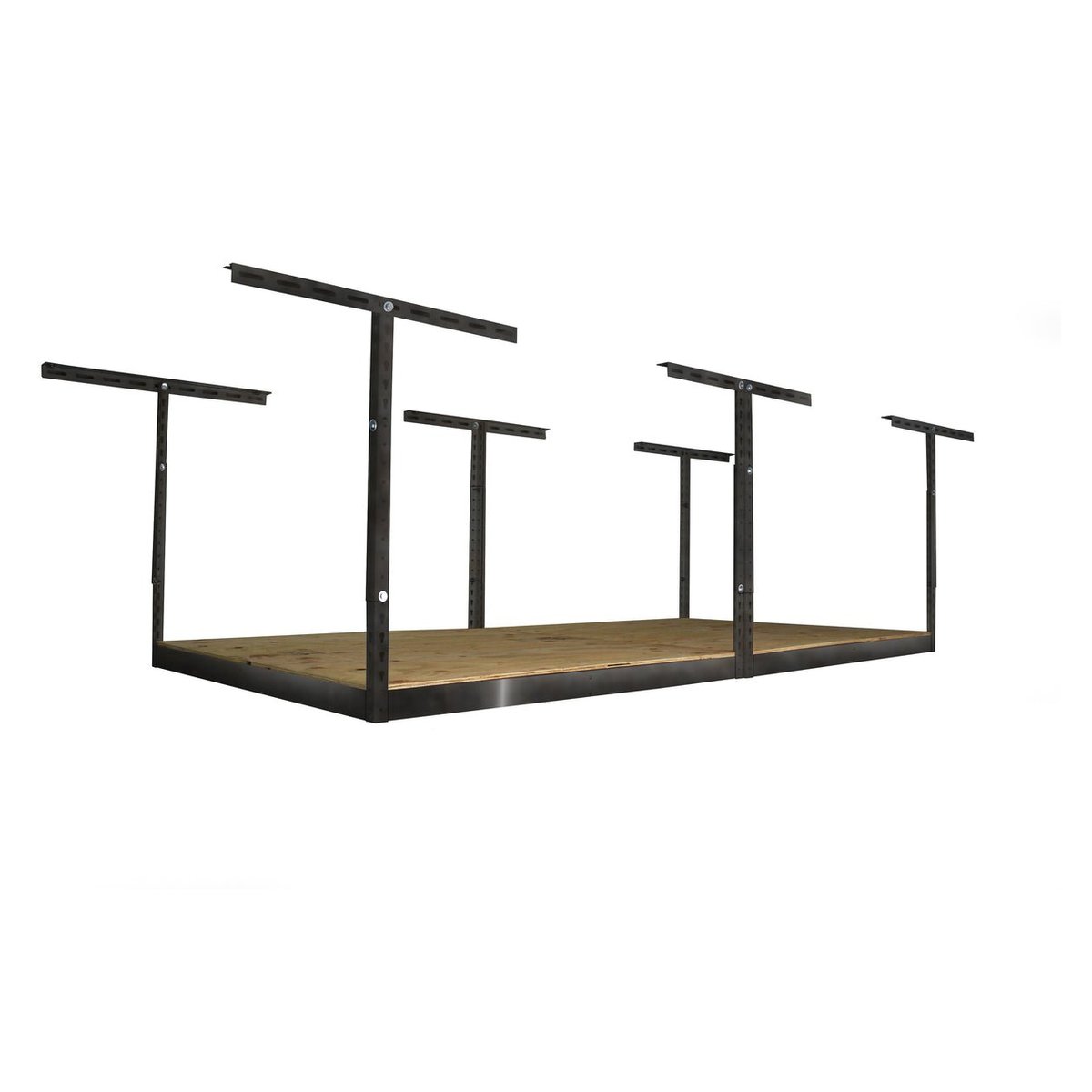
Not the right fit if you want the same deck for less — the MonsterRAX frame kit is two 4 × 4 frames and your own plywood.
250 lb bare, 500 lb a frame once decked, bottom band
Model
SR-4X8WD-H
Deck
None — two 4 × 4 frames
Capacity
250 lb bare; 500 lb/frame decked
Ceiling drop
24–45 in (18–33, 12–21 sold)
Joists
Wood only, no steel
Warranty
Limited lifetime
Reasons to buy
Two independent 4 × 4 frames rather than one 4 × 8, splitting across two bays
Your own 3/8-inch plywood is the only route to the published 500 pounds per frame — the cheapest capacity here
Three drop ranges, from 12-21 up to 24-45 inches
Limited lifetime warranty published in full on the warranty page
Reasons to avoid
Decking is not included and MonsterRAX says so in capitals — budget plywood and a saw, or a cutting service
Undecked the rating is 250 pounds, second-lowest here
For somebody who already owns a circular saw and resents paying for wire decking: two 4 × 4 frames plus a ripped sheet of 3/8-inch plywood costs less than any complete 4 × 8 rack here and lands at a published 500 pounds per frame. Wrong rack for anyone who wants to open a box and be done in an hour — the plywood is not optional if you want the higher number.
Not the right fit if you want it finished out of the box — the SafeRacks 4 × 8 ships with its deck and five hooks.
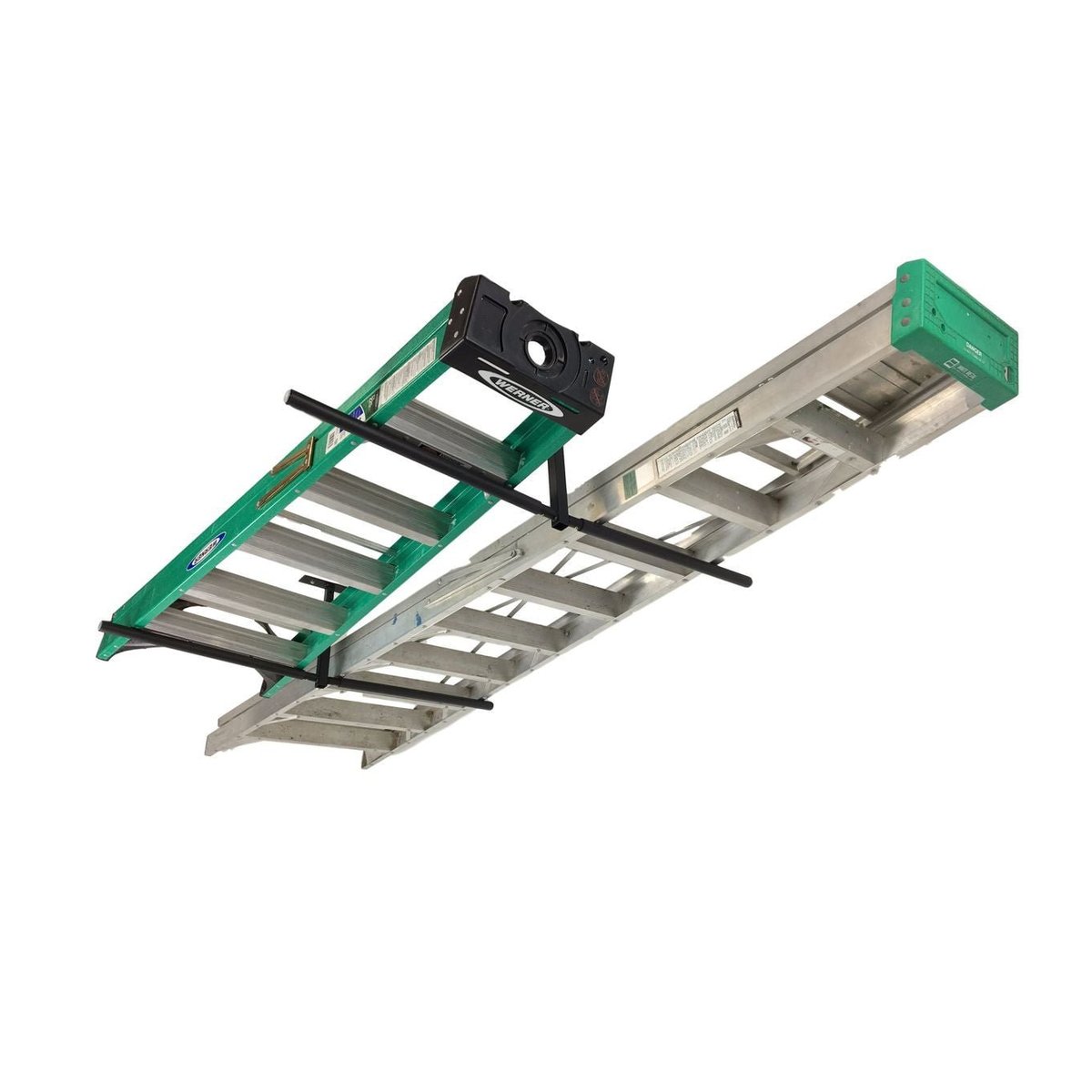
A 90-degree rotating base that mounts to joists running either way — the only rack here that solves wrong-way joists
Takes ladders up to 36 inches wide, with padded arms that come off for narrower loads
Uses only 10 to 18 inches of clearance, under a lifetime warranty
Reasons to avoid
150 pounds total, 75 per side — a ladder and lumber rack, not a storage deck
Nothing without two long parallel edges stays on it — bins fall through
Extension ladders are the worst thing in a garage — long, heavy at one end, nowhere to lean them that is not in the way. Two posts, four arms, and the ladder lives on the ceiling. Buy it alongside a deck rack rather than instead of one; and if your joists run the wrong way for a 4 × 8 rack, this is the one product here that does not care.
Not the right fit if you want a deck for bins — this is a ladder rack, so go to the SafeRacks 4 × 8.
Manufacturer pages and installation documents only — FLEXIMOUNTS' product pages, SafeRacks' and MonsterRAX's product data, Gladiator's spec table, Knape & Vogt's HyLoft PDF. Collected in September 2026; specs change, so check the manufacturer page before you drill.
Where a brand and a retailer disagreed, the brand's number is recorded and the conflict printed — twice: HyLoft publishes 200 pounds a pair against 250 in retailer copy, Gladiator 1,000 a unit against 750.
Every capacity was checked for its qualifier. "Evenly distributed", "total", "per pair" and "per 4 × 4 frame with plywood" are four different claims, and the table keeps each brand's wording.
Drop ranges were converted into remaining headroom against 8, 9 and 10-foot ceilings — which is how the HyLoft became the low-ceiling pick.
The verdict
Best overall: the FLEXIMOUNTS Classic 4 × 8. Not the biggest headline number in the category — Gladiator's GearLoft is, and it has no buy box — but the one whose documentation holds up, because FLEXIMOUNTS publishes the tested figure beside the rated one and says what to do when your joists are 48 inches apart.
Best value is the MonsterRAX frame kit if you will cut the plywood; SafeRacks is the complete kit at the top of the range, and for an 8-foot ceiling it is the HyLoft, and it is not close. The decision most people get wrong is buying on capacity when the constraint is headroom: measure, then take the highest capacity that fits under the answer.
Between 150 and 750 pounds across the six picks — the table keeps each brand's qualifier. The two 4 × 8 wire-deck racks sit at 600 and 750. The rating covers the rack, not your ceiling.
Will an overhead rack fit an 8-foot garage ceiling?
Only a shallow one. A 22 to 24-inch minimum drop leaves about 72 to 74 inches of headroom — less than the 75.3-inch roof height Ford publishes for a 2026 F-150 SuperCrew — while the HyLoft's 17-inch drop leaves roughly 79.
What joist spacing do these racks need?
FLEXIMOUNTS Classic fits any spacing at or under 24 inches on center, plus 48; the GL1 lists 12, 16 and 24. SafeRacks and NewAge require wood joists and exclude steel, I-beams and concrete.
Can I hang a rack from garage roof trusses?
Ask a professional first. The code's attic live load for limited storage is 10 pounds per square foot — across a 4 × 8 rack that is 320 pounds, less than half what most of these racks are rated to hold.
How often should I check the bolts on a ceiling rack?
At least once a year — Knape & Vogt write that into the HyLoft warranty conditions. Seasonal temperature swings in an uninsulated garage work fasteners loose.
Also considered
Gladiator Overhead GearLoft Storage Rack 4 × 8 (GALS48M4JG) — The highest published capacity in this class — 1,000 pounds a unit with "evenly distributed" attached, built-in decking and a 10-year warranty — and Gladiator's own page says 1,000 where retailer copy for the same model says 750. Checked on 12 September 2026, neither of its Amazon pages had a buy box, which is normal for full-size steel garage furniture that ships freight. Gladiator sells it direct if you want it.
NewAge Products VersaRac 4 × 8 — The only rack publishing a steel gauge (13) and a width that telescopes from 72.43 to 96.43 inches. It lands at 600 pounds — the same as SafeRacks — at a higher price, with no warranty term on the product page.
FLEXIMOUNTS Double Layer 4 × 8 (GR48B-2T) — Two decks on one footprint, adjusting between 37 and 69.5 inches, and FLEXIMOUNTS state plainly it is for 10 to 15-foot garages. Its 880 to 1,000-pound capacity is published as a range covering three sizes, so you cannot tell what your rack is rated for.
Ceiling hoists and pulley lifts for bins — Fine for a kayak or a cargo box, wrong for general storage. Rope-and-pulley hoists publish 100 to 150-pound limits and put the whole load on one attachment point, where the racks above spread it across six posts.