As an Amazon Associate I earn from qualifying purchases. Links marked "at Amazon" are paid links.
Top-entry vs front-entry litter box (2026), decided by four published numbers
By Chris Y. · Two cats, one-bedroom apartment; measures the inside of everything
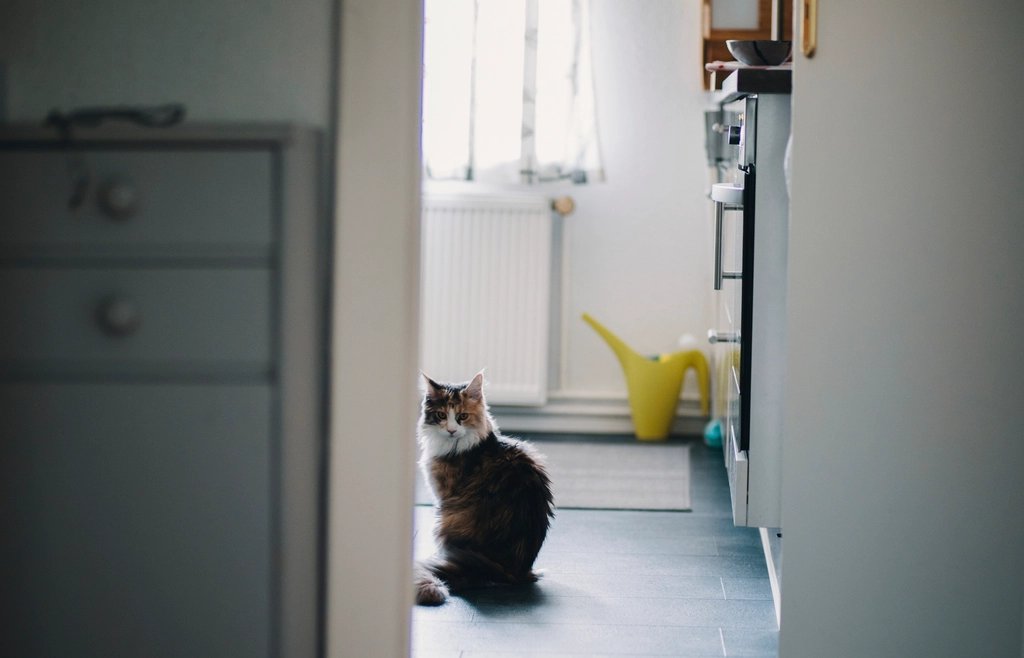
Photo: rawpixel (CC0)
The short version — top entry wins on tracking and on keeping dogs out, front entry wins on every cat that is old, heavy, short-legged or nervous, and the deciding number is the step height. Buy the Modkat Litter Box if your cat is under about 12 lb and jumps happily; buy the Modkat Flip if it hesitates at anything, because its entrance sits 6.75 inches from the floor.
This is a comparison where one brand publishes what the rest of the category hides. Modkat prints the top-entry opening at 9.5 inches, the front entrance at 8.25 by 9.5 inches, the height of that entrance from the floor at 6.75 inches, and a lid capacity for both. Four numbers, and they settle the argument better than any amount of prose about litter tracking.
What neither design changes is the welfare advice underneath. The ASPCA's position on covers is to remove them, and Ohio State's Indoor Pet Initiative says cats generally prefer large uncovered boxes. A lidded box of either kind is a compromise you make for your floor, and the way to make it a fair one is to keep the old open pan in the flat for two weeks and let the cat vote.
How to shop for a top-entry litter box
Step height at the entrance
The single number that predicts whether an older cat keeps using the box. A front entrance 6.75 inches from the floor is a step; the wall of a top-entry box is a jump onto a lid at fifteen inches. Cornell's feline behavior guidance notes that kittens and elderly cats need low sides, and a high entrance is the same obstacle as a high wall.
Opening size against the cat's chest
A 9.5-inch top hole and an 8.25 by 9.5-inch front doorway are near-identical in width, so a broad-chested cat is equally squeezed by both. The difference is that a cat entering from above drops through; a cat entering from the front has to duck and walk.
Tracking
Top entry exists for this. The lid is the walk-off surface, and litter kicked up inside hits a roof instead of a room. The Modkat Flip answers with a front step designed to contain litter, which is a partial fix rather than the same fix.
Whether it keeps a dog out
Modkat says its top-entry box keeps most dogs out, which is a real feature in a two-species flat and something no front-entry box can claim. A curved corridor in a litter cabinet is the other way to solve it.
Lid capacity
These lids get stood on, and by more than the cat. Modkat publishes 30 lb for the top-entry lid and 24 lb for the Flip's magnetic lid, which tells you which one tolerates being a shelf and which one does not.
How you scoop it
A swivel lid that drops stray litter back inside is a different weekly experience from a hinged front lid you lift. Both Modkat designs open properly; most marketplace hoods do not.
Best top-entry box
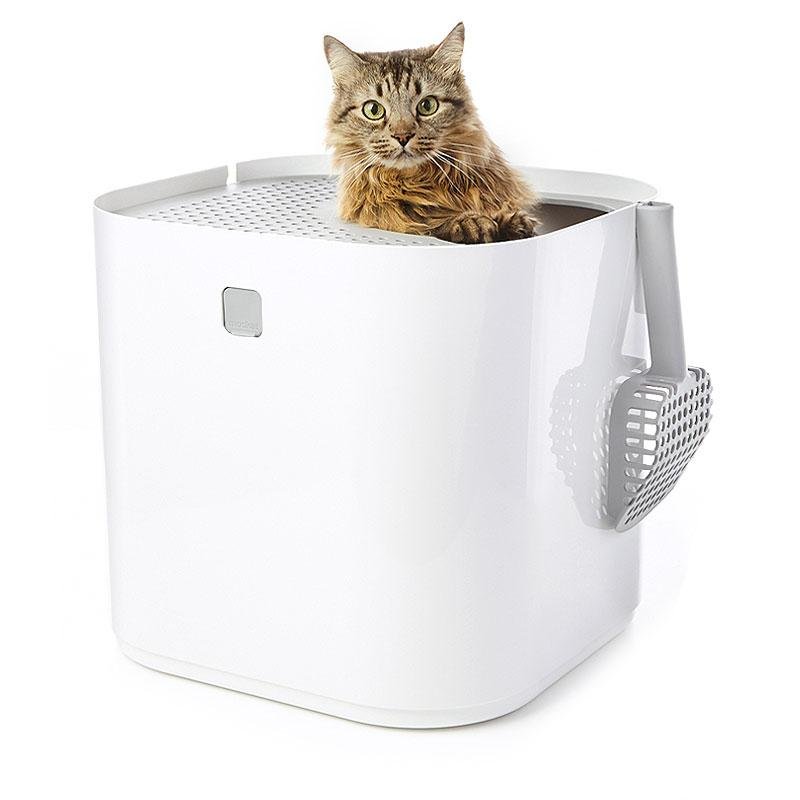
Image: Modkat
Modkat Litter Box
A 9.5-inch hole, and a lid rated to 30 lb
Dimensions
16 x 16 x 15 in (40.6 x 40.6 x 38 cm)
Entry opening
9.5 in (24 cm) circular hole in the lid
Entrance height from floor
15 in — the cat jumps to the lid
Unit weight
6.5 lb (3 kg)
Lid capacity
30 lb (13.6 kg)
Design
Swivel lid, seamless base, 10 in reusable liner
Suits
cats up to 12 lb, per Modkat
Reasons to buy
Sixteen inches square is the smallest footprint of any covered box here, because the entry is on top rather than at the end
The swivel lid doubles as the walk-off surface, so stray litter falls back inside instead of onto the floor
Seamless base with no joins, which is the fix for the side-peeing cat that defeats every clip-together hooded pan
Modkat says it keeps most dogs out, which no front-entry box of any kind can offer
Lid rated to 30 lb, so it survives being used as a shelf for the scoop, the bag and occasionally the cat
Reasons to avoid
Modkat's own page says it suits cats up to 12 lb, and that is a real ceiling rather than a suggestion
Fifteen inches of wall to clear on the way in and a 10-inch liner depth to climb out of, which is a lot of vertical work for an arthritic cat
The 9.5-inch opening is the narrowest dimension in this comparison for a broad-chested cat
This is the box to buy if your cat is young, agile and under twelve pounds, and your problem is litter in the hallway. The mechanism is simple and it works: everything the cat kicks hits a lid, and the cat walks out across that lid before it reaches your floor.
The reason it is not a universal recommendation sits on Modkat's own specification block. Great for cats up to 12 lb, they write, and a 9.5-inch opening on a 15-inch-tall cube is not a box you buy speculatively for a heavy cat or an old one.
Not the right fit if your cat is over 12 lb, elderly, or hesitates at heights — take the front-entry Flip, whose doorway starts 6.75 inches off the floor.
A doorway 6.75 inches off the floor, and a tall base
Dimensions
20.5 x 15.75 x 16.8 in (52 x 40 x 42.5 cm)
Entry opening
8.25 x 9.5 in (20.3 x 24.1 cm)
Entrance height from floor
6.75 in (17.1 cm)
Unit weight
7 lb (3.5 kg)
Lid capacity
24 lb (10.9 kg)
Design
Magnetic three-position lid, front step, reusable liner
Suits
no weight limit published by Modkat for this model
Reasons to buy
A 6.75-inch entrance height is the number that keeps an older or arthritic cat using the box, and Modkat is one of very few brands that publishes it
The magnetic lid opens halfway for a quick scoop and comes off entirely for a wash, which is two habits rather than one
A tall seamless base contains the cat that pees against a wall, without the joins that leak on a clip-together hood
A front step is built into the design specifically to knock litter off paws on the way out
Reasons to avoid
Front entry will never match top entry for tracking, however good the step is
At 20.5 inches long it needs twenty inches of floor against a wall, compared with a 16-inch square cube
Lid capacity is 24 lb rather than 30 lb, so it is less of a shelf
This is the box for every cat the top-entry box excludes: the fourteen-pound one, the twelve-year-old one, the one that stands at the bottom of the stairs thinking about it. Six and three quarter inches is a step up rather than a climb, and the published number is what lets you check it against the cat you have.
The compromise is honest and it is about your floor rather than your cat. Litter will come out of a front-entry box in a way it does not come out of a top-entry one, and the answer is a mat rather than a different box — the litter mat guide covers the sizes that actually cover the exit path.
Not the right fit if your problem is a dog that raids the box — only the top-entry design keeps most dogs out.
Nothing here has been filled with litter by us. Both boxes are compared on figures published by Modkat on its own product pages, read against the welfare guidance listed in the sources.
Modkat is used for both sides of the comparison on purpose. It is the only brand in this category that publishes an entry opening, an entrance height from the floor and a lid capacity for both designs, which makes it the only fair like-for-like test available.
Every dimension quoted is the manufacturer's own, in both inches and centimetres as published.
The welfare position — that cats generally prefer large uncovered boxes — is taken from Ohio State's Indoor Pet Initiative and the ASPCA rather than from us, and it is stated rather than buried because it is the strongest argument against both of these products.
The verdict
Top entry if your cat is under about 12 lb, agile, and your problem is litter on the floor or a dog in the box. Front entry if your cat is heavy, elderly, short-legged or hesitant, because 6.75 inches is a step and fifteen inches is a decision. Those are the two sentences.
And the third sentence, which the welfare sources insist on: neither of these is what a cat would choose. Keep the open pan for a fortnight after the new box arrives, put both where the guidance says — quiet, accessible, away from food and noisy appliances — and watch which one gets used before you get rid of anything.
Yes, and the mechanism is geometric rather than magic. Litter kicked toward a wall hits a roof, and the cat then walks out across that roof, leaving most of what it is carrying on the lid. The Modkat lid is explicitly described as doubling as a walk-off mat.
Are top-entry litter boxes bad for older cats?
They are bad for any cat that cannot comfortably jump onto a fifteen-inch cube and drop ten inches inside. Cornell's feline behavior guidance notes that kittens and elderly cats need low sides, and a top entry is the highest side of all. If your cat has started pausing before it jumps onto the sofa, this is not the box.
What size should the entry hole be?
Wider than your cat's chest, with room to spare. The two published openings here — 9.5 inches across on the top-entry box and 8.25 by 9.5 inches at the front of the Flip — are near-identical in width, so the difference between the designs is the approach rather than the squeeze.
Will a top-entry box keep the dog out of the litter?
Mostly. Modkat claims it keeps most dogs out, which is the honest version of the claim, and a determined small dog is still a determined small dog. The other answer is an enclosure with a turned corridor, covered in the hidden litter furniture guide.
Does a lidded box make the smell worse?
It concentrates it. Ohio State's Indoor Pet Initiative states that covered boxes concentrate odors more than uncovered ones, and Cornell makes the same point. That is an argument for scooping daily rather than an argument against lids, but it is the reason the welfare guidance keeps recommending open pans.
Also considered
Modkat XL — Not a rejection so much as the third answer. At 21 by 16.5 by 17 inches it converts between a 10.25-inch top entry and an 8.3 by 9.8-inch front entry that sits 6.25 inches off the floor, so a household that cannot decide can buy both configurations in one box. It is the largest and the most expensive of the three.
Marketplace top-entry boxes with no published opening — The entire purchase is the size of the hole and the height of the climb. A product sold with neither figure cannot be matched to a cat, and the cat is the one that decides whether you own a litter box or an expensive plastic crate.
Clip-together hooded pans — The join between a hood and a pan is where urine escapes on a cat that stands close to the wall, which is the most common reason people replace a hooded box within a year. Both boxes above answer it with a seamless base.