As an Amazon Associate I earn from qualifying purchases. Links marked "at Amazon" are paid links.
How much vertical space a cat actually needs — a small-apartment guide
 By Chris Y. · Two cats, one-bedroom apartment; measures the inside of everything
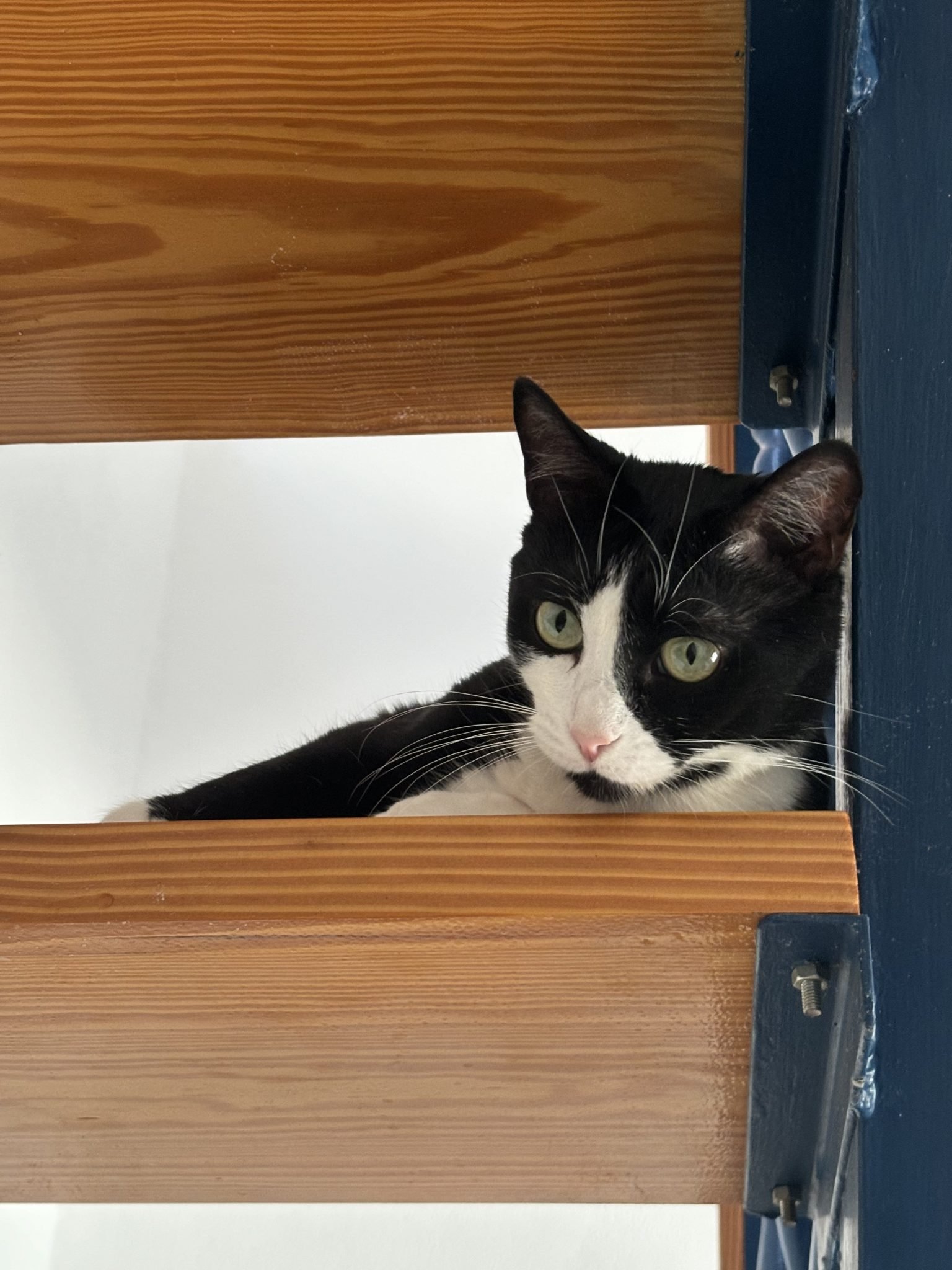
There is no number. That is the first honest thing to say about vertical space, because the internet is full of confident figures — six feet, two shelves per cat, one perch per window — and not one of them appears in the veterinary guidance. What the guidance asks for is specific in a different way, and it is more useful.
The 2013 AAFP and ISFM Feline Environmental Needs Guidelines ask for a safe place, described as a private and secure area, often in a raised location, and they ask for a minimum of two resting areas per cat's environment, placed separately from each other and from the food, water and litter. Ohio State's Indoor Pet Initiative adds the behavioral reason in plainer words — cats may feel safer if they can sleep somewhere high.
So the real question is not how many feet. It is how many separate raised places a cat can choose between, how big each one is, and whether the cat can reach them in stages. This page works that out for a one-bedroom flat, and it is mostly furniture you already own.
Questions people ask
How high should a cat perch be?
High enough that the cat can see the room and low enough that it can reach it in two hops. No published guideline sets a height; the AAFP and ISFM guidelines specify the quality of the place — private, secure, often raised — rather than a figure. In practice, the top of a bookcase reached via two intermediate steps beats a single high shelf a cat has to launch at.
How many perches does one cat need?
At least two resting places, in separate locations. Pillar 2 of the AAFP and ISFM guidelines asks for a minimum of two resting areas, two feeding areas and two toileting areas so the cat has a choice, and says each key resource should be in its own location.
Do cats need vertical space if they have a cat tree?
A tree is one location, not several. The guidelines are about choice and separation, so a tree plus a windowsill plus the top of a wardrobe is three options in three parts of the flat; a single tall tree is one option with several floors, and a second cat can sit at the bottom of it.
How big does a perch need to be?
Wide enough and long enough for the cat to fully stretch, which is the wording the AAFP and ISFM guidelines use, and they add that a hammock-style dip in the middle helps a cat feel concealed. In practice that means roughly 10 to 11 inches of depth and about 20 inches of length for an average cat.
My cat only sits on top of the fridge. Is that a problem?
It is information. Ohio State's advice is to watch where your cat curls up and falls asleep, because that is where it feels comfortable, and to move it elsewhere only gradually and with treats. A cat that has chosen one high spot is telling you what height and what kind of concealment it wants — match the next perch to that, not to a photograph.
What the guidelines actually ask for
Three documents carry most of the weight here, and it is worth reading what they say rather than what gets quoted from them.
The AAFP and ISFM Feline Environmental Needs Guidelines organize everything around five pillars. Pillar 1 is a safe place, and the description is precise: a private and secure area, often in a raised location, giving the cat a sense of enclosure, isolation or seclusion, that it can retreat to so it feels protected. The guidelines add that a cat feels safer if it cannot see a potential threat, even when its whole body is not fully concealed.
Pillar 2 is multiple and separated key environmental resources. Key resources are named as the feeding, drinking, toileting, scratching, play and resting or sleeping areas, and the guidelines ask for a minimum of two resting areas, two feeding areas and two toileting areas, each in its own location. They also state the reason: if resources are in different places, individual cats can avoid seeing each other, which reduces competition and stress.
On perches specifically, the same document says they should be wide enough and long enough to allow the cat to fully stretch, and that a hammock-style dip in the middle of a perch or shelf aids the cat's sense of feeling hidden.
Ohio State's Indoor Pet Initiative supplies the behavioral half. Cats need something that allows them to raise themselves from ground level, it says; a perch gives them a safe and private place to watch the action from above, and more than one perch lets them look outside at different angles. It also makes the point most often missed in small flats — cats may feel safer if they can sleep somewhere high, where no other animal or human could sneak up on them.
Nowhere in any of it is there a height in feet. The specification is choice, separation, concealment and size, and all four of those are achievable in seven hundred square feet.
Translating that into a one-bedroom flat
Here is the arithmetic. One cat needs two separate resting places minimum, at least one of which should be raised and feel enclosed. Two cats need those two places each, in locations where they do not have to look at each other, plus a second feeding station and a second litter box.
For one cat in a one-bedroom flat, a workable set looks like this:
- A raised, enclosed place in the room the household uses. A covered bed on a low cabinet, a capsule on a wall, or the top of a bookcase with a blanket on it. This is Pillar 1, and it is the one people skip.
- A window position. Not for height but for information — Ohio State's argument is that a cat can hear and smell what is outside and gets anxious when it cannot see it. A perch on the glass or a chair pushed to the sill both qualify.
- A quiet place away from the first two. The bedroom, a shelf in a wardrobe, anywhere the doorbell is less loud. This is the refuge the guidance describes, and it is the one that gets used when the flat is full of visitors.
For two cats, double it and separate it. Two perches in the same window is one location with two floors, which is better than one perch and worse than two windows. The guideline's own reasoning — so that individual cats can avoid seeing one another — is the test to apply.
The route matters more than the summit
The most common mistake in small-flat cat furniture is buying height without buying access. A single shelf at six feet is a launch; three shelves at rising heights is a staircase, and a staircase is what an eight-year-old cat will still be using at fourteen.
Aim for steps of roughly 16 to 24 inches between surfaces, which is a comfortable hop rather than a jump, and make sure there is a way down that is not the way up — cats descend badly and a dead-end high shelf produces a cat that goes up and then complains. Furniture counts. Sofa to sideboard to the top of a bookcase is a route, and it cost nothing.
If you are renting, the drill-free guide covers the three ways to get height without fixings. If you can drill, the wall shelf guide starts with the one maker that publishes a tested load rating.
How deep does a raised place have to be?
Deep enough for the cat to lie fully stretched, per the guidelines. That is the specification, and in product terms it lands at around 10 to 11 inches of depth and about 20 inches of length for an average domestic cat.
Under nine inches deep and you have built a route rather than a destination; the cat will pass along it and sleep somewhere else. The published depths in the shelves we would recommend cluster at 10 to 11 inches for exactly this reason, and the dip that the guidelines mention — a hammock shape, a capsule, a bed with sides — is what turns a platform into a place.
Signs your cat does not have enough
None of these are diagnoses, and all of them are worth a vet conversation before a furniture purchase, because several have medical causes too.
- The cat sleeps only under things — beds, sofas, the bath — rather than on them. That is a cat choosing concealment because concealment at height is not available.
- In a two-cat flat, one cat has stopped using a whole room. Pillar 2 exists because of this exact pattern.
- The cat sits on the highest thing in the kitchen regardless of how often it is removed. It has found the only raised safe place in the flat, and the answer is a better one rather than a stricter rule.
- Scratching has moved to door frames and the corners of furniture near where the cat sleeps. Ohio State notes cats scratch prominent objects near sleeping areas and room entrances, and a cat sleeping in the wrong place scratches in the wrong place.
What to buy, in order
- A raised, enclosed bed in the room you use most. Cheapest version: a cardboard box on its side on top of a cabinet, which the AAFP guidelines describe approvingly as a safe place.
- A window position — a perch on the glass if your pane clears the maker's published requirement, or a chair moved to the sill if it does not.
- A route — two or three shelves or pieces of furniture spaced 16 to 24 inches apart, ending somewhere the cat can lie flat.
- A second quiet place in another room, which is usually free.
That is four items, two of which cost nothing, and together they satisfy the parts of the environmental guidelines that a flat can control. It is a more useful target than any number of feet.
Sources
- AAFP and ISFM Feline Environmental Needs Guidelines (five pillars, safe places, perches, resources)
- Ohio State University Indoor Pet Initiative — Perches
- Ohio State University Indoor Pet Initiative — Resting Areas
- Ohio State University Indoor Pet Initiative — Scratching
- ASPCA — Destructive Scratching
- American Association of Feline Practitioners — Environmental Needs Guidelines landing page