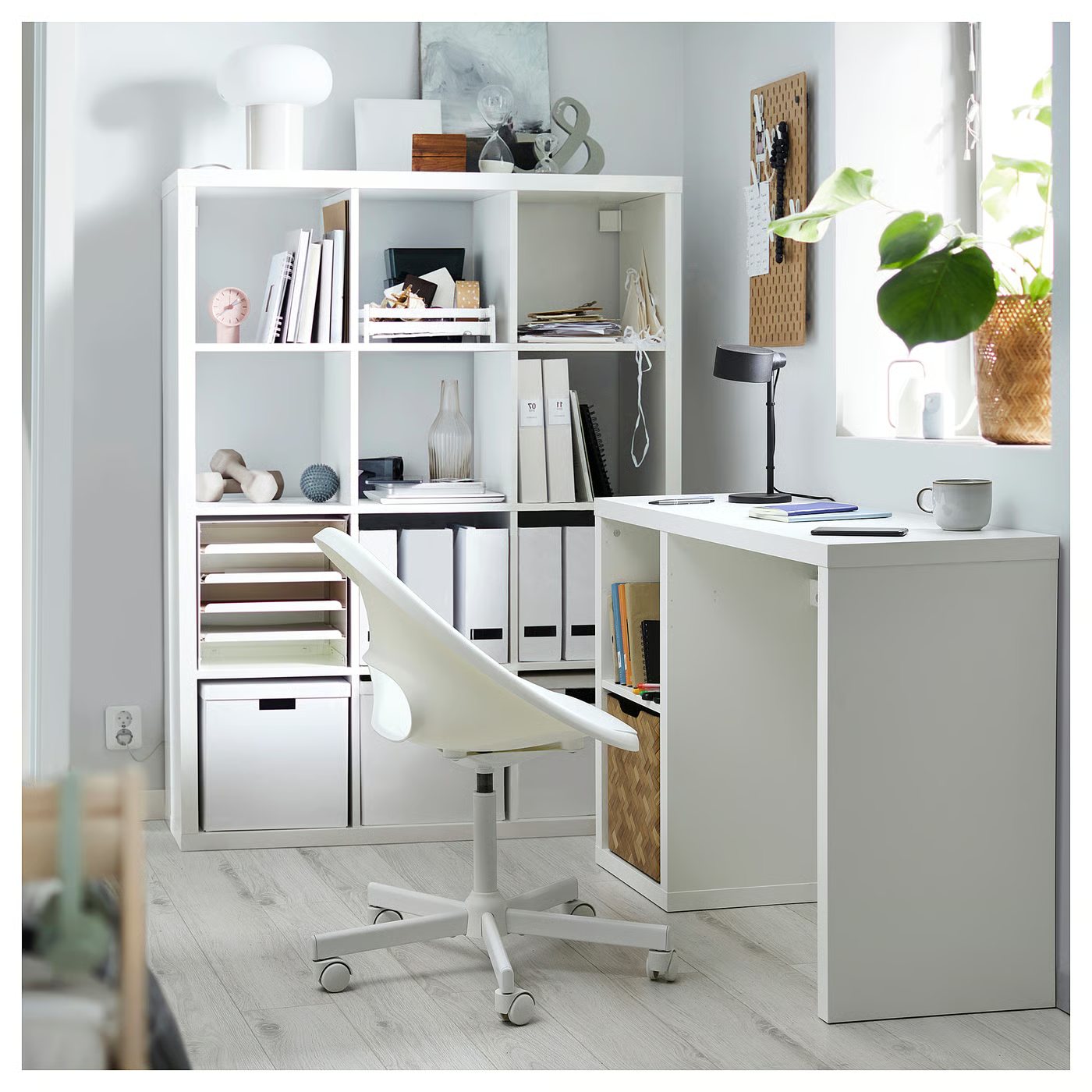
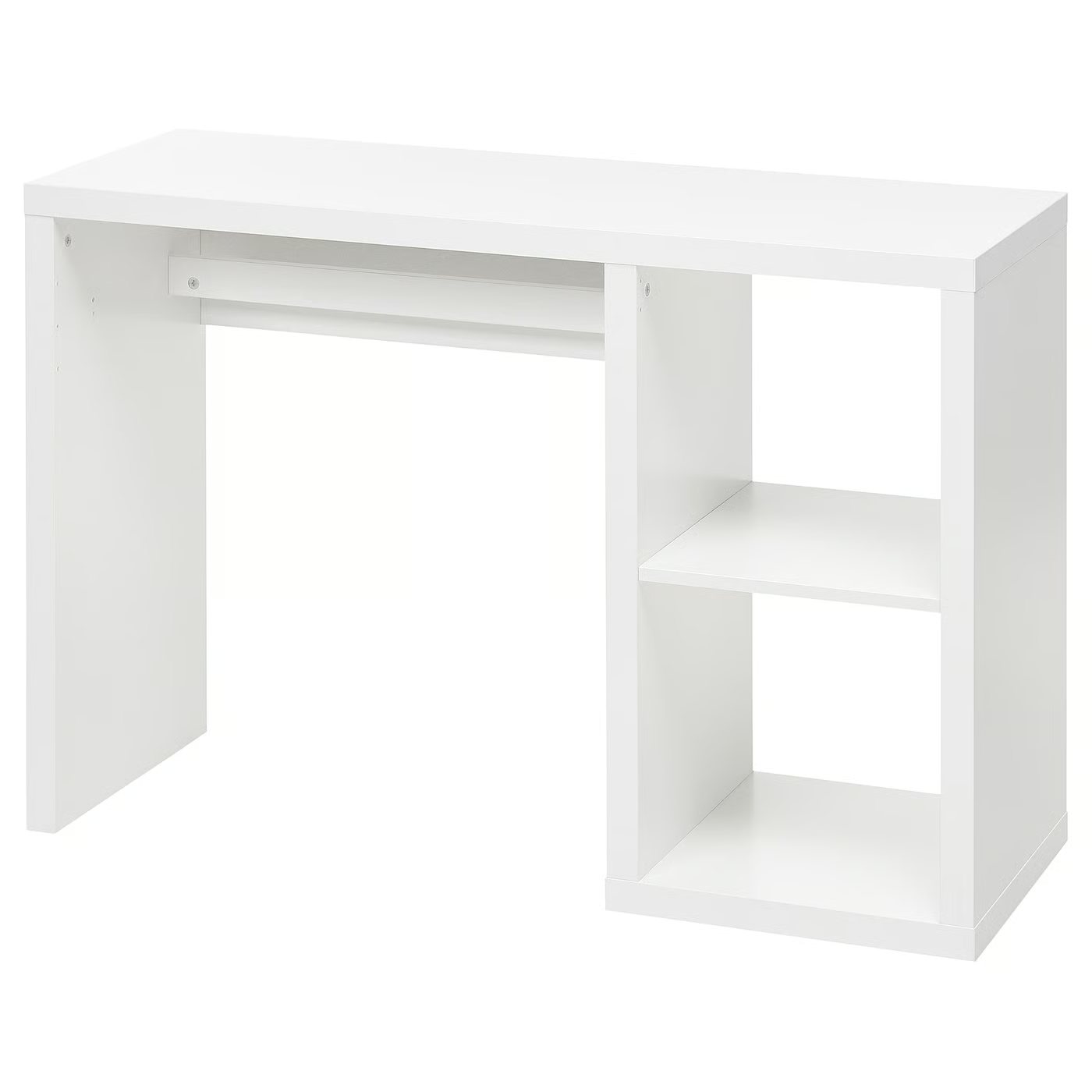
Buy the IKEA KALLAX Desk ($). It is 15⅜ inches deep — shallower than every other desk here by more than four inches — and IKEA publishes 28⅜ inches of clear knee height under the top and a 13-inch-square cube on each shelf. In a bedroom where the walkway past the desk is the real constraint, depth is the number that decides everything, and this is the shallowest honest desk you can buy.
Almost everyone shops a compact desk by width, because width is what the product name says. Depth is what makes a room unwalkable: a 24-inch desk against a bedroom wall leaves nine fewer inches of floor in front of it than a 15-inch one, and where the bed is four feet away that is the difference between a workspace and an obstacle.
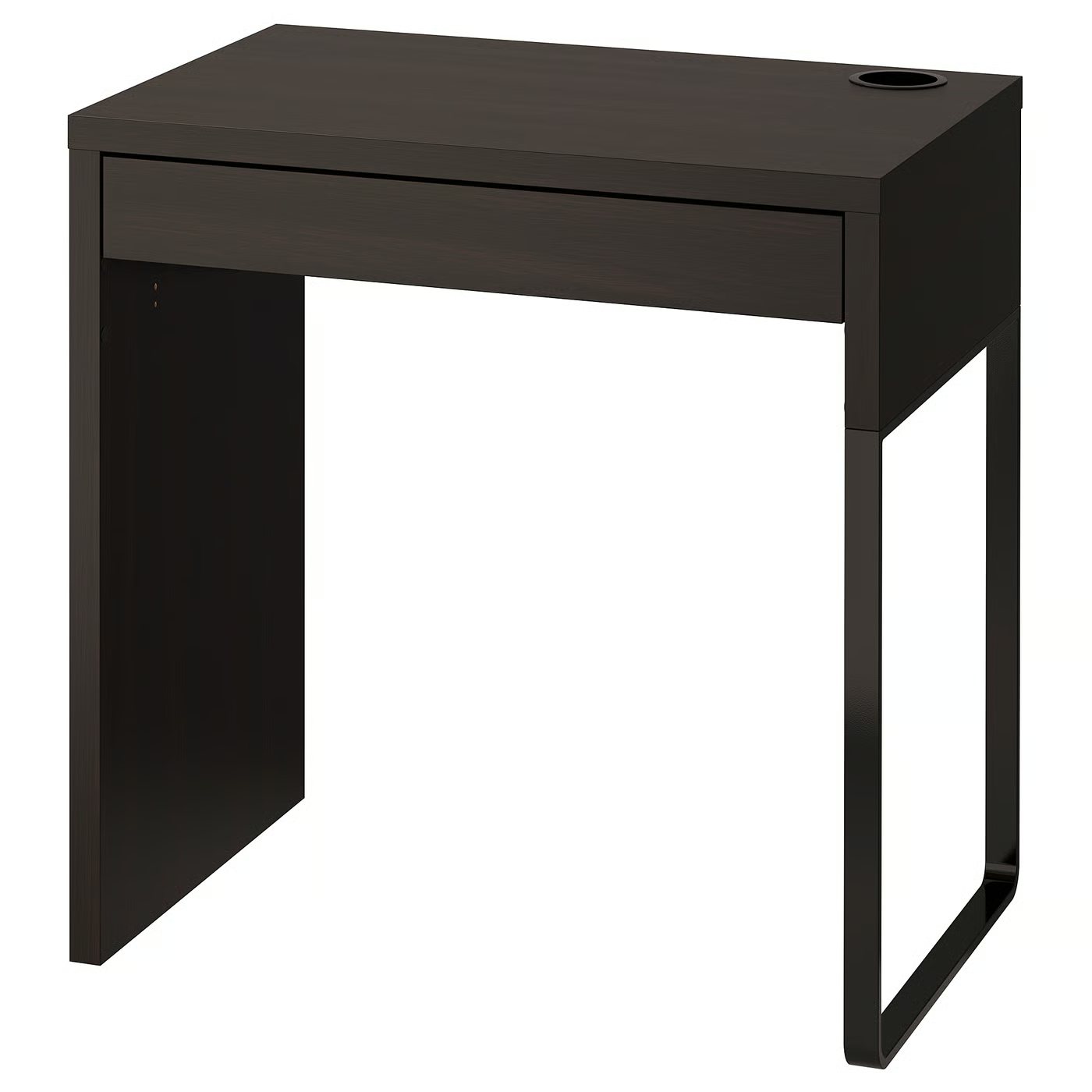
Depth has a cost worth naming: a shallow desk cannot put a monitor at arm's length on its own, which is why nearly everyone who buys one fits a monitor arm. Want the depth in the desk instead? The MICKE at 19⅝ inches and the VIVO mobile desk at 22. Every dimension below is quoted from the maker's own page.
How to shop for a compact desk
Published depth, before anything else
The range here runs from 15⅜ to 24 inches. That nine-inch spread is floor in a room that has none.
Clear knee height and knee width
IKEA publishes 28⅜ inches of clearance under the KALLAX top. Most makers publish nothing, so the crossbar that ruins the knee space is a surprise you get on assembly day.
A published load rating
Two monitors, a dock and a laptop is 40 to 60 lb. Mount-It! rates the MI-8035 at 154 lb and VIVO the mobile desk at 88; IKEA and Branch publish no figure for these models at all.
Whether the desk can stop being a desk
In a studio the furniture shares the room with the evening. A wall leaf folds flat; a desk on casters leaves the room. A fixed slab does neither.
Where the cable run goes
MICKE has a cable outlet in its back panel and KALLAX hides the run behind the shelf leg. On the flat-topped desks it is on you, and an under-desk tray is the fix.
Best overall
Image: IKEA
IKEA KALLAX Desk
Fifteen inches deep, shelves included
Top size
43¾ × 15⅜ in
Height
30⅜ in
Holds
Not published
Model
305.824.45
Reasons to buy
At 15⅜ inches deep it takes about eight inches less floor than a conventional 24-inch desk, which in a bedroom is the whole argument
IKEA publishes 28⅜ inches of clear height under the worktop, so a chair with arms actually goes under it
The two 13-inch cubes in the shelf leg replace a separate drawer unit, which is the piece of furniture that usually arrives next
The shelf unit mounts on the left or the right, so the desk fits either side of a window or a door swing
The cable run drops behind the shelf unit rather than down the middle of the open leg, so the back of the desk stays presentable in a studio
Reasons to avoid
Fifteen inches is not enough depth to put a monitor at a comfortable viewing distance on its own stand — budget for an arm
IKEA publishes no load rating for this model, so a heavy multi-monitor rig is an unknown rather than a supported use
This is the desk for a room where the walkway matters more than the worktop. Two-thirds of the top is a clear 26-inch span, the shelf leg absorbs the books and the router, and the whole thing takes less floor than a bedside table.
The compromise is the one every shallow desk makes: 15 inches puts a screen roughly 20 inches from your face on its factory stand, well inside the distance CCOHS describes as comfortable. An arm fixes that cheaply.
Not the right fit if you want the monitor at arm's length without buying anything else — take the VIVO at 22 inches deep.
At 28¾ inches wide it fits between a window and a door frame where nothing else here will
The back panel has a cable outlet built into it, so the power brick lives behind the desk instead of on the floor beside it
The legs mount on the left or the right, which matters when the only free wall has the socket at one end
Nearly 20 inches deep, enough for a keyboard, a mouse and a laptop lid without the screen touching the wall
Reasons to avoid
Twenty-nine inches of width is one monitor and nothing else — this is a laptop desk with a screen, not a two-monitor desk
No published load rating, and the drawer unit takes a slice of the knee space on whichever side you build it
Marketplace resellers list MICKE desks at several times IKEA's own price — a 41-inch MICKE workstation checked on 12 September 2026 was three and a half times what IKEA charges. Buy it from IKEA
The MICKE answers a specific room: the one where the desk lives in a gap rather than along a wall. Under 29 inches wide with drawers included, and a cable outlet most desks at any price leave out.
Read the width honestly: a 27-inch monitor is about 24 inches wide, leaving two inches either side and nowhere for a notebook.
Not the right fit if you run two monitors — nothing under 40 inches wide will do that comfortably.
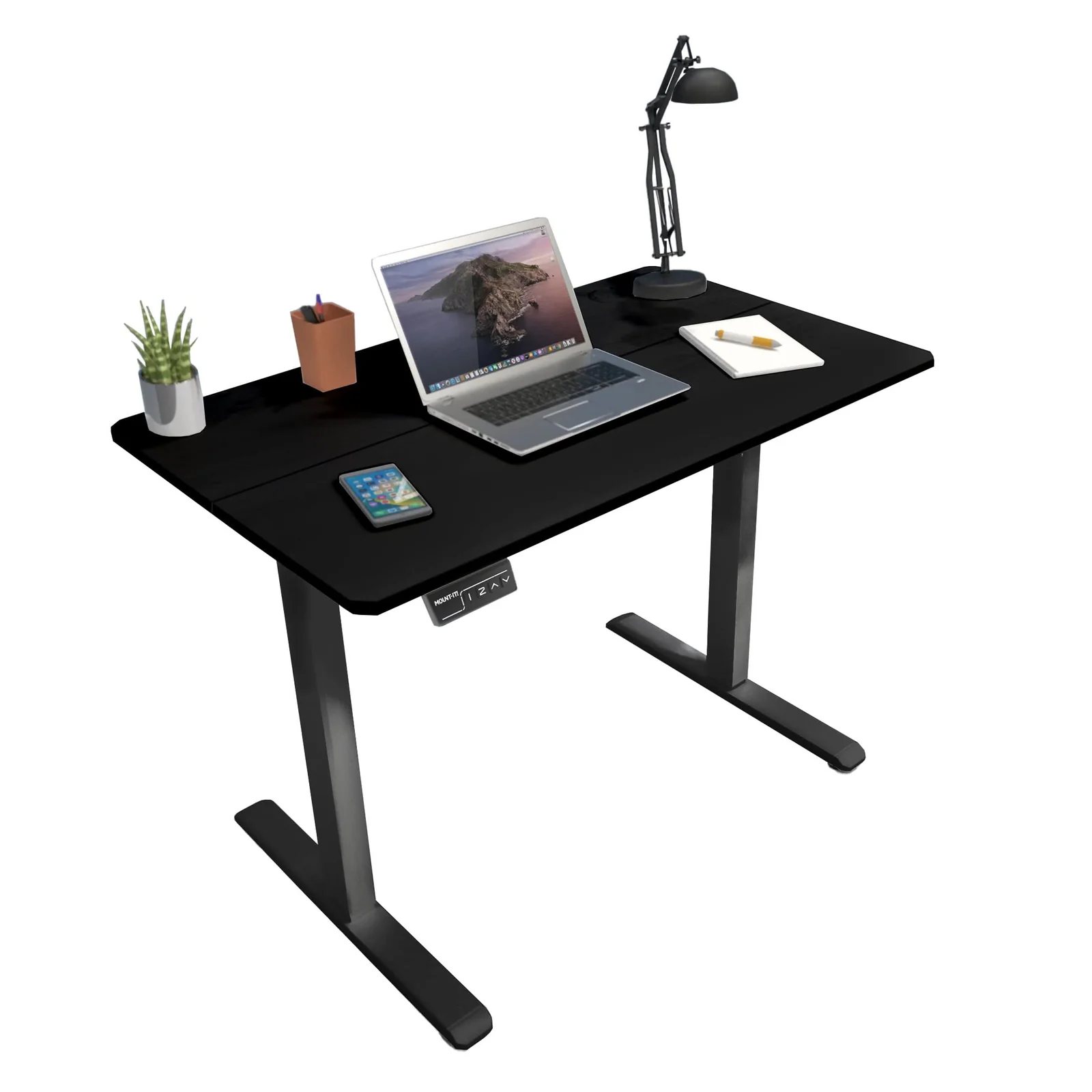
Mount-It! Compact Electric Standing Desk with 40 inch tabletop
Forty inches wide, 154 lb rated
Top size
39.4 × 23.6 in
Height
28.7–46.5 in
Holds
154 lb
Model
MI-8035
Reasons to buy
A published 154 lb capacity, by far the highest here, so two monitors and a tower are within rating rather than within hope
Height runs 28.7 to 46.5 inches with two memory presets — a genuine seated-to-standing range, not a token lift
Two-stage rectangular columns and a single motor moving at 0.8 inches a second, quoted by Mount-It! at under 55 dB
A cable grommet is cut into the top, so the cable run starts at the desk rather than hanging off the back edge
Reasons to avoid
At 23.6 inches deep it is the second deepest desk here, which is the price of the sit-stand frame
A single motor means the whole width travels on one column pair; heavy asymmetric loads are not what it is built for
Most sit-stand desks start at 48 inches wide because the frames are built for it. A 39.4 by 23.6-inch top with a 154 lb rating puts a real standing desk in a bedroom corner.
CCOHS says the platform should land at your standing elbow height; 46.5 inches covers a user up to roughly six foot four. It will not go below 28.7 inches, worth checking if you are short.
Not the right fit if the desk has to disappear in the evening — that is the wall-mounted leaf.
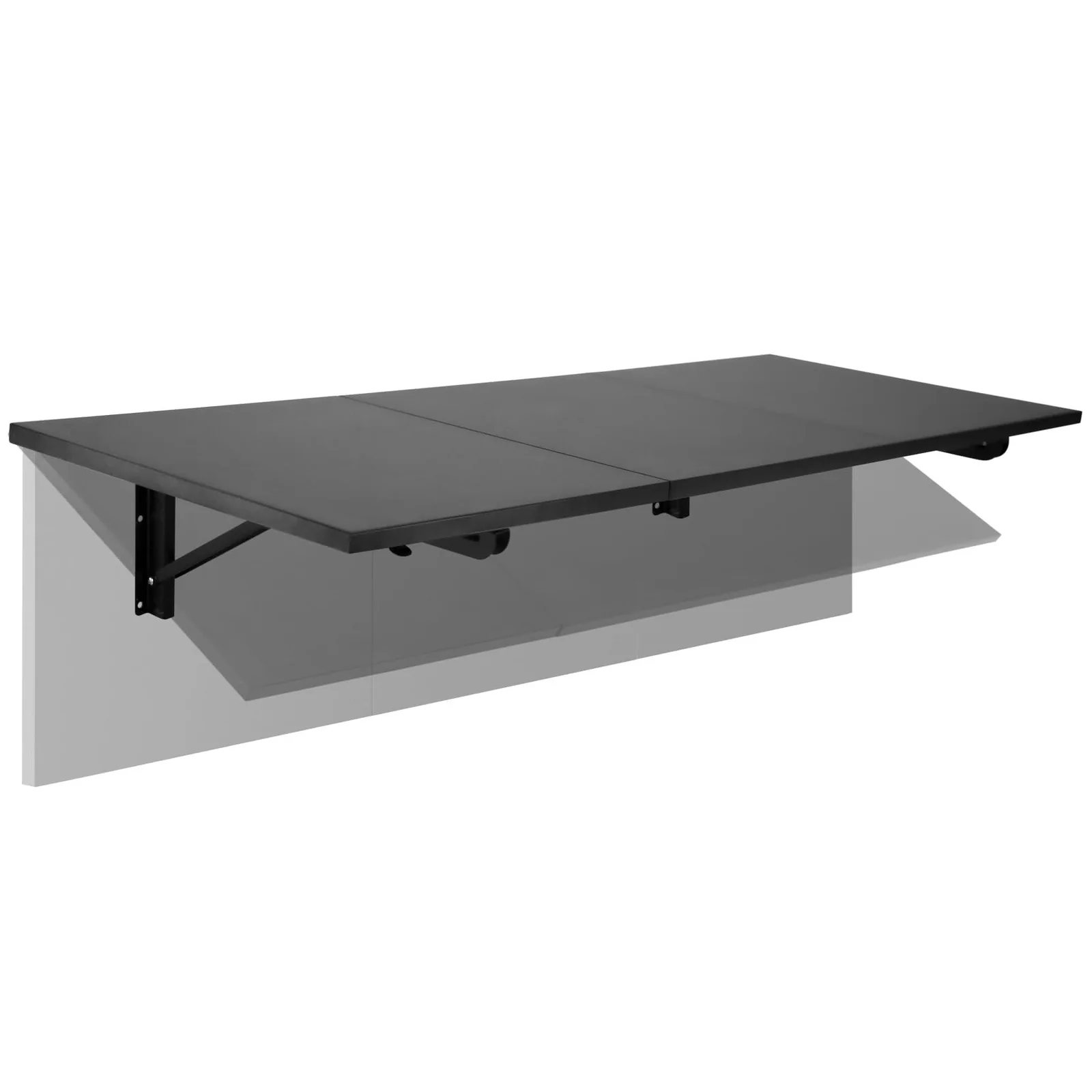
Folds flat against the wall, which is the only way a desk stops occupying a studio when the working day ends
Two width options from one product — 30 inches or 45 — so it suits an alcove or a full wall
You set the height on the wall, so it can be built to a standing height, a seated height, or a child's height
Fifteen inches deep matches the shallowest fixed desk here, and it takes none of that depth back when folded
Reasons to avoid
Thirty-three pounds is the lowest rating on this page. A monitor, an arm and a laptop is close to the limit
It goes into a wall, which most renters can do and some leases forbid; the fixing has to land on studs
No legs means no under-desk drawer unit and nowhere to hide a power strip without planning the run first
A folding leaf is the honest answer when the room has one job by day and another at night. It is the only desk here that returns its whole footprint.
Treat the 33 lb rating as the design constraint. It carries a laptop, a light monitor on a clamp and a lamp; it does not carry a 34-inch curved panel on a heavy arm, and a wall fixing is the wrong place to find that out.
Not the right fit if you want storage in the desk — the KALLAX brings two cubes with it.
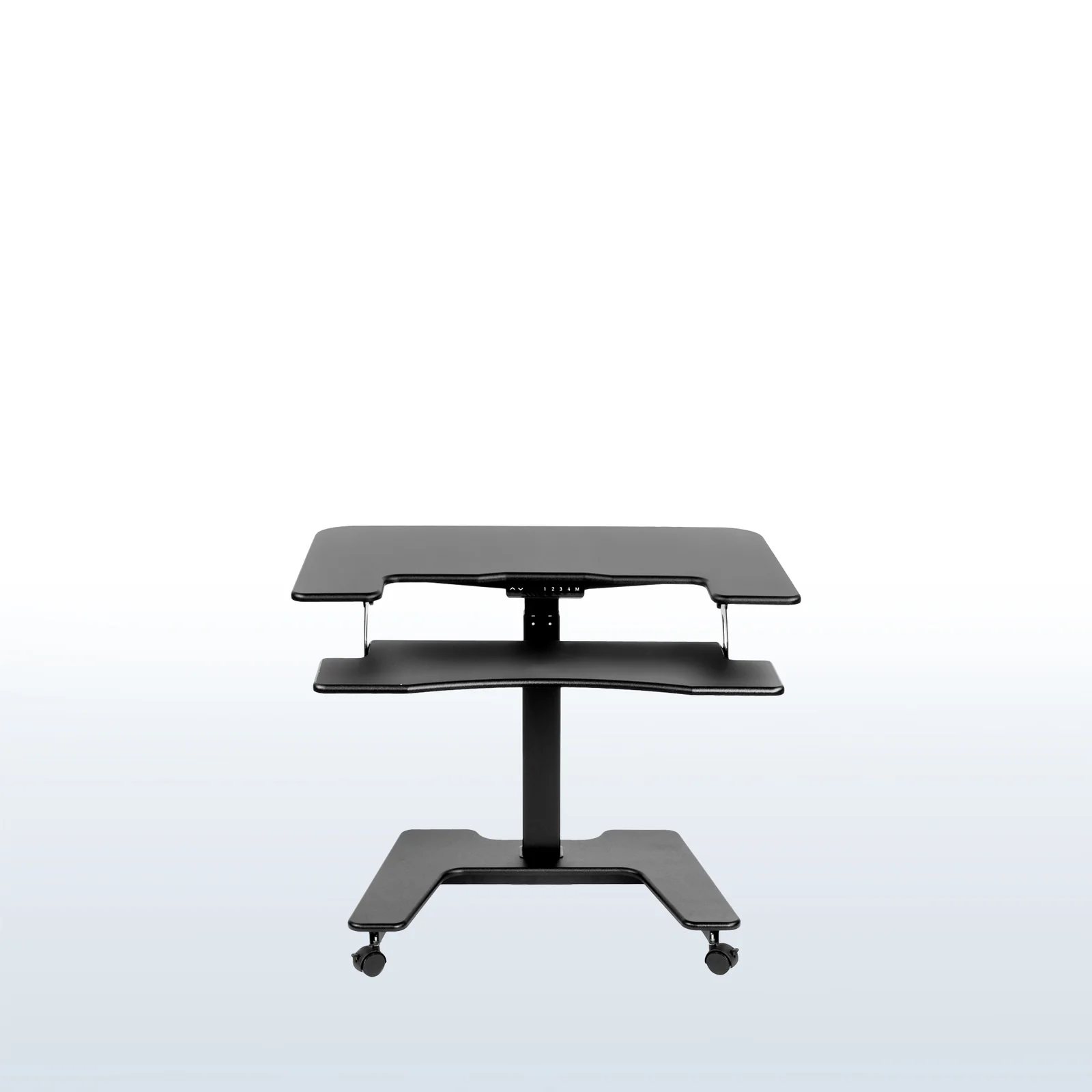
A 25.5-inch height range, the widest here — it goes lower than any fixed desk and higher than the sit-stand
All four casters lock, so it is a rolling cart when you want one and a desk when you do not
The base is 30.4 by 19.8 inches, narrower than the top, so it tucks into a corner the worktop overhangs
A separate keyboard tray at 32.2 by 11 inches keeps the main deck clear for a screen
Twenty-two inches of depth is enough to put a monitor at a workable distance without an arm
Reasons to avoid
The keyboard tray is rated to 4.4 lb, which is a keyboard and a mouse and nothing else
Eighty-eight pounds total is well under the Mount-It! desk's 154 lb, and the casters are part of why
A two-deck cart reads as office equipment rather than furniture, which matters if the desk is in a living room
This is the desk for a home with no fixed place for one. It works against a wall, rolls to a window for a call, and parks in a corner on a 30-inch base.
The height range is the underrated part: 25.7 inches suits someone short or a child, 51.2 makes it a standing desk for someone tall. No fixed desk here does either.
Not the right fit if the desk lives in one place forever — you are paying for casters you will lock once.
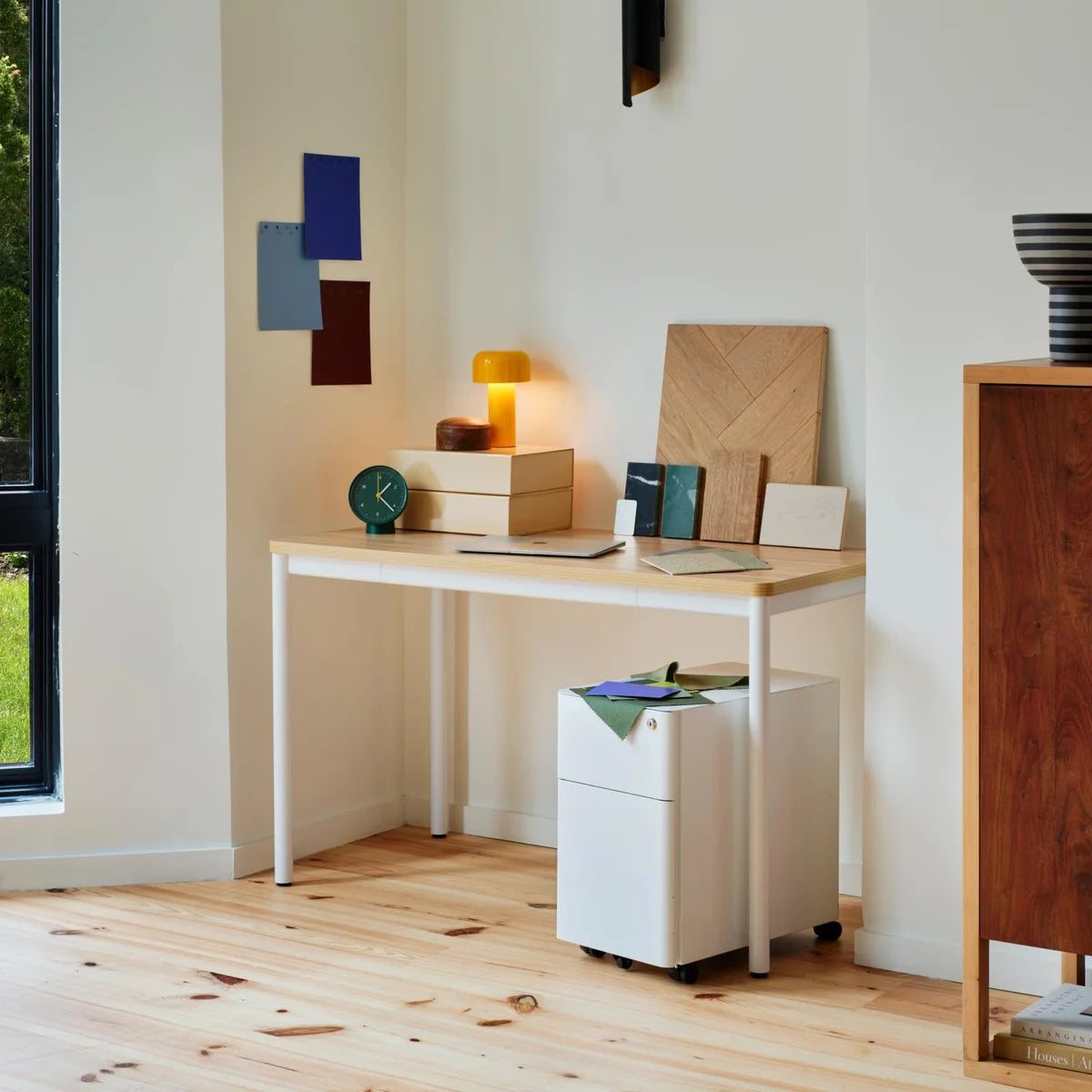
Laminated MDF on powder-coated steel rather than particleboard and plastic edging, which is what makes it survive a move
A modular frame that takes Branch's own drawer, cable organizer and desk tray, so the accessories are designed to fit rather than bodged on
Branch publishes three sizes on one product page, and the smallest is a genuine 36 by 24 inches
Branch states contract-grade certifications, which is a durability claim you can check rather than a marketing adjective
Reasons to avoid
The 36-inch version was out of stock in every finish on 12 September 2026; the 48-inch is the one you can actually order, and it is the widest desk here
Branch publishes a product weight of 42 to 51 lb but no load rating, so heavy multi-monitor use is unstated
It costs roughly five times the KALLAX for a desk that is nine inches deeper
Everything else here looks like a desk. This looks like a table that happens to work, which matters when it sits in a living room you use every evening.
It is also the least compact thing here. Twenty-four inches deep and 48 wide is a full-size desk bought for how it looks, not for the floor it saves.
Not the right fit if floor space is the constraint — the KALLAX is nine inches shallower for a fraction of the outlay.
Nothing here has been assembled by us. Every dimension above is quoted from the manufacturer's own page or dimensioned drawing, and those pages are linked in Sources.
A candidate had to publish a top size and a height on its own site, which removed several well-known flat-pack brands whose dimensions load only in a browser.
Desks were judged against one room: a bedroom corner with under five feet of free wall, where the floor in front of the desk is a walkway.
Where a maker publishes no load rating the table says so. Three of six publish nothing, which is itself a finding about this category.
Price bands were set by fetching each product's live retail page on 12 September 2026 and sorting the six by price. A band describes position on this page only.
The verdict
Best overall: the IKEA KALLAX Desk, at 15⅜ inches deep with 28⅜ inches of published knee clearance and two 13-inch cubes built into the leg. In a small room, depth is the specification that changes how the room feels, and nothing else here is close.
Deep enough to put the screen roughly an arm's length away — CCOHS puts the eye's resting point of accommodation at about 80 cm, or 31.5 inches. On a factory stand that wants around 24 inches of desk; below that a monitor arm does the job instead.
Will a chair with arms fit under these?
IKEA publishes 28⅜ inches of clear height under the KALLAX top, which takes most task chairs with the arms lowered. The other five publish no clearance figure, so measure your chair's arm height against the desk height minus the top thickness.
Is a 15-inch-deep desk actually usable?
For a laptop, a keyboard and a mouse, yes — a full-size keyboard is about 6 inches deep, a laptop about 9. It stops working the moment a monitor sits on the desk rather than over it.
Can I put a monitor arm on any of these?
On the flat-topped ones, yes, if the top thickness suits the clamp — Mount-It! publishes a 0.6-inch top for the MI-8035, inside every clamp range in our arm guide. The wall-mounted leaf is the exception: its 33 lb rating includes the arm.
Standing desk or a converter on a normal desk?
A converter is cheaper and fits the desk you own, but it adds 15 to 26 inches of depth on the desk and never gives it back. On a shallow desk that is usually the wrong trade. The full comparison is in standing desk versus desk converter.
How much floor does the desk itself need?
Add about 30 inches in front for a chair you can push back and sit in. A 15⅜-inch desk claims about 46 inches of room depth; a 24-inch desk claims about 54.
Also considered
Corner and L-shaped desks sold as space-saving — An L-desk claims two walls and the corner between them — in a small room, the only place a bed or sofa can go.
Desks whose only published dimension is the top — Several popular flat-pack desks publish a width and a depth and nothing about height, clearance or load — and height decides whether your chair works.
Folding card-table style desks — Right idea, but the tops flex under a monitor arm and almost none publish a load rating. The wall leaf does the same job with a stated 33 lb limit.
Ladder and leaning desks — The shelves above the worktop are the selling point and the problem: they take the space a monitor needs and force the screen forward.
Sauder and Bush Furniture desks — Both make sensible compact desks and neither publishes dimensions in a form we could read from their own public pages, so nothing they sell could be compared here on equal terms.