As an Amazon Associate I earn from qualifying purchases. Links marked "at Amazon" are paid links.
How to stop a dog barking at the door (without a bark collar)
 By Chris Y. · One dog, one apartment, a tape measure and a chest girth chart
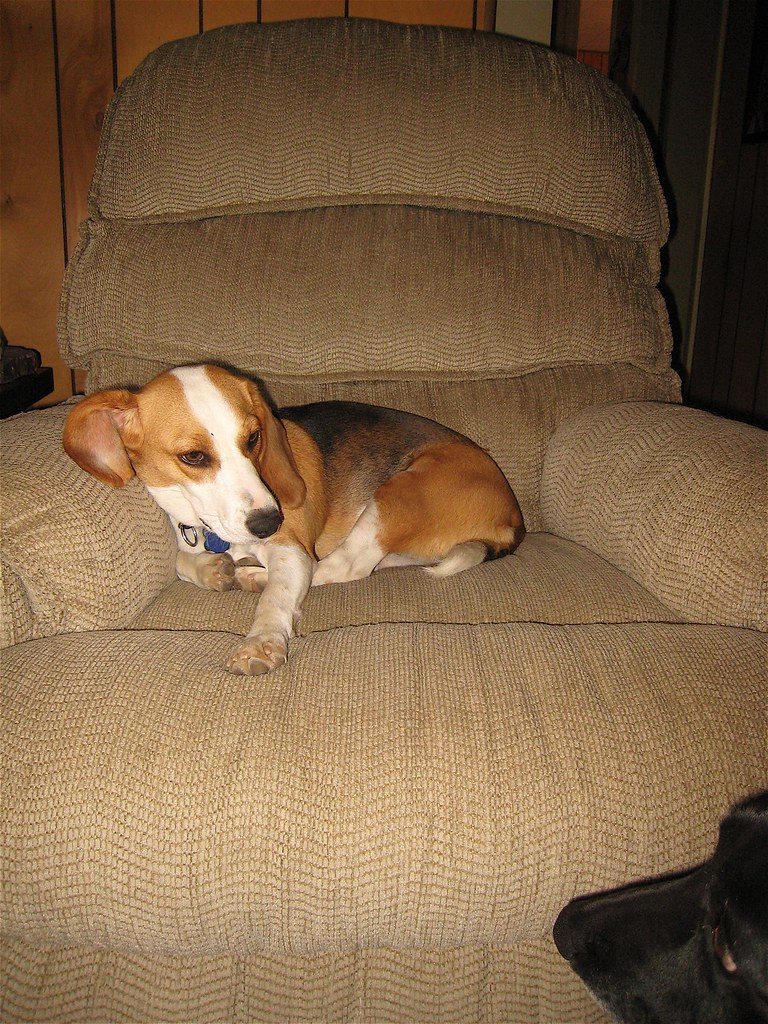
Door barking is alarm barking, and it is the hardest kind to fix because it works — the dog barks, the person in the corridor leaves, and that has happened several times a day for years. The fix is three things done at once and in order — remove the view, change what the sound predicts, and pay a different behavior.
Nothing here is a trick. Expect two to six weeks of five-minute sessions, twice a day, and expect a setback the first time a real delivery arrives in the middle of it. What you are aiming at is not a silent dog — it is a dog that barks twice and then goes to its mat.
The method below is the one the ASPCA and the American Veterinary Society of Animal Behavior actually recommend, and it deliberately leaves out the things they advise against. Sources are listed at the bottom.
A dog that barks at the door is not being naughty and is not being dominant. The ASPCA classifies this as territorial or alarm barking, and describes that behavior as motivated by a mix of fear and anticipation — the dog has heard something at a boundary and is doing the thing its species does about boundaries. In a house with a garden this is mildly annoying. In an apartment, with a shared corridor and a delivery driver every afternoon, it is the single most common reason people start looking for help.
First, work out which bark it is
The ASPCA separates barking into five types — territorial or alarm, attention-seeking, greeting, compulsive, and frustration-induced — and the treatment for each is different. Door barking is usually alarm barking, but not always, and getting this wrong wastes weeks.
- Alarm or territorial — barking starts at a sound (footsteps in the corridor, the lift, a knock) and the body is stiff, the bark is low and repetitive. The dog usually moves toward the door.
- Greeting — the tail is going, the body is loose and wiggly, there is whining in with the barking. The dog is pleased, not alarmed. This is a different and easier problem.
- Frustration — the barking starts when the dog is prevented from getting to the door, often from behind a closed bedroom door or inside a pen.
- Attention-seeking — barking that stops when you look at the dog and starts again when you look away. The ASPCA is blunt that these dogs have usually been taught to be this way without anyone meaning to.
Spend two days writing down every incident with the time, the trigger and the body language. It sounds fussy. It is the difference between treating the right problem and treating the wrong one.
Second, remove the trigger while you train
You cannot train a dog while it is rehearsing the behavior ten times a day. Every bark at a real delivery driver is a repetition that undoes a session, so management comes first and runs alongside everything else.
The ASPCA's own advice for territorial barking leads with blocking visual access — its wording is to block the dog's ability to see people and animals, using opaque fencing outdoors or a film on the glass indoors. In a flat the practical versions are:
- Frosted window film on the lower half of any pane the dog uses to watch the entrance. Cheap, removable, and it works the day it goes on.
- Move the dog's bed out of the hallway. A dog that sleeps four feet from the front door is on sentry duty whether it wants to be or not. A bed somewhere else in the flat is a real intervention, not a cosmetic one.
- Sound cover. A radio or a fan at a low, constant level takes the edge off corridor noise. It does not need to be loud enough to mask anything; it needs to make an individual footstep less startling.
- Close the corridor sightline. If the door has a glass panel, cover it. If the dog can see under it, a draft excluder does more than it sounds like it should.
Management alone is not a fix — it is what makes the training possible. Plan to keep it for the whole of the training period and then remove it slowly, one item at a time.
Third, change what the sound means
This is the part that actually rewires the behavior, and it has a name: desensitization and counterconditioning. The principle is simple and the execution is where people go wrong.
The dog currently believes that a knock predicts an intruder. You are going to teach it that a knock predicts chicken. To do that, the knock has to happen at a level so low that the dog notices it but does not bark — and then food appears, every time, before the dog has reacted.
- Find the level the dog notices but tolerates. Have somebody tap the wall down the corridor, or tap the door with one finger. If the dog barks, it was too loud. Go quieter. This first step takes an evening and most people skip it.
- Pair it, in that order. Sound first, food second — always. Something genuinely good: chicken, cheese, liver. Ordinary kibble will not beat a decade of successful barking.
- Ten to fifteen repetitions a session, twice a day. Five minutes each. Stop while the dog is still interested.
- Raise the volume by a fraction every few sessions. A tap becomes a knock, a knock becomes the real door, the real door becomes the real doorbell. If the dog barks, you moved too fast — drop back two steps rather than one and carry on.
- Add the real thing last. A friend knocking properly, then a friend ringing the bell, then a friend coming in.
The ASPCA also describes the simpler version of this for people who cannot arrange a helper: when the trigger happens in real life, high-value treats appear regardless of what the dog is doing. It is less precise, it takes longer, and it still works, because the association is doing the work rather than the obedience.
Fourth, pay a different behavior
A dog cannot bark at the door and lie on a mat across the room at the same time. This is why the ASPCA recommends teaching an alternative behavior — going to a mat, a bed or a crate — rather than only teaching the dog to stop.
Build it in this order, away from the door and with no knocking involved:
- Reward the dog for standing on a mat. Then for sitting. Then for lying down. A dozen repetitions a session.
- Add a word — "place", "bed", whatever you will actually say — once the dog is offering it.
- Add duration: three seconds, then ten, then thirty, paying at intervals while the dog stays.
- Add distance: you step away one pace, come back, pay. Then two paces.
- Only now add a knock, at the quietest level from the last section, and pay heavily for the dog staying put.
The mat should be somewhere the dog can see you but not the door. If your flat has no such place, the crate in the right corner is often the answer, and a dog that already likes its crate has half of this trained already.
About the "quiet" cue
The ASPCA describes a specific method: let the dog bark three or four times, then say "Quiet" calmly, gently hold the muzzle closed, and reward the silence that follows — repeated until the word alone produces the pause. Many modern trainers teach a hands-free version, in which you say the word, wait for the natural gap between barks, mark it and pay, because putting a hand on the muzzle of a dog that is genuinely alarmed can backfire.
Either way, note where it sits in the order. A "quiet" cue is the fourth thing you teach, not the first. It gives you a way to interrupt an outburst that has already started. It does not change what the doorbell means to the dog, which is the actual problem.
What not to do
The American Veterinary Society of Animal Behavior's position statement on humane dog training recommends reward-based training and advises against methods that use fear, pain or discomfort — both on welfare grounds and because aversive methods are associated with worse outcomes for the very behaviors people are trying to fix.
Applied to door barking, that rules out a short list of popular ideas:
- Bark collars. The ASPCA calls them punishment devices and says they are not recommended as a first choice. It also makes the practical point that dogs become collar-wise and simply go back to barking when the collar is off. On fear-based barking, punishing the bark can make the underlying fear worse while removing the warning it produced.
- Shouting at the dog. From the dog's side this is the pack joining in. It is also attention, which is the exact currency of the second most common type of barking.
- Flooding. Having someone knock over and over until the dog gives up is not desensitization; it is the opposite of it, and it usually produces a dog that is more reactive, not less.
- Waiting it out. Ignoring works on attention-seeking barking and does nothing at all for alarm barking, because the reinforcement is the person leaving the corridor, not you.
The part nobody wants to hear
A large share of apartment door barking is an under-exercised, under-occupied dog with a hair trigger. A dog that has had a proper walk and something to think about is harder to set off than the same dog after eight hours alone with nothing.
Two short walks plus ten minutes of something mentally difficult does more for a barking problem than any amount of door work on its own. Feeding a meal out of a slow feeder or a lick mat instead of a bowl takes a ninety-second event and turns it into ten minutes of work, twice a day, for no extra effort from you. Scatter-feeding the same meal across a rug does something similar. If you would rather follow a structured plan, the online training programs compared elsewhere on this site are built around exactly that kind of daily mental work.
When it is not a training problem
Take it to a veterinarian rather than a trainer if any of the following are true:
- The barking started suddenly in an adult dog that was previously quiet, with no change in the household.
- It happens only when the dog is alone and comes with pacing, drooling, destruction near exits, or house soiling — that pattern suggests separation distress, which is a clinical problem rather than a manners problem.
- The dog is older and the barking is disoriented, at nothing, or at night.
- There is any growling, snapping or lunging at people coming through the door.
A veterinarian can rule out pain and hearing or cognitive change, and can refer you to a board-certified veterinary behaviorist. Nothing on this page is a substitute for that, and a dog that is frightened rather than merely noisy gets worse, not better, with a training plan aimed at the noise.
A realistic timeline
Week one is management only: film on the glass, bed moved, radio on, no training at all. Weeks two and three are the quiet knock paired with food, twice a day, five minutes. Weeks three and four add the mat, separately. Week five puts them together at low volume. Week six is a friend at the real door.
Expect a setback the first time a real delivery arrives mid-program, and expect the dog to be noticeably better before it is finished. The aim is not a dog that never barks at the door — a dog that barks twice and then goes to its mat is a normal dog and a good neighbor, and that is what this gets you.